Author: Paul Meehan

  • How to Choose the Right Custom Pouch Configuration

    How to Choose the Right Custom Pouch Configuration

    3 Steps to Choosing the Right Stand-Up Pouch

    Choosing the right custom pouch configuration is about more than just selecting a size that fits your product. Every successful custom pouch relies on the right combination of dimensions, materials, and functional features working together to protect your product, support your brand, and meet customer expectations. In today’s flexible packaging market, factors like barrier protection, closure options, and package format all play a role in keeping products fresh and performing well throughout storage, shipping, and display.

    While size is an important consideration, it is only one part of the equation. Understanding how materials and pouch features impact product protection and usability will help you choose a custom pouch configuration that delivers the best results for your specific application.
    Three stand-up pouches in small, medium, and large sizes displayed side by side to illustrate how pouch dimensions vary based on product volume and fill weight.

    Step 1: Choose the Right Pouch Size

    Selecting the right pouch size is one of the most important decisions when building a custom pouch configuration. Many first-time buyers underestimate how much space their product requires, which can lead to costly packaging mistakes. Different products require different size configurations because volume varies significantly based on density and shape. For example, fine-grain salt takes up much less space than whole coffee beans, even when the weight is the same.

    We’ve seen some memorable sizing mishaps over the years. One customer selected a pouch they thought would work for popcorn, only to discover it was sized for unpopped kernels rather than fully popped popcorn. Choosing the correct pouch size from the start can save time, money, and frustration.

    Understanding Pouch Size Options

    Before selecting a custom-sized pouch, it’s important to understand how pouch dimensions are measured.

    For stand-up pouches, dimensions are listed in the following order:

    Width × Height × Gusset

    If a gusset measurement is not included, the package is not a stand-up pouch. Instead, it is likely a flat 2-seal or 3-seal pouch, which does not have the same shelf-standing capabilities.

    It’s also important to remember that pouch dimensions are measured from the outside of the package. Internal capacity will be slightly smaller because seams take up space within the pouch. Never assume your product will fit based solely on exterior dimensions without testing samples first.

    You should also account for any features included in your custom configuration, such as zippers, tear notches, or hang holes. These components occupy space in the package, reducing the usable fill area. The fillable area is the section below the zipper and should always be taken into account when calculating product capacity.
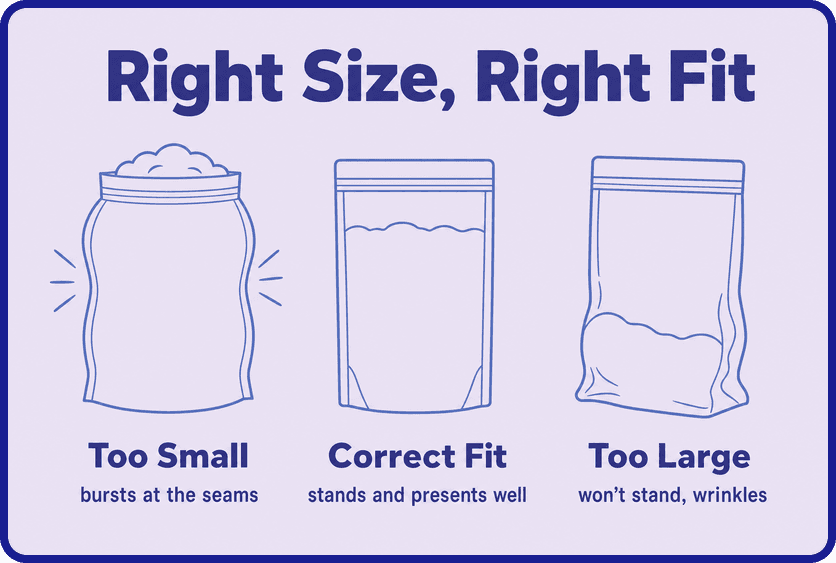
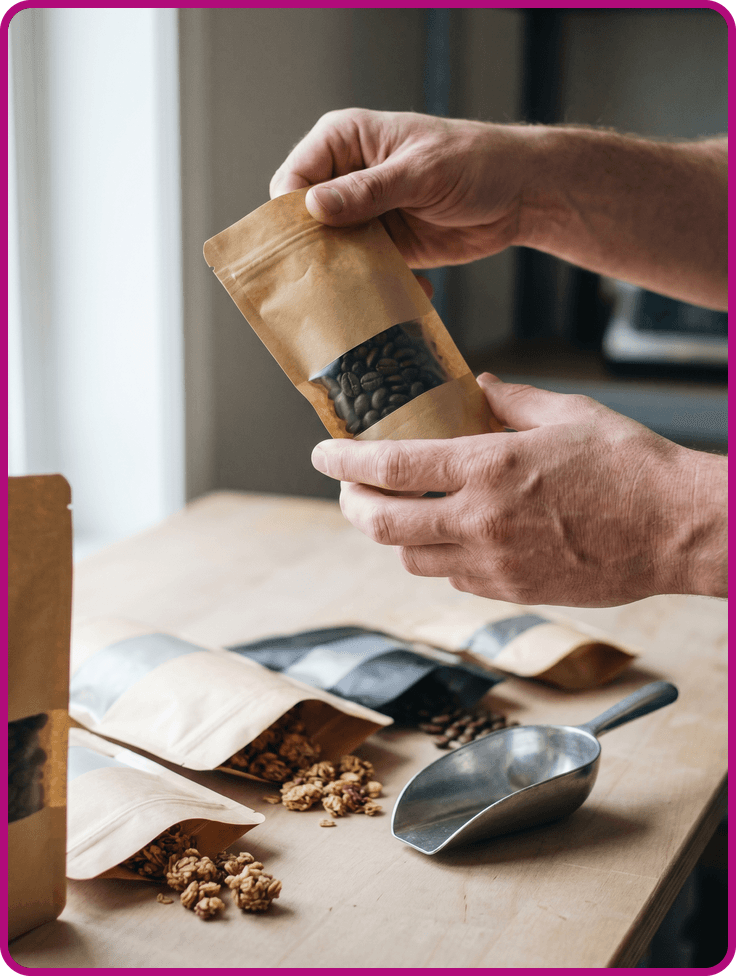
    Infographic comparing pouches that are too small, correctly sized, and too large, demonstrating the importance of proper fill volume and presentation.Person holding a sample stand-up pouch containing coffee beans while reviewing packaging options and product fit before production.

    Start by Ordering Samples of Different Sizes

    The best way to determine the right size options for your product is to order sample pouches before placing a production order.

    Fill each pouch with the intended amount of product and evaluate its performance. A well-sized pouch leaves enough room for fill weight, sealing, and natural product expansion without wasting material. Overfill a pouch, and it may burst at the seams during transport, storage, or while sitting on a retail shelf. On the other hand, an oversized pouch won’t stand properly and may wrinkle, which can negatively impact shelf presentation.

    Testing samples also helps you determine whether additional headspace is needed. Certain products release gases or naturally expand over time, making extra room essential. In these situations, you may also want to consider adding a degassing valve to your custom pouch configuration.

    What Size Pouch Do I Need?

    Now that you understand how pouch dimensions work, the next step is to determine how much product will fit in different pouch sizes.

    Capacity can vary considerably depending on the product being packaged. A pouch that comfortably holds coffee beans may not be suitable for snacks, powders, candies, pet treats, cannabis flower, or other products with different densities and shapes. Because of these variations, capacity charts should be used as general guidelines rather than exact measurements.

    For example, one ounce (28g) of cannabis flower may require a stand-up pouch measuring 6″ × 9″ × 3.5″, while a quarter ounce (7g) may fit comfortably in a much smaller pouch measuring 3.5″ × 4.5″.

    Before ordering packaging in bulk, test several sample sizes using your actual product. Order samples in multiple sizes until you find the one that works best for your fill weight, product type, and custom packaging requirements. This simple step can help ensure your final custom pouch delivers the appearance, functionality, and performance you’re looking for.
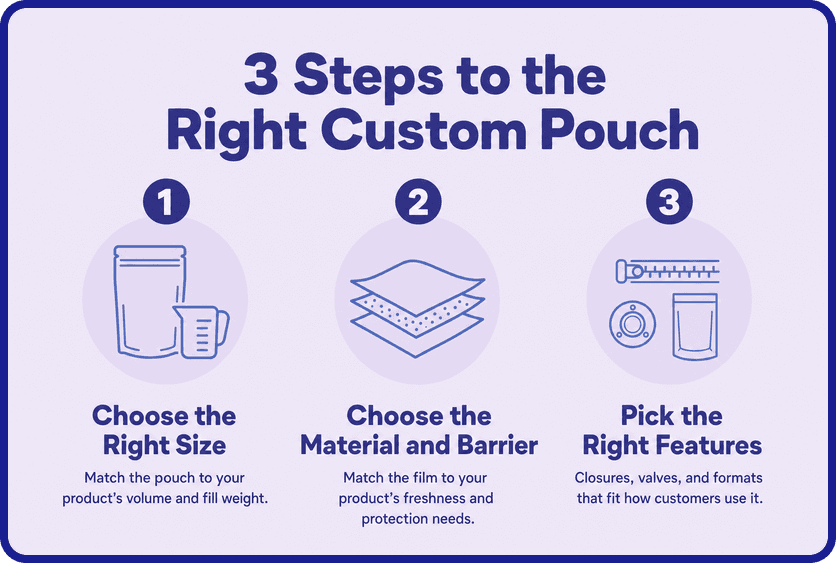
    Illustrated guide showing the three key steps to choosing custom packaging: selecting the correct size, choosing barrier materials, and selecting pouch features.

    Step 2: Choose the Right Pouch Material and Barrier Protection

    Once you’ve selected the right custom pouch size, the next step is choosing the material structure. The pouch materials you choose directly affect freshness, product protection, print quality, appearance, and overall package performance.

    Today’s flexible packaging market offers a wide range of options, including metalized, foil, clear, silver, kraft, recyclable, compostable, and biodegradable materials. Each material provides a different level of barrier protection, making it important to match the material to your product’s specific requirements.

    So how do you choose the right material?

    Consider the following:

    • How long your product will remain in the package
    • The level of freshness you need to maintain
    • How sensitive your product is to oxygen, moisture, light, or odors
    • Your desired brand image and package appearance
    • Sustainability goals for your packaging program

    The level of barrier protection you need depends on your product’s sensitivity to oxygen and moisture. Products that require long-lasting freshness typically benefit from high-barrier film structures that provide greater protection from environmental exposure. Products with shorter storage requirements may perform well using lower-barrier materials, offering a more economical solution.
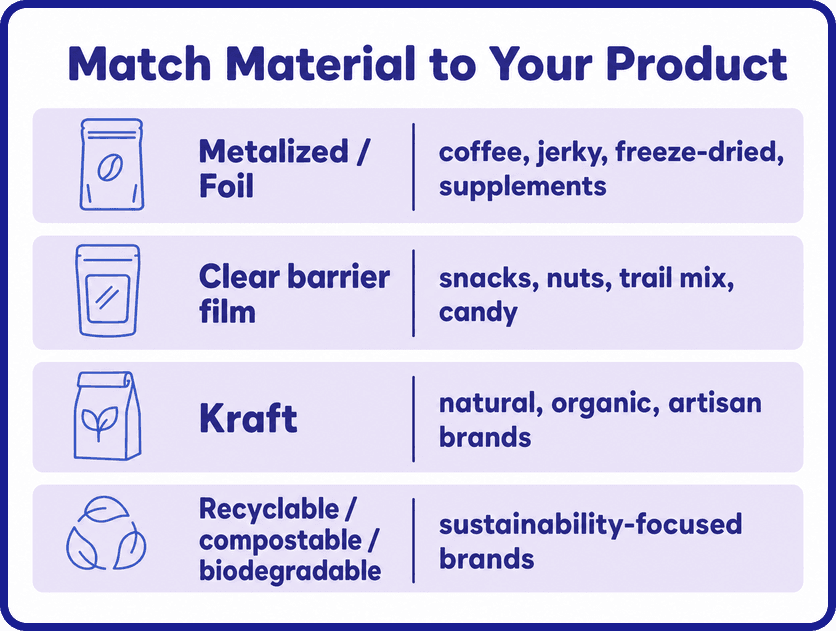
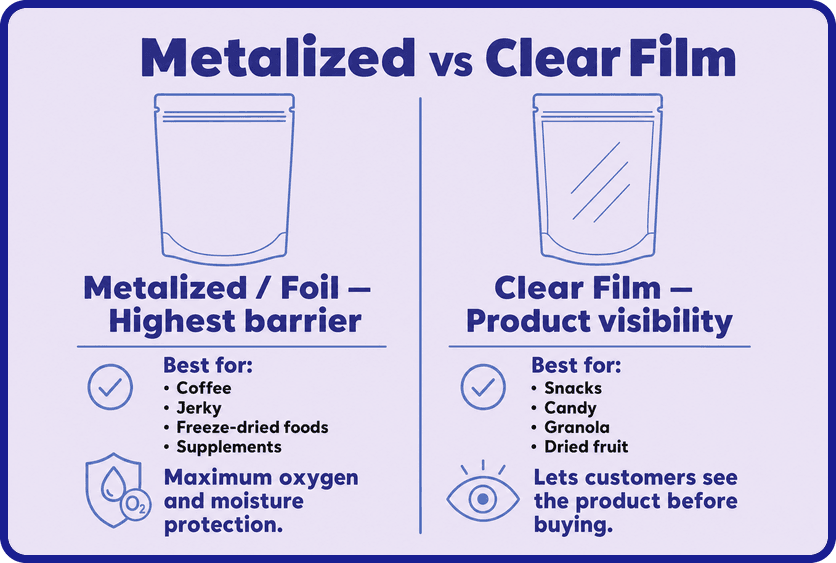
    Infographic comparing metallized foil, clear barrier film, kraft paper, and recyclable packaging materials with recommended applications for each product category.Comparison chart showing metallized foil pouches versus clear film pouches, illustrating differences between maximum barrier protection and product visibility.

    Metalized Film vs. Clear Film: Which Barrier Is Right for Your Product?

    When comparing pouch materials, one of the most important decisions is whether you need a high-barrier metalized structure or a transparent package that showcases the product.

    Metalized film offers the highest barrier protection for oxygen and moisture-sensitive products like coffee, jerky, freeze-dried foods, supplements, and other products that need maximum freshness retention. These high-barrier film structures help protect flavor, aroma, texture, and product quality throughout storage and distribution.

    Clear film is a strong choice for snacks, dried goods, candies, granola, and other products where visibility supports the purchase decision. Modern clear barrier film options can still provide excellent barrier protection while allowing customers to see the product before buying.

    Matching Materials to Your Product

    Different products require different levels of protection, which is why selecting the right barrier structure is so important.

    High-barrier foil and metalized film structures are commonly used for coffeejerkyfreeze-dried foodssupplements, and other products that need maximum protection from oxygen and moisture. These materials help keep products fresh longer and preserve quality throughout the supply chain.

    Clear barrier film is often used for snack foods, nuts, trail mix, dried fruit, candy, and other products where product visibility is an important part of the buying experience. These structures balance product protection with merchandising appeal.

    Kraft paper film structures are popular among natural, organic, and artisan brands. When paired with an appropriate barrier layer, kraft materials can provide the freshness and protection needed while supporting a more rustic package appearance.

    For brands focused on sustainability, recyclable, compostable, and biodegradable flexible packaging options continue to expand. These materials can provide varying levels of barrier protection depending on the structure selected, making it important to evaluate both environmental goals and product performance requirements.
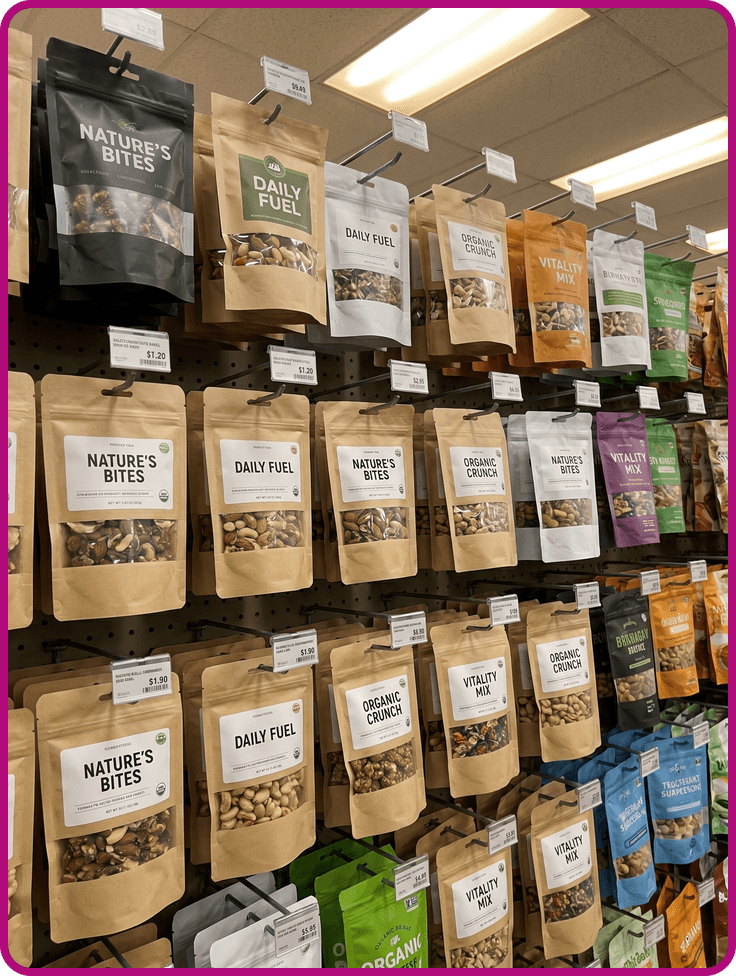
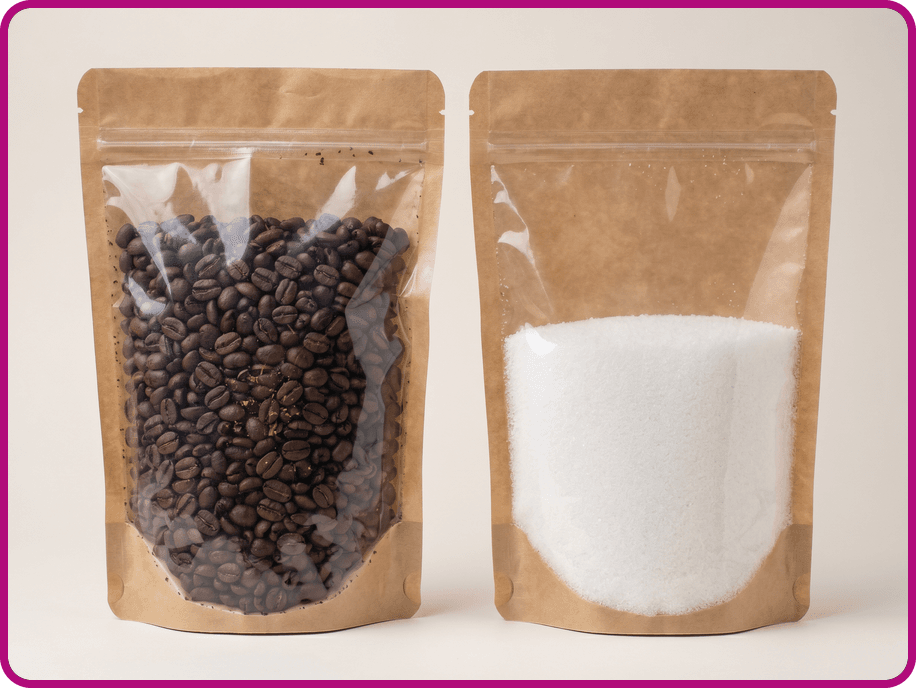
    Retail display featuring stand-up pouches with hang holes suspended on peg hooks, illustrating how hang holes improve merchandising flexibility and retail visibility.Two kraft stand-up pouches with clear windows displaying coffee beans and powdered ingredients, demonstrating how product windows improve shelf appeal and customer confidence.

    Additional Material Considerations

    The material structure you choose will also impact the overall cost of your custom pouch configuration. Higher levels of barrier protection generally require more specialized film constructions, which can increase packaging costs. Likewise, adding a clear window may limit the types of barrier film structures available for your package design.

    Because material selection plays such a critical role in freshness, product protection, and package performance, it’s worth evaluating several options before making a final decision. Testing sample pouches with your actual product is often the best way to determine which material structure delivers the right balance of protection, appearance, and cost for your custom packaging project.

    Step 3: Pick the Right Features for Your Custom Pouch Configuration

    Once you’ve chosen the size and material, it’s time to finalize the features that will complete your custom pouch configuration. This is where packaging becomes more than a container—it becomes part of the customer experience.

    The custom pouch configuration you build determines how customers interact with your product every time they pick it up, open it, store it, and use it. Features like hang holes, resealable closures, child-resistant zippers, and specialty valves can improve convenience, product protection, and retail performance while helping your brand stand out in a crowded marketplace.

    The Versatile Hang Hole

    A hang hole is one of the simplest yet most effective features available in flexible packaging.

    If your product will be displayed on peg racks in convenience stores, grocery stores, dispensaries, or specialty retail environments, a hang hole can significantly increase merchandising flexibility. While many people associate hang holes with lower-cost items, they’re commonly used for premium snack, supplements, nuts, candy, and other grab-and-go products positioned near checkout areas.

    Even if your package is designed for shelf display, it’s worth considering whether retailers may choose to merchandise it on a peg wall in certain locations. A hang hole gives retailers more display options without affecting package functionality.

    For brands looking to create a premium appearance, choosing an on-trend style such as a matte finish paired with a euro slot hang hole can help signal quality and improve shelf appeal.
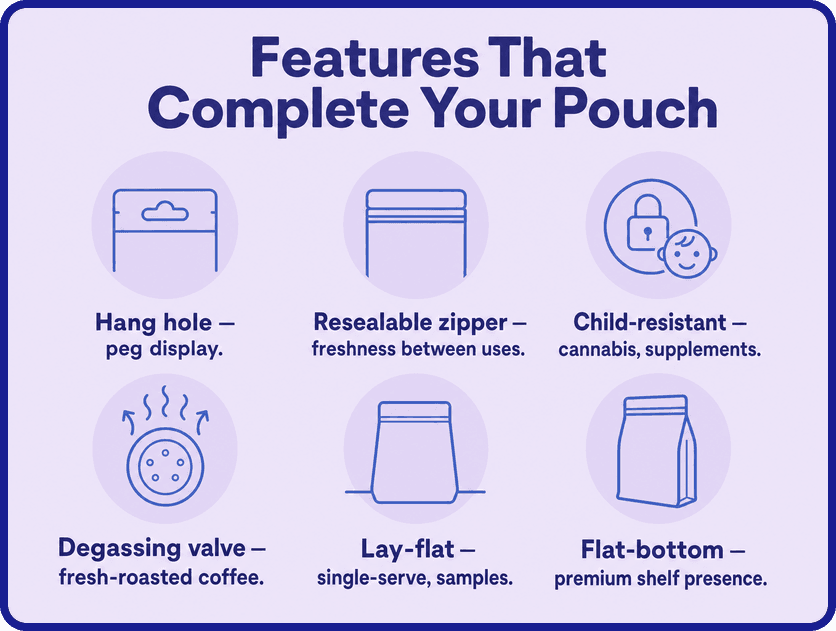

    Infographic showing popular stand-up pouch features including hang holes, resealable zippers, child-resistant closures, degassing valves, lay-flat designs, and flat-bottom pouches.Close-up of a resealable zipper on a custom stand-up pouch, showing how zip closures preserve freshness and allow repeated use.

    The Resealable Zipper

    Not all zipper closures are created equal.

    Different products require different closure styles, and selecting the right option can have a significant impact on customer satisfaction. Products with multiple-use consumption, such as coffee, snacks, supplements, pet treats, and powdered ingredients, often benefit from resealable packaging that helps maintain freshness between uses.

    For example, matcha green tea and other fine powders typically require a powder-resistant zipper design. Without the proper closure, product particles can become trapped in the seal, making it difficult to reclose the package properly. This can reduce freshness and create a frustrating user experience.

    Other specialty closures are available for products that release gas after packaging, such as freshly roasted coffee. In these situations, degassing valves can be incorporated into the custom configuration to preserve freshness while preventing package expansion.

    The Child-Resistant Configuration

    Some products require additional safety features to meet regulatory or consumer expectations.

    Cannabis packaging often requires child-resistant closures, although regulations vary by state. Child-resistant packaging may also be appropriate for supplements, detergents, fertilizers, and other products that could pose a risk if accessed by children.

    These configurations are designed to support child protection requirements while maintaining usability for adult consumers. Many child-resistant packages also include odor-control properties, opaque materials, and additional tamper protection features that improve both safety and product protection.

    When evaluating child-resistant options, it’s important to consider both compliance requirements and the overall customer experience to ensure the package remains functional and easy to use.
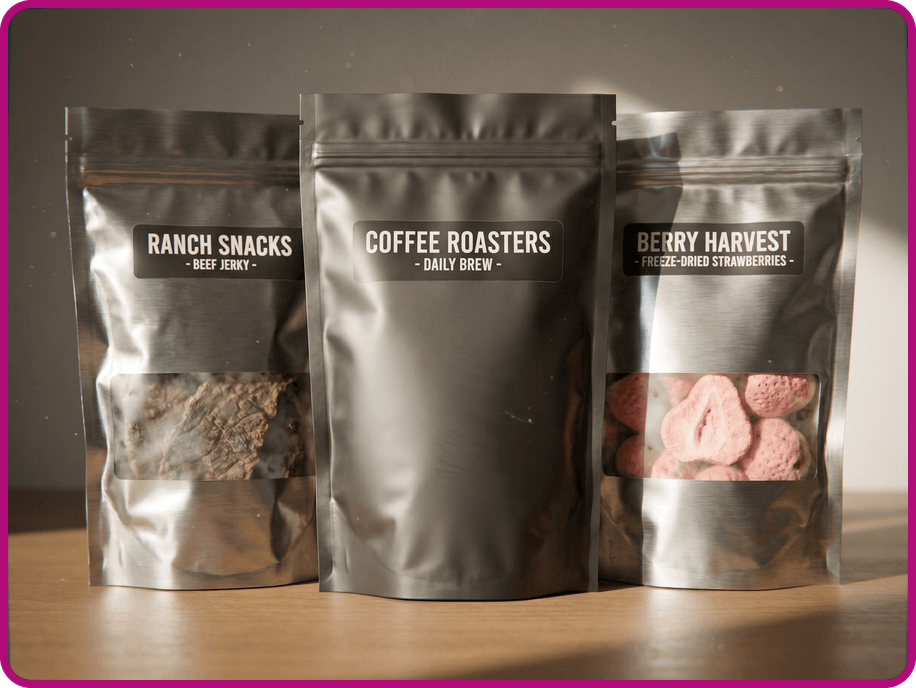
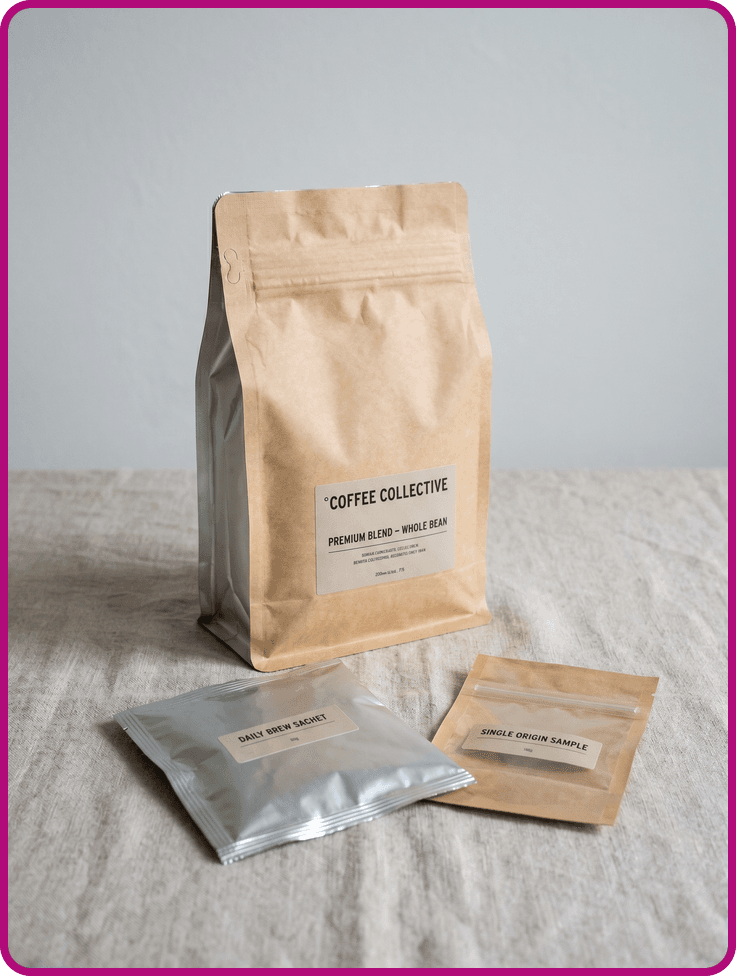
    Various stand-up pouches designed for coffee, jerky, and freeze-dried foods, highlighting how packaging requirements vary by product type and freshness needs.Custom coffee pouch displayed alongside single-serve sample packets, demonstrating how product format and serving size influence pouch selection.

    Lay-Flat Pouches and Other Format Configurations to Consider

    Not every product requires a stand-up format. Depending on your application, another packaging configuration may offer a better combination of cost, presentation, and functionality.

    Lay-flat pouches are a popular option for single-serve products, samples, travel sizes, and lightweight items. Because they do not include a bottom gusset, they typically use less material and can provide a more economical packaging solution.

    Flat-bottom pouches offer enhanced shelf stability and a premium, box-like appearance. They are commonly used for coffee, pet food, specialty foods, and other products where strong shelf presence is important.

    When selecting a custom pouch, consider how the package will be displayed, transported, and used. The right custom configuration should support your product, align with your brand positioning, and deliver the functionality customers expect. Evaluating multiple format options before production can help ensure your final packaging solution performs exactly as intended.

    Get an Instant Estimate

    There is a lot to discover about stand up pouch manufacturing, features, design and more- if you have never used them before. Your budget will also determine the style and the configuration of the pouches you choose. Visit CarePac today to get an instant online estimate and discover more on the benefits and configuration of stand up pouches and take advantage of their low minimum orders, free samples, and exceptional customer service.
  • What to Know Before Ordering 10k+ Custom Pouch Bags

    What to Know Before Ordering 10k+ Custom Pouch Bags

    What to Know Before Ordering 10,000+ Custom Pouch Bags

    Ordering Custom Pouches in Bulk

    As you already know, a lot more is on the line with high-volume, bulk orders than with smaller quantities. At this volume, mistakes are expensive and a wrong film spec, an artwork or design file that isn’t production-ready or a missed lead time window doesn’t just cost companies a few hundred dollars – it costs you weeks, hundreds of thousands of dollars and potentially a production shutdown.

    In this blog, we’ll walk you through what you need to know before you order 10,000+ custom pouches, so you’re happy with the finished product.

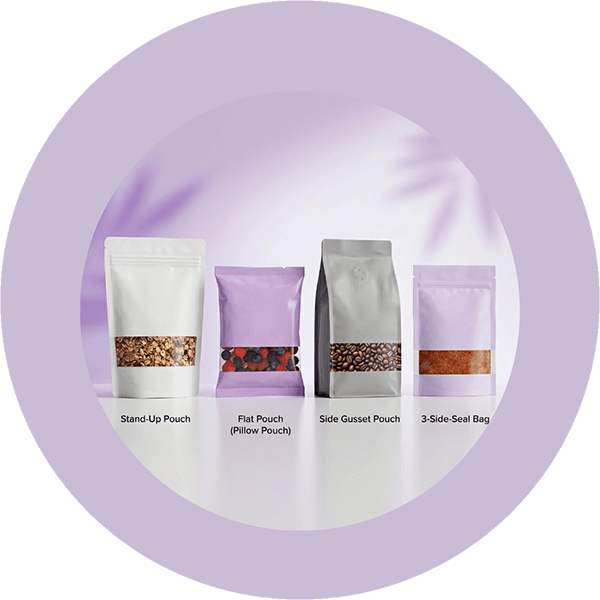
    Comparison of stand-up pouches, pillow pouches, side gusset bags, and three-side seal bags, illustrating common flexible packaging formats used for large-volume custom packaging orders.

    Lock In Your Stand Up Pouch Specs Before You Request a Quote

    At 10,000+ units, every decision is a cost decision, so it’s beneficial to be confident in your choices. From whether to use sustainable materials to whether to include resealable zippers or tear notches, there’s a lot to consider. In this section, we’ll walk you through the five things that must be finalized before a quote can be accurate and explain why each one matters at scale.

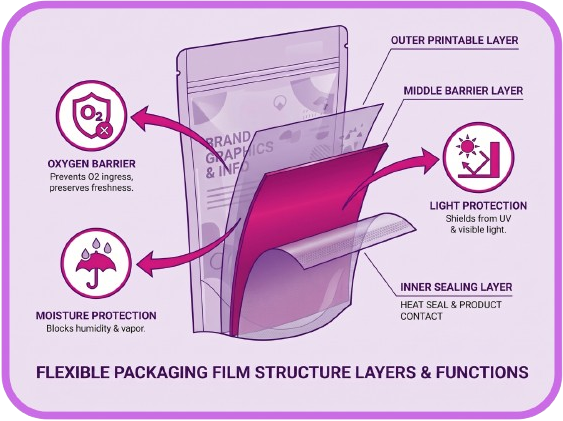
    Diagram showing multilayer flexible packaging construction, including printable, barrier, and sealant layers designed to provide oxygen, moisture, and light protection for packaged products.

    1. Format and Size

    Before you worry about the specifics of your packaging, you’ll need to decide on which pouch configuration you need. Popular options include stand-up pouches, flat pouch, side-gusset, and 3-side-seal bags. Dimensions are always listed as width x height x gusset, and fill volume (not product weight!) determines the right size. Since a wrong size at 10,000+ units means 10,000+ unusable pouches, we recommend ordering samples from our website if there’s any doubt.

    2. Film and Barrier Structure

    This is the area where most high-volume buyers underspec. The film you choose determines barrier performance, print quality, finish options, and shelf life. These are extremely important considerations if you’re packaging food, powders, or liquids that can leak or spoil while in transit and storage. Here’s a quick breakdown:

    • High-barrier and durable foil/mylar laminates are the best choice for oxygen and moisture-sensitive products (coffee, jerky, freeze-dried foods, supplements)
    • Clear barrier film is ideal for products where visibility at retail matters (snacks, dry goods)
    • Kraft is suitable for natural/organic brand positioning
    • Recyclable mono-material for sustainability-driven brands or retailers with eco requirements

    3. Features and Closures

    Depending on what you’re packaging and shipping, you might need to customize special features or closure options into your pouch, including zippers, hang holes, tear notches, degassing valves, or a window. Each feature adds to the unit cost, and some (such as child-resistant zippers) may be required for compliance. At 10,000+ units, you should know exactly which features you need before ordering, as changing a specification or feature mid-quote adds time.

    4. Quantity and SKU count

    Are all 10k units one SKU, or are SKUs split across multiple sizes and designs? Because multiple SKUs at the same spec can often be consolidated into a single production run, buyers should ask about this before finalizing their order. Different specs mean separate runs and separate pricing.

    5. Finish

    This is the fun part! Once you’ve settled on a format, size, material, barrier structure, and special features, you can decide which finishing touches to add to your bag. From matte and gloss to soft-touch and holographic finishes, the finish affects both the appearance and per-unit cost of your bags. Again, this should all be confirmed before the artwork file is made and finalized.

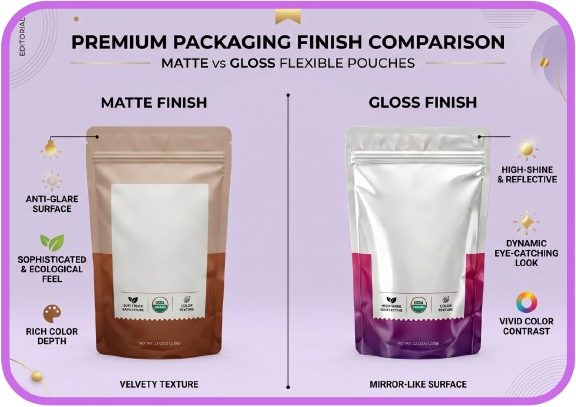
    Side-by-side comparison of matte and gloss custom pouch finishes, highlighting differences in appearance, texture, shelf impact, color vibrancy, and branding presentation.

    Your Artwork File Needs to Be Print-Ready Before You Order Pouches

    Artwork delays are the single most common reason large orders run late. At 10k+ units, the print process differs from a digital short run, and files that “look fine” in a design app will fail in production if they’re not set up correctly. In this section, we’ll walk you through what “production-ready” actually means so you can brief your designer correctly before submitting your files.

    File Format

    Adobe Illustrator (.ai) is the standard. PDFs are acceptable if saved correctly. We do not accept Canva exports or low-resolution JPEGs. Supplying the correct file type helps avoid production delays and ensures that your artwork is processed accurately by our prepress team.

    Use the Dieline

    We provide downloadable dieline templates for every pouch format and style. The artwork must be built on the correct dieline with the front, back, and gusset panel details laid out accurately. Using the proper template ensures that graphics, text, and packaging features align correctly once the pouch is formed and sealed.

    Resolution

    All embedded images must be 300 dpi CMYK. Vector art (logos, text, line graphics) must be outlined and linked correctly. Low-resolution artwork may appear blurry or pixelated in print, especially on larger pouch formats or high-volume production runs. If you need help, we offer design support.

    Color Mode

    CMYK throughout. Any Pantone/PMS colors should be explicitly called out. RGB files will shift in print at 10k units; that shift is locked in. Converting files to CMYK before submission gives you a more accurate representation of how colors will reproduce on the final package.

    Bleed and Safe Zones

    Artwork must extend beyond the cut line (bleed), and critical elements, text, and business logos must remain within the safe zone. Getting this wrong at scale means reprints. Even slight movement during cutting or pouch conversion can affect placement, so following bleed and safe zone guidelines is essential for professional results.

    White Ink Layer

    If you’re ordering on clear film, a white ink base layer is required in the file. This is a common miss for buyers new to clear film. Without a properly defined white ink layer, colors can appear translucent, muted, or different from expected when printed on transparent material.

    Hidden Layers

    Remove all unused or hidden layers before submitting. Production teams work from the file as submitted. Cleaning up your file reduces the risk of unintended artwork appearing in production and helps streamline the prepress review process.

    Plan Around Lead Times Especially for First Runs

    Lead time is the most misunderstood element of a large pouch order, especially for buyers who have only done short digital runs before. In this section, we’ll help you set realistic expectations and explain what affects lead times so you can plan your production calendar correctly.

    • First run vs. reorder: A first-time production run at 10k+ units takes longer than a reorder. The supplier needs to setup plates, create a proof, and get approval before production starts. Reorders are faster because specs and artwork are already in the system.
    • Three lead time tiers: CarePac offers express, standard, and economy lead times. Buyers should know what they need and factor the cost difference into their budget before requesting a quote from our store. Don’t request economy pricing and then need express delivery.
    • Artwork approval is part of the lead time: The production clock doesn’t start until the buyer approves the proof. Buyers who take two weeks to review a proof have added two weeks to their order. Have a stakeholder identified and ready to approve before the order is uploaded and placed.
    • Plan for your fill line schedule: Large pouch orders need to land before the buyer’s fill line run, not the day of. Build in a buffer for receiving, inspection, and resolution of any quality issues before filling begins.
    • Regulatory lead time (if applicable): Child-resistant pouches, food-contact compliance, and certain barrier film certifications may require additional documentation review. Flag these early and leave time to review and reflect the features.

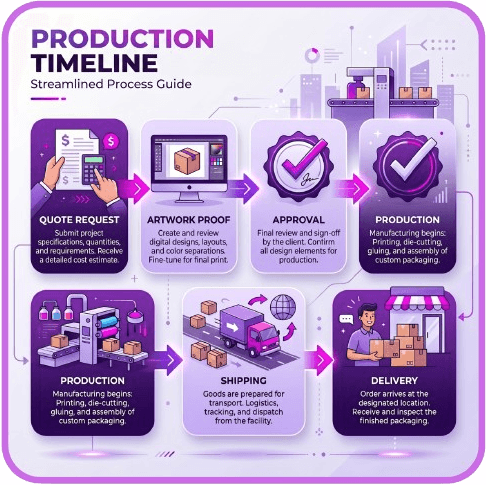
    Production timeline infographic outlining the custom pouch ordering process, including quote request, artwork proofing, approval, manufacturing, shipping, and final delivery.

    Compliance Requirements That Affect Your Pouch Order

    Compliance issues discovered after production are extremely expensive. Though there are a wide range of compliance requirements your packaging will need to meet depending on your industry, here are some of the most common compliance areas we run into:

    Food-contact compliance: Any pouch used for food products must be made from FDA CFR-compliant materials. CarePac’s materials are FDA CFR 73, BPA-free, and phthalate-free. Buyers should confirm that this is documented on their order before checkout.

    Child-resistant requirements: Child-resistant packaging requirements for cannabis, supplements, detergent pods, and other potentially hazardous products vary by state and category. Buyers need to know their requirements before specifying features. Important note: Child-resistant zippers are not interchangeable with standard zippers. 

    Kosher/TSE/other certifications: Some buyers’ customers or retail partners require specific material certifications. CarePac materials are Kosher and TSE-free, but buyers should confirm what their retailer or co-packer requires and verify against their spec sheet.

    Sustainability/recyclability claims: If the buyer intends to print recyclability claims on the pouch, the film structure must support those claims. Confirm the film certification before finalizing artwork printing, as a claim on a non-certified structure creates a compliance liability.

    What to Have Ready When You Request a Quote from CarePac

    Before requesting a quote, make sure you’ve confirmed the key details of your project. That includes your pouch format, finished dimensions based on fill testing, film structure and barrier requirements, desired features such as zippers, tear notches, valves, windows, hang holes, and finishes, as well as your total order quantity and number of SKUs. You should also know whether your artwork is production-ready on the correct dieline or if you’ll need design support; your required in-hands date and preferred lead time tier; and any compliance requirements, such as FDA, child-resistant, or recyclability.

    Once you have those details, you’re ready to request a custom packaging quote. Visit CarePac’s quote page to submit your project requirements and receive pricing tailored to your specifications. If you still have questions about pouch formats, materials, artwork setup, or production timelines, schedule a free consultation with the CarePac team and get expert guidance before you’re ready to quote.

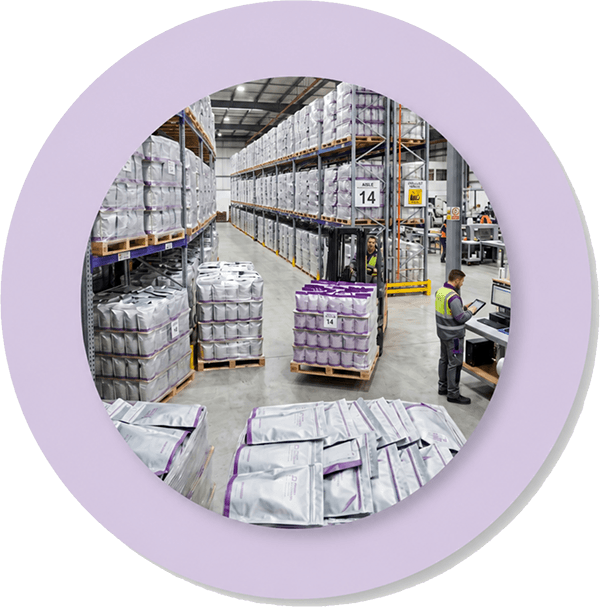
    Warehouse storing large quantities of finished custom stand-up pouches on pallets, demonstrating inventory management, bulk purchasing advantages, and production efficiency for high-volume orders.

    Frequently Asked Questions 

    Lets Get Started

    Made In The USA

    Full PouchCustomization

    Scalable Printing Digital & Plate

  • Best Flexible Pouch Formats for High-Volume Food Brands

    Best Flexible Pouch Formats for High-Volume Food Brands

    Best Flexible Pouch Formats for High-Volume Food Brands

    When it comes to high-volume food buyers and manufacturing companies, you face different trade-offs and issues than smaller food brands do. At scale, a cost-per-unit difference of a few cents can add up to six figures (or more!) annually, while the wrong pouch format can create friction on the fill line or in the warehouse, be detrimental to consumer convenience, or affect shelf visibility in retail. In this article, we’ll break down the best flexible packaging types for high-volume food brands, along with several factors to consider when purchasing.

    Stand-Up Pouch Packaging: The Retail Workhorse for Food Brands

    Stand-up pouch packaging is the most widely used flexible packaging format for frozen food, dry snacks, baby food, coffee beans, pet food, supplements, liquids, dried fruits, personal care products, powders, sauces, heavy products, and dried goods. Not only does this type of packaging provide barrier protection, but the gusseted bottom construction is essential, as it enables the stand-up pouch to stand on a shelf or retail display. It’s also beneficial to brands because it enables a “billboard effect” at the point of purchase, as the entire front (and really, all four sides) of the recyclable or compostable pouch can be customized with branding, your website, or text to your preference.

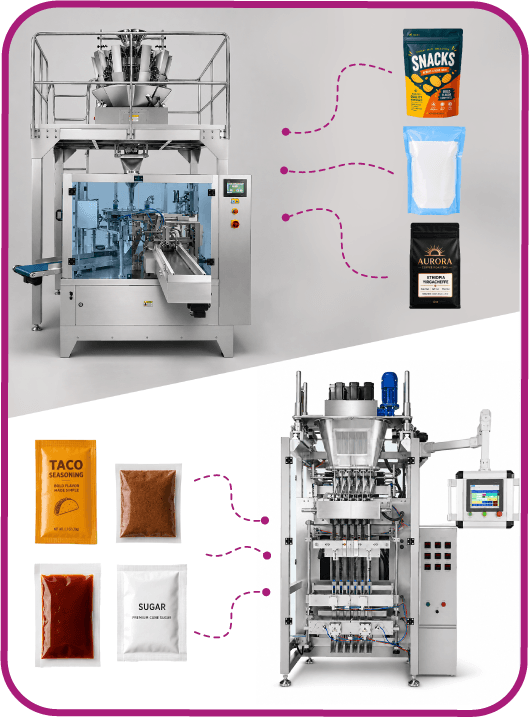
    There are several benefits to stand-up pouch packaging, particularly for high-volume food brands. This type of packaging is available in rollstock for form-fill-seal lines and is compatible with VFFS (vertical form-fill-seal) and HFFS (horizontal form-fill-seal) equipment. Stand-up pouch packaging is ideal for any retail food product where the brand competes visually on a shelf; in these situations, the extra cost per unit pays back in velocity. In terms of limitations, the higher per-unit cost might not be the right call for every product.

    Flat Bottom Pouches: Premium Shelf Presence for Flagship SKUs

    Flat-bottom gusset pouches are a step up from a standard pouch and other more basic sustainable packaging options. They’re more structured and feel more premium, making them a great option for flagship or hero SKUs where the brand wants a box-like appearance without the cost and sustainability tradeoffs of a carton. While a stand-up pouch has a gusset that enables it to stand upright on a shelf, the construction of a flat-bottom pouch is a bit different: it has a rectangular, flat base and side gussets that create box-like stability, with a full printable surface on all panels.

    One important thing to note about flat-bottom pouches is that they require different filling equipment from standard mono-material doypacks, so you may need to flag this with your co-packer before purchasing. If you sell specialty coffee, gourmet snacks, premium nuts, tea, or any food or snack category that commands a higher price, this higher-quality, rigid packaging can help your product stand out on the shelf.

    Side Gusset Pouches: High Capacity for Coffee, Tea, and Bulk Food Products

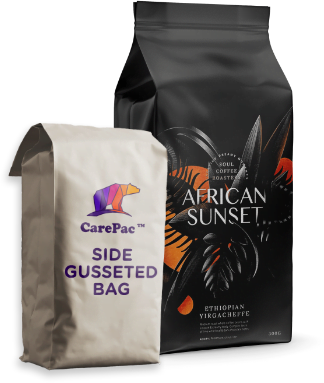
    Side gusset pouches have expandable folds on both sides (rather than the bottom), creating a flat front and back panel with depth for high-fill-weight products. What sets side gusset pouches apart from other types of high barrier pouches is the flat front panel: it offers an uninterrupted, undistorted print surface at any fill weight. This type of packaging is common in both retail and food service/bulk formats and is great for high-volume purposes: coffee roasters, tea brands, bulk nuts, and pet food. If you have heavy or high-volume fills that a standard doypack would underfill, this is the best choice for you.

    As with the other packaging types on this list, side gusset pouches provide enhanced barrier properties and can be customized to include custom shapes or features like a resealable zipper, child-resistant properties, or a degassing valve, and can be made from different types of materials, such as plastic or kraft paper.

    3-Side Seal Pouches: The High-Volume, Low-Cost Flexible Packaging for Single-Serve Food

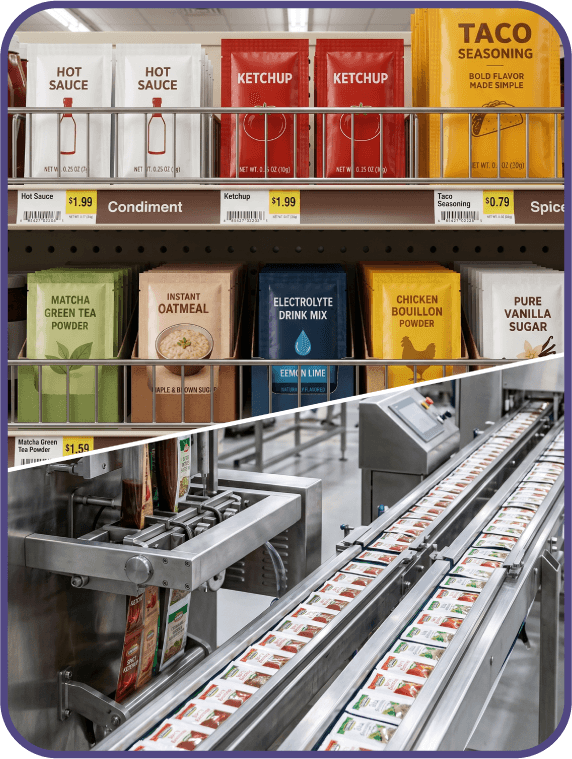
    For food brands that produce high volumes of single-serve products, 3-side-seal pouches are often the most cost-effective packaging format. Commonly used for spice packets, seasoning sachets, condiment portions, powdered drink mixes, and product samples, these pouches are designed for efficiency at scale. Their flat construction requires less material than gusseted formats, reducing per-unit packaging costs while also lowering freight expenses by allowing more units to ship in each case.

    While they are often associated with lower costs, 3-side seal pouches should not be viewed as a “cheap” packaging option. Rather, they are the operationally correct choice for many high-volume, single-serve applications. In fact, numerous large food brands use 3-side seal pouches as their primary packaging format for portion-controlled products while reserving stand-up pouches for larger retail sizes. They are particularly well-suited for foodservice portioning, single-serve condiments, ingredient packets, product sampling programs, and subscription box inclusions, where efficiency, consistency, and cost control are key priorities.

    Choosing the Right Flexible Food Packaging for Your Food Operation

    For most food brands, pouch selection is less about aesthetics and more about operational fit. The right structure is usually determined by three core questions that directly impact production efficiency, distribution cost, and long-term profitability.

    1. What does your fill line look like?

    The thickness of a vacuum bag determines its puncture resistance and barrier properties, typically measured in mils (thousandths of an inch) or microns. 3 mil is the industry standard for most applications, and offers a great balance of flexibility and protection against freezer burn. 4 mil is good for items with sharp edges, and 5+ mil are ideal for heavy-duty industrial applications.

    2. What channel are you selling into?

    Your go-to-market channel should strongly influence format choice. Retail shelf presence benefits from structures with strong shelf stability and billboard impact, such as stand-up pouches, flat-bottom pouches, and side-gusset bags. E-commerce and subscription programs often prioritize shipping efficiency, in which flat formats and 3-side seal pouches perform well because they stack tightly and reduce dimensional weight in mailers. Foodservice applications, on the other hand, typically rely on 3-side-seal sachets or larger side-gusset bags for portion control and bulk-dispensing efficiency.

    3. What does your margin math look like per SKU?

    Cost per unit matters, but only in context. A slightly more expensive pouch format that improves retail visibility and sell-through can ultimately outperform a lower-cost option that slows shelf movement. The real decision comes down to balancing packaging costs against expected velocity, shrink risk, and replenishment cycles. In many cases, the most profitable structure is not the cheapest per unit—it’s the one that optimizes total SKU performance across production, distribution, and retail execution.

    CarePac works with food brands at every volume level. If you’re evaluating formats or looking to optimize an existing run, request a quote and our team will match you to the right structure.

    Best Pouch for Food Packaging: FAQs

    Lets Get Started

    Made In The USA

    Full PouchCustomization

    Scalable Printing Digital & Plate

  • Which Countries Have the Best Prices on Packaging

    Which Countries Have the Best Prices on Packaging

    Countries With Lowest Packaging Prices

    The Global Landscape: Why Custom Packaging Prices Vary by Country

    Packaging prices are rarely uniform across the globe. While it can be tempting to many consumers to chase the lowest per unit cost, the true price of cheap packaging is a complex calculation of packaging material, labor costs, freight, and logistics. Price differences are very real, but so are significant variations in quality, lead times, and reputational risk to your brand.

    CarePac brings extensive, hands-on experience navigating these global differences and, in this blog, we’ll break down the primary drivers causing packaging prices to vary by country and by packaging company. If you’re looking to reduce packaging costs by outsourcing overseas, this guide is for you.

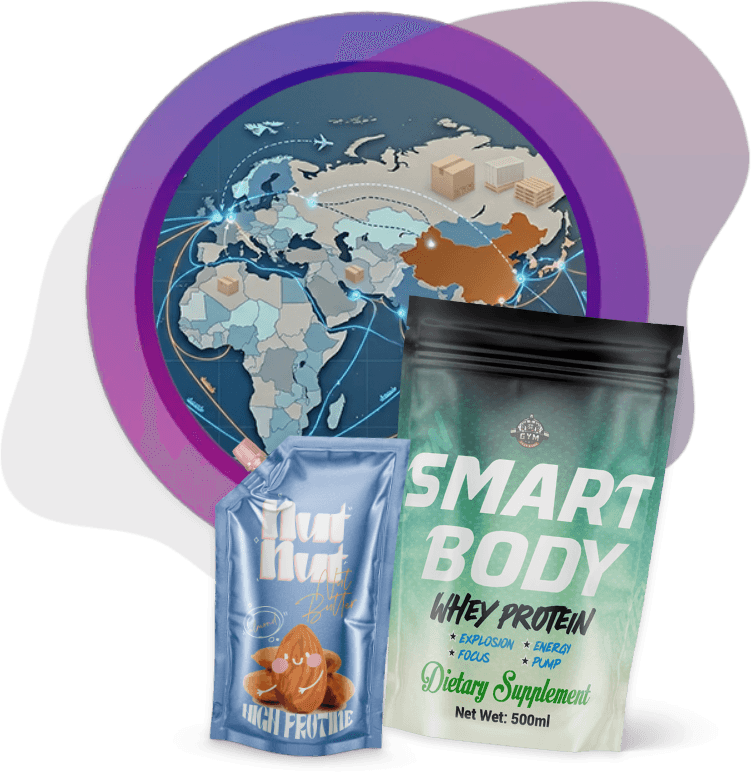
    World trade map with custom flexible packaging pouches highlighting global packaging suppliers, international pouch manufacturing, overseas sourcing strategies, and competitive packaging pricing options.

    China — Lowest Unit Prices, Highest Hidden Cost Structures

    China is the often the cheapest option for lower to mid-volume orders, particularly if you’re ordering 100,000 units or less. If you’re ordering more units than that, other countries actually have a better cost advantage because the price for labor in China has actually skyrocketed in the last decade due to the increase in their skilled workforce. Here are some quick pros and cons of ordering your flexible packaging from a packaging company in China.

    Pros:

    • Lower cost per unit 
    • Huge manufacturing capacity
    • Wide selection of cheap packaging materials, including recycled materials

    Cons:

    • Quality inconsistencies 
    • Freight volatility 
    • Tariffs, duties, port fees
    • Miscommunication
    • Delays (CNY, congestion) 
    • High MOQs

    Ultimately, ordering packaging components from an Asian country like China can appear to be cheap at checkout but expensive once issues begin to surface.

    Shipping boxes labeled “Made in China” representing overseas packaging manufacturing, bulk flexible packaging sourcing, lower production costs, and international packaging supply chains.

    Vietnam — Cost Effective Pricing, Improved Quality, Longer Lead Times

    Vietnam has established itself as one of the lowest-cost manufacturing companies in the world because of its extremely low labor costs, which tend to be 40-60% lower than those in China. While the country is officially under a Communist government, it is highly proactive in promoting business and signing trade agreements. Though Vietnam lacks some of the newest technology and doesn’t excel at digital printing, they’re a great solution if you’re looking for high volume and low pricing.

    Pros:

    • Growing packaging industry, including food packaging 
    • Slightly more stable quality than some Chinese factories
    • Good for larger runs

    Cons:

    • Longer lead times
    • Limited customization compared to China
    • Still requires overseas logistics & import fees
    • Smaller vendor base, i.e., raw materials and plastic packaging can be harder to source

    In essence, Vietnam is a good middle ground when it comes to quality packaging, but still has plenty of overseas unpredictability to take into consideration.

    Shipping package on top of a global map representing international freight logistics, overseas packaging procurement, export packaging solutions, and global packaging distribution strategies.

    India — Low Flexible Packaging Cost, Compromising Quality

    India was briefly seen as the next major hub for affordable packaging manufacturing because it avoided the heavy tariffs placed on countries like China and Vietnam during the Trump administration. That changed when trade tensions between the U.S. and India resulted in significantly higher tariffs on Indian goods as well. India remains highly business-friendly, but sourcing packaging there is often more relationship-driven than in many other countries on this list. When purchasing low-cost packaging from India, having a trusted local partner on the ground can be invaluable for maintaining quality and ensuring smooth production.

    Pros:

    • Very low per-unit price
    • Strong for certain substrates

    Cons:

    • Quality variability
    • Ink and film consistency issues
    • Communication barriers
    • Very long lead times

    When it comes to the packaging industry in India, you’ll have to ask yourself this question: “Savings vs reliability – which matters more?”

    Open cardboard shipping box placed on a world map illustrating international packaging sourcing, global logistics, overseas packaging suppliers, and worldwide shipping distribution networks.

    Mexico — Moderate Pricing + Faster Shipping

    Mexico usually isn’t a good solution for most packaging buyers because it’s a very specialized manufacturing country. It doesn’t focus on cheap packaging and its packaging supplies primarily come from other countries. For example, in many cases, if you’re buying your packaging from Mexico it was probably originally sourced from Vietnam.

    Pros:

    • Shorter shipping timelines (land freight)
    • Lower freight cost
    • NAFTA/USMCA tariff benefits

    Cons:

    • Higher unit cost than Asia
    • Smaller supplier pool
    • Limited highly-specialized materials/effects

    Although Mexico isn’t often the first choice for packaging, it can be a good choice for brands needing more predictable timelines.

    Mexican flag symbolizing packaging manufacturing and sourcing opportunities in Mexico for affordable custom packaging, shorter lead times, and North American supply chain advantages.

    United States — Higher Unit Price, Lowest Total Risk

    With the ongoing shifts in globalization many companies are rethinking how to reduce supply chain risk. One of the most effective strategies is keeping production as close to home as possible, which is a major advantage of manufacturing in the United States.

    In addition, increased automation and relatively low petroleum costs help make U.S.-based production more economically viable than many businesses assume. While we may be somewhat biased as a U.S.-based company, we believe domestic manufacturing offers a practical and resilient solution for companies looking to strengthen their supply chains.

    Pros:

    • Fastest communication
    • Highest quality oversight
    • No import fees / freight simplicity
    • Lowest risk of misprints
    • Predictable timelines

    Cons:

    • Higher per-unit packaging cost
    • Potentially higher MOQs than new brands want

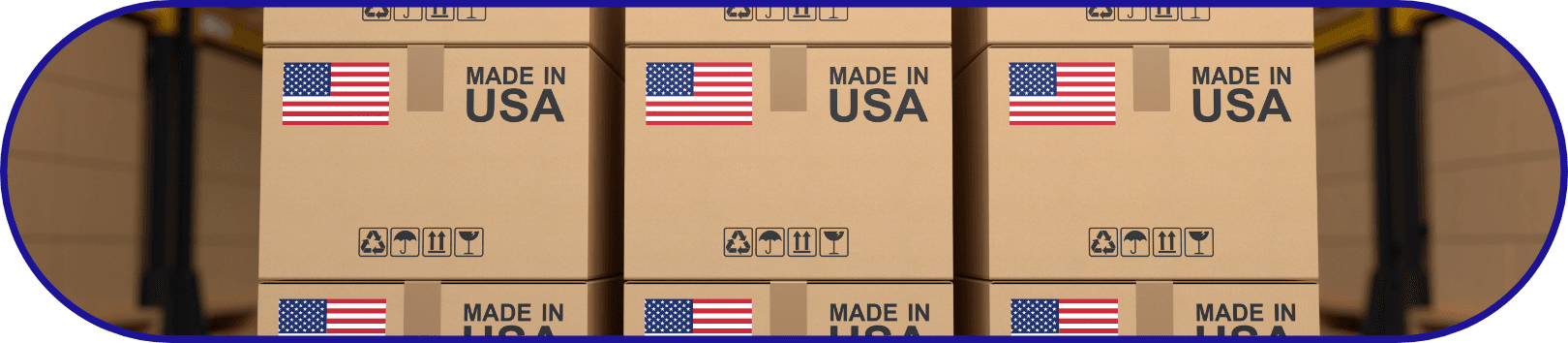
    Stacked shipping boxes labeled “Made in USA” representing domestic packaging manufacturing, faster turnaround times, lower freight risks, and reliable packaging supply chain solutions.

    The Hidden Cost Equation (Where Brands Miscalculate “Cheap” Packaging)

    What looks inexpensive on paper often becomes far more costly once the full picture is considered. Many brands focus on unit price alone and overlook the additional expenses that accumulate throughout the sourcing process.

    Common hidden packaging costs include:

    • Freight variability – Ocean and air shipping rates can fluctuate significantly, making landed costs unpredictable.
    • Duties and tariffs – Import fees can add substantial percentage increases to your total cost.
    • Customs brokerage – Required services that many buyers forget to factor into budgets.
    • Port and storage fees – Delays at ports can lead to unexpected storage and demurrage charges.
    • Quality control failures – Defects may not be discovered until inventory arrives, when it’s too late to fix cheaply.
    • Reprints and remanufacturing – Errors in different materials or artwork can require full production runs to be repeated.
    • MOQ waste – Large minimum orders often force brands to purchase more inventory than they actually need.
    • Communication delays – Time zone differences slow decision-making and problem resolution.
    • Missed retailer deadlines – Late shipments can result in lost shelf space, penalties, or canceled orders.

    When these important factors are added together, the lowest quoted price is often not the lowest total cost. Brands that account for the full cost equation tend to make more sustainable sourcing decisions.

    So Which Country Has the “Best Prices”? The Answer Depends on Consumer Preferences

    The “best price” isn’t just about the lowest per-unit packaging cost — it’s about the lowest end-to-end cost. When you factor in freight, delays, quality risks, and inventory waste, the cheapest quote doesn’t always translate into the most affordable outcome.

    Here’s how the equation often breaks down:

    Chinese flag

    Lowest unit packaging cost — China

    China frequently offers the lowest per-unit pricing, especially for high-volume production. However, the total cost can rise quickly once freight, tariffs, longer lead times, and risk are included.

    Mexican Flag

    Best balance — Mexico

    Mexico often provides a middle ground: competitive pricing combined with shorter transit times and easier communication. For many brands, this balance can reduce overall costs and improve reliability.

    United States of America Flag

    Lowest risk and most predictable total cost — United States

    Domestic production typically has higher upfront pricing but fewer surprises. Faster turnaround times, easier quality control, and lower logistics complexity often make total costs more predictable.

    The reality is simple: cheap is only cheap when nothing goes wrong — and something almost always goes wrong in overseas production.

    The smartest sourcing decisions come from evaluating the full cost picture, not just the number on the initial quote.

    How CarePac Helps You Navigate Pricing Without Surprises

    If you’ve sourced cheap packaging before, you’ve likely encountered unexpected costs, confusing quotes, or production delays. The goal isn’t just to find a lower price — it’s to make sure the price you see is the price you can rely on. CarePac focuses on making the process clearer and more predictable so you can make confident decisions.

    Business team reviewing custom flexible packaging pouch samples and discussing international packaging suppliers, pricing strategies, and cost-effective packaging solutions for global sourcing.

    Here’s how we help reduce uncertainty:

    U.S.-based communication and predictable timelines

    Work with a responsive team in your time zone, with realistic schedules you can plan around.

    Transparent pricing structure

    Quotes are designed to reflect true project costs — not teaser prices that grow later through hidden fees.

    Lower MOQs for growing brands

    Order quantities that match your current stage, so you’re not forced into excess inventory.

    Accurate proofs and strong quality control

    Clear proofs and careful review processes help prevent costly errors before production begins.

    Guidance on materials and specifications

    Get practical input on substrates, sizing, and technical details so your packaging works the first time.

    Experience across domestic and overseas production

    Advice is based on real-world experience managing both U.S. and international supply chains, helping you choose what actually makes sense for your situation.

    You’ve seen the pitfalls — this is how to avoid them.

    Want clarity around your quality packaging costs?

    Get expert guidance with your first quote — no pressure, no surprises.

    Lets Get Started

    Made In The USA

    Full PouchCustomization

    Scalable Printing Digital & Plate

  • Costs to Watch for When Ordering Packaging From Overseas

    Costs to Watch for When Ordering Packaging From Overseas

    Costs to Watch for When Ordering Packaging From Overseas

    Why Overseas Packaging Looks Cheaper (Until You Add Everything Up)

    While overseas packaging might seem appealing initially, the lower unit price, high-volume factors, and tempting MOQs come with hidden costs and fees nobody likes to talk about. Many brands only budget for per-unit cost and ignore everything else, but it’s important to note that ordering packaging materials overseas can be more expensive than purchasing domestically once all the fees are included. These fees including customs forms, international shipping costs, insurance (especially for fragile items), international shipment delays, and inventory loss.

    Airplane model on stacked cardboard boxes representing international shipping logistics, highlighting freight costs, air shipping fees, and global supply chain expenses when ordering packaging from overseas suppliers.Illustration of global shipping network with boxes and location markers, symbolizing international logistics, customs clearance, import duties, and supply chain risks in overseas packaging procurement.

    If you’re considering shipping overseas packaging materials to your destination country, here are some hidden costs to watch for when ordering packaging overseas. From customs forms to shipping fragile items internationally with bubble wrap, this comprehensive list can help you manage your expectations and decide if purchasing packaging overseas is right for you.

    Cost #1 — Freight Costs (and Why They Fluctuate Constantly)

    The number one cost to keep in mind actually isn’t that hidden (or so you’d think.) Unfortunately, freight costs for international shipments can vary wildly and the price you’re given upfront for global shipping isn’t always the price you’ll pay. Here are some of the reasons your final commercial invoice for international shipping services might be higher than what you initially anticipated:

    • Peak season surcharges 
    • Fuel adjustments 
    • DIM weight for bulky products 
    • Unexpected rate hikes 
    • Port congestion delays leading to hefty storage fees

    It is not uncommon for brands to budget $800 for freight but end up paying $2,100 because of peak season or DIM weight when they ship internationally.

    Upward trending cost graph showing fuel surcharges, port congestion, and peak season pricing alongside warehouse worker managing shipments, illustrating rising overseas packaging costs and supply chain disruptions.

    Cost #2 — Duties, Tariffs & Customs Forms Fees

    The second hidden international shipping cost for packaging that often gets forgotten about are duties, tariffs, and customs fees. See below for some of the more common fees that fall into this category, plus an explanation of each to help determine if these international shipping costs relate to you:

    Country of origin tariffs- Import taxes that vary based on important information, like the product’s manufacturing country, not necessarily where it ships from or its destination country, significantly affect the global shipping costs and trade policy application.

    Formal entry fees- A mandatory charge for sending packages, like the U.S. Customs Merchandise Processing Fee (MPF) for processing commercial imports valued above a certain threshold. 

    Custom brokerage fees- A charge by a licensed professional or courier (like UPS/ FedEx) for handling the complex process of clearing imported goods through a country’s customs. This fee covers paperwork, duty/tax calculation and payment, and coordination with authorities. 

    Agricultural or FDA inspection fees- These fees vary widely by service, commodity, and agency, and cover the import/export certifications, grading, and facility reinspection. 

    Delays causing additional charges- Both expected and unexpected delays can cause additional charges in the form of storage fees.

    Cost #3 — Quality Control Failures (The Most Expensive Hidden Cost)

    Issues with packaging quality control is where the real costs explode. From not choosing the right packaging materials to skipping the QA process to save time and resources, here’s all the things that can go wrong with your order, impacting the final amount of your commercial invoice:

    • Packaging arriving with poor color match 
    • Zipper failures 
    • Incorrect size or gusset 
    • Film thickness off-spec 
    • Ink smudging or lamination issues

    Remakes, replacements, and emergency domestic runs caused by these packaging issues often cost 2-5x more than if you would have purchased the packaging in your home country. Don’t create more problems for yourself by outsourcing critical things like your packaging. For example, our client had to overnight 5,000 replacement bags because their overseas shipment arrived with broken zippers – the replacement fees ended up costing more than the entire original order.

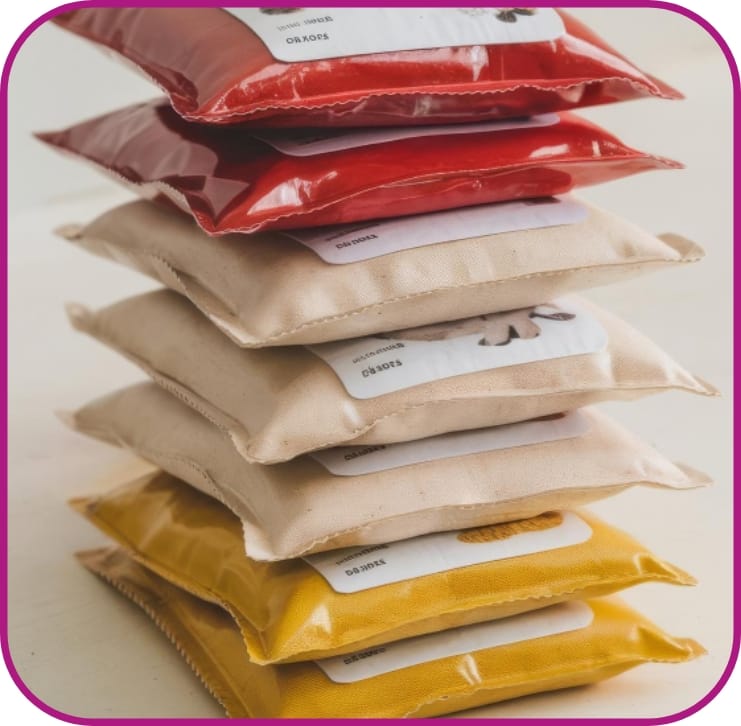
    Custom flexible packaging pouches displayed above a magnified dollar bill, representing total cost analysis beyond unit price, including hidden expenses like logistics, defects, and reorders from overseas suppliers.Stacked flexible plastic pouches filled with product, illustrating risks of ordering incorrect packaging specifications overseas leading to unusable inventory, waste, and additional replacement costs.

    Cost #4 — Extra Sample Rounds & Reproofing Fees

    This is one item that most brands don’t plan for and one that can have extremely high costs is those associated with extra sample rounds and reproofing fees. For example, samples that don’t match production may require resampling, artwork that’s misunderstood can lead to more proof cycles, color drift can cause more ink drawdowns, and each one of these has its own fees and time delays. 

    This is one area that’s extremely difficult to plan or schedule for as well. You may not even encounter these with the right shipping service, but with the wrong one, this can be extremely messy, complicated, and expensive.

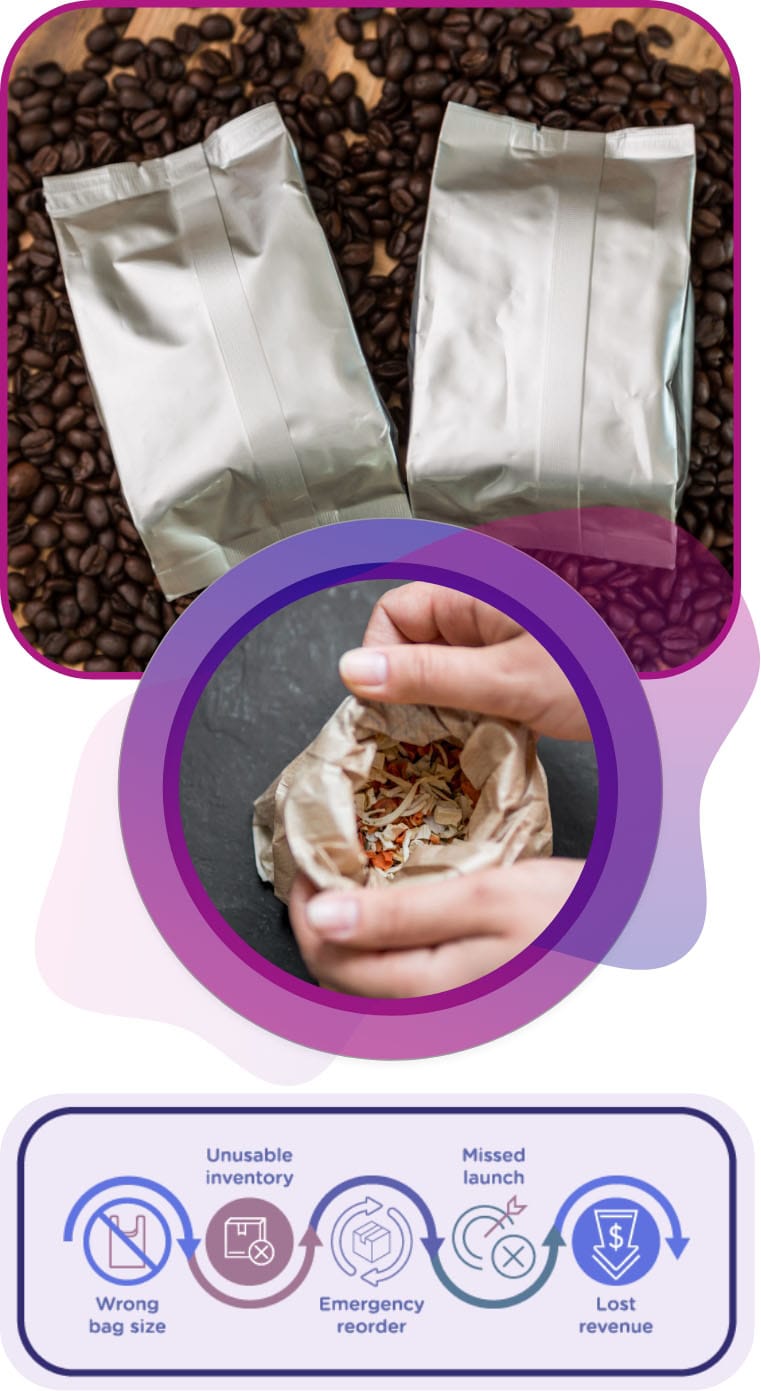
    Cost #5 — Incorrect Sizing or Packaging Material Specs (And the Domino Effect)

    Packaging mistakes rarely stay contained. A small miscalculation in sizing or materials on a form can quietly trigger a chain reaction of operational and financial costs that compound over time.

    • Bags that are too large waste valuable space, driving up dimensional weight and shipping costs on every order.
    • Bags that are too small can render finished inventory unusable, forcing last-minute workarounds or full reprints.
    • The wrong substrate can shorten shelf life, degrade product quality, or lead to customer complaints and returns.
    • Insufficient thickness increases the risk of punctures, leaks, and transit damage—often discovered only after product has already shipped.

    We’ve seen this play out in the real world. In one case, a founder ordered 20,000 bags that couldn’t be used at all because a vendor made assumptions about material layering instead of validating the specs. What looked like a simple packaging order turned into a costly delay, a full reorder, and lost momentum at a critical stage of growth.

    When packaging specs are wrong, the cost isn’t just the bags—it’s the wasted inventory, higher logistics spend, missed timelines, and avoidable stress on the business.

    Unbranded coffee bags and opened pouch with contents visible, highlighting packaging quality control issues, seal integrity problems, and product contamination risks from overseas manufacturing.Infographic showing wrong bag size leading to unusable inventory, emergency reorders, missed product launches, and lost revenue, emphasizing hidden costs of incorrect overseas packaging orders.

    Cost #6 — MOQ Waste & Inventory Loss

    High minimum order quantities—especially from overseas vendors—can lock brands into major financial risk long before a product is fully validated. What looks like a “better unit price” on paper often creates hidden costs that surface months later.

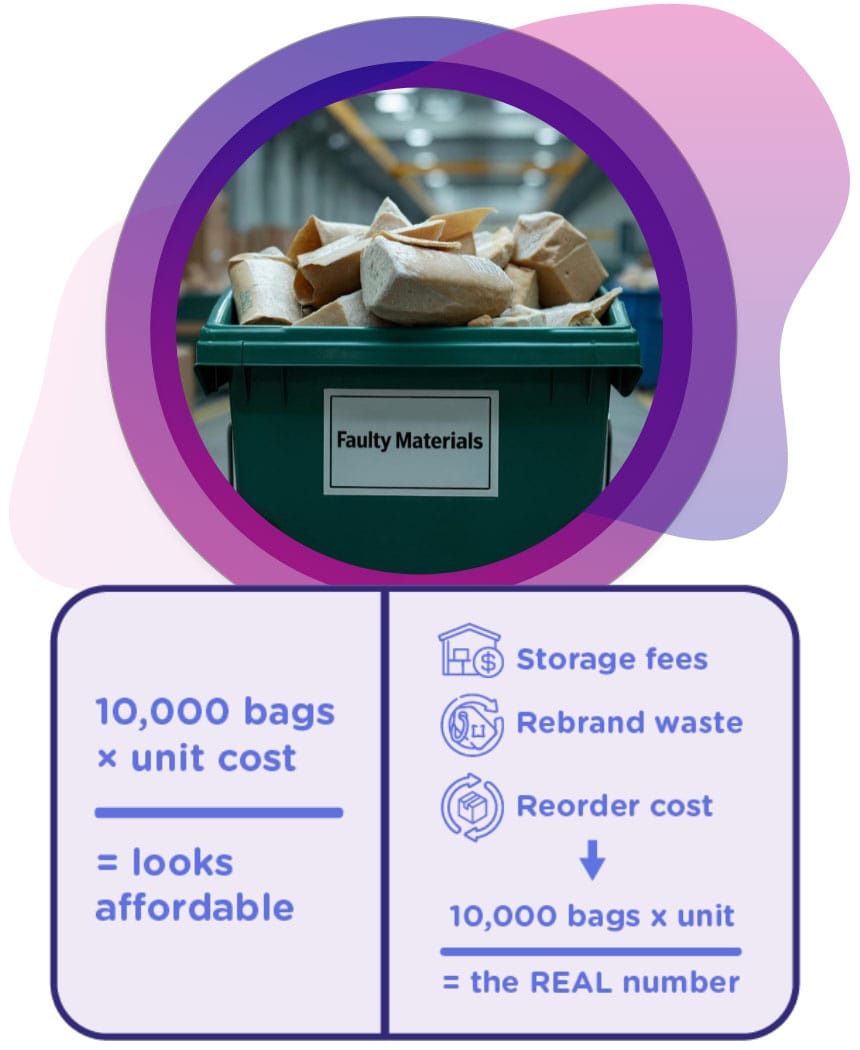
    • Ordering 10,000–50,000 bags upfront forces brands to commit capital before demand, product-market fit, or distribution is proven.
    • Rebrands, regulatory updates, or formula changes can instantly make existing packaging obsolete.
    • Leftover inventory doesn’t just sit idle—it racks up ongoing storage and warehousing fees.
    • Correcting a mistake means paying again for new packaging, often on an accelerated timeline with higher per-unit costs.

    We’ve seen brands launch strong, only to realize six months in that their positioning needed to change. In one case, a rebrand made sense strategically—but it also meant scrapping $12,000 worth of unused bags that could never be recovered or repurposed.

    When MOQs are too high, packaging stops being a flexible tool and becomes a sunk cost. The risk isn’t just overordering—it’s paying multiple times for packaging that should have evolved with the business.

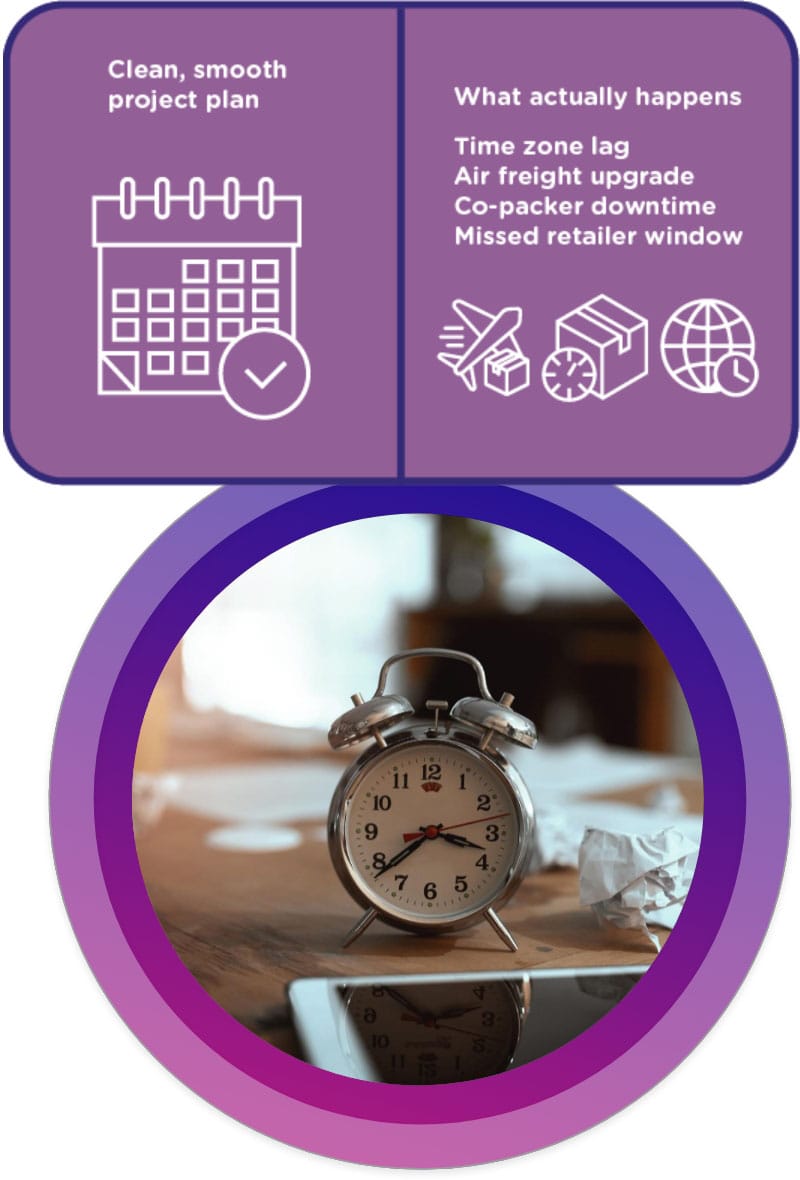
    Cost #7 — Delays (The Silent Profit Killer)

    Delays are the most underreported—and often the most financially painful—hidden cost in packaging and production. They don’t always show up as a single line item, but they quietly erode margins across the entire operation.

    • Missed retailer windows can mean losing shelf space, launch momentum, or entire purchase orders.
    • Overlapping batch production forces teams to rush or reschedule runs, increasing labor costs and error rates.
    • Last-minute air freight upgrades quickly erase any savings gained from lower unit pricing.
    • Co-packer downtime means paying for idle capacity while waiting on packaging to arrive or be corrected.
    • Slow supplier communication, especially with a 12–15 hour time zone lag, stretches simple decisions into multi-day delays.

    Individually, each delay may seem manageable. Combined, they create a compounding effect that stalls growth, strains cash flow, and pushes teams into reactive, expensive decisions.

    When timelines slip, the real cost isn’t just time—it’s lost revenue, higher logistics spend, and opportunities that don’t come back.

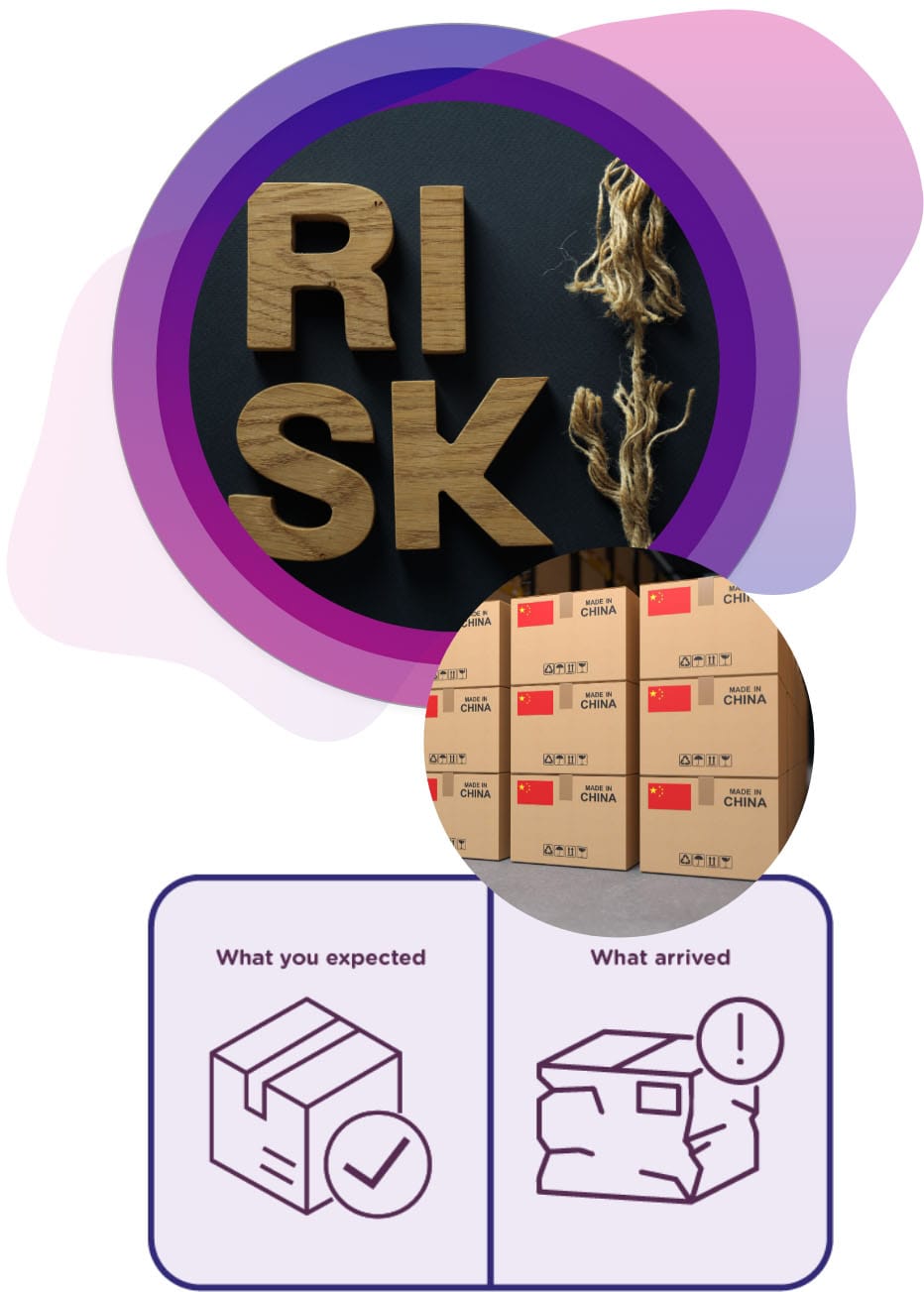
    Comparison graphic of planned packaging timeline versus real-world delays like time zone lag, air freight upgrades, co-packer downtime, and missed retailer deadlines when sourcing overseas.Risk concept with frayed rope and stacked boxes labeled made in China alongside comparison of expected vs damaged shipment, highlighting quality inconsistencies and transit damage risks in overseas packaging.

    Cost #8 — Lack of Accountability & Zero Recourse

    When something goes wrong with overseas packaging vendors, brands often discover there’s little to no real accountability—and even less recourse. The risk doesn’t just lie in the mistake itself, but in who ultimately absorbs the fallout.

    • Refunds are rare, even when errors are clear or documented.
    • Replacement runs typically take 6–10+ weeks, pushing launches and restocks even further out.
    • Brands absorb 100% of the financial impact, from scrapped inventory to expedited logistics.
    • No local support or escalation path means issues stall in inboxes instead of getting resolved.

    We’ve seen situations where a founder flagged a clear misprint, only to be told it was “close enough”—and then watched communication from the supplier slow to a stop. With no leverage, no refund, and no timeline for correction, the brand was forced to move forward at their own expense.

    Without accountability, mistakes don’t just cost money—they cost momentum. And in fast-moving consumer brands, lost momentum can be harder to recover than lost dollars.

    When Overseas Isn’t Worth It: The True Cost Comparison

    At first glance, overseas packaging looks cheaper. The unit price is lower, the quotes are attractive, and the savings feel obvious. But unit price alone doesn’t reflect total cost—or total risk.

    Overseas vendors:

    Low unit price

    High hidden costs from mistakes, delays, reprints, storage, and freight upgrades

    Long lead times with limited accountability

    Higher operational and financial risk absorbed entirely by the brand

    CarePac:

    Higher unit price

    Predictable total cost with fewer surprises

    Faster timelines and real accountability

    Lower overall risk and better control as your business evolves

    When you factor in errors, delays, reprints, and lost momentum, overseas packaging often ends up costing more—not just in dollars, but in time, cash flow, and missed opportunities.

    The real question isn’t “What’s the cheapest bag?” It’s “What’s the lowest-risk way to scale?”

    How CarePac Helps You Avoid These Hidden Costs

    If you’ve dealt with packaging surprises before, you already know the damage they cause—missed timelines, wasted spend, and unnecessary stress. CarePac exists to remove those variables, not introduce new ones.

    Our company works as a transition partner for growing brands that want clarity, control, and fewer “unknowns” as they scale.

    • U.S.-based communication means faster answers, real conversations, and no 12-hour time zone delays.
    • Predictable timelines allow our customers to plan production and launches with confidence.
    • Quality control matched to approved proofs, so what you sign off on is what arrives.
    • Real-time artwork support to catch issues before they become expensive mistakes.
    • Regulatory checks built into the process, reducing the risk of reprints or compliance issues.
    • MOQs sized for real growth, not premature overcommitment.
    • No surprise fees, no last-minute “adjustments,” and no hidden costs buried after the fact.

    You’ve already dealt with surprises. This is how you eliminate them.

    Want clarity around your packaging costs? Contact us today to learn more.

    Comparison graphic showing overseas packaging challenges like delays and cost increases versus streamlined domestic supply with faster turnaround, reliable logistics, and consistent packaging quality.

    FAQs: International Shipping Costs

    If you still have more questions about whether or not to ship internationally, here are some frequently asked questions our business receives from our customers: 

    Lets Get Started

    Made In The USA

    Full PouchCustomization

    Scalable Printing Digital & Plate

  • The Realities of Ordering Packaging From China

    The Realities of Ordering Packaging From China

    The Realities of Ordering Packaging From China (What Experienced Brands Already Know)

    Why So Many E-Commerce Brands Start With Chinese Companies— And Why They End Up Switching

    For many e-commerce brands, especially those who are just getting their feet wet in the packaging industry, starting with overseas packaging suppliers in China makes complete sense. Between lower costs per unit, wide material options, and massive production capabilities, overseas manufacturing does have some advantages, particularly if you’re scaling fast or focused on cost savings. And to be clear: overseas vendors CAN deliver great results and reduce costs, but the production process can quickly break down, especially as your business needs change or grow.

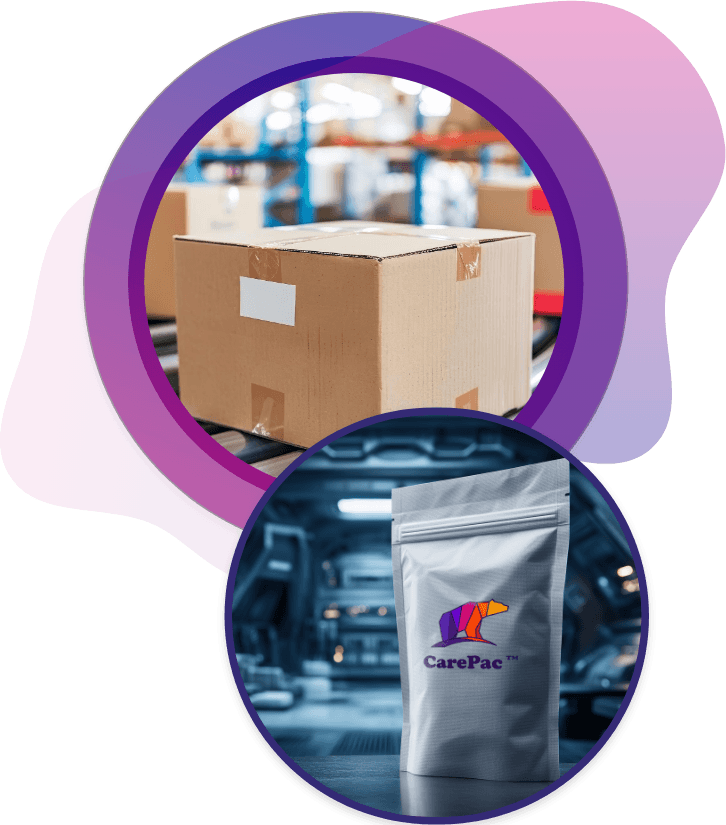
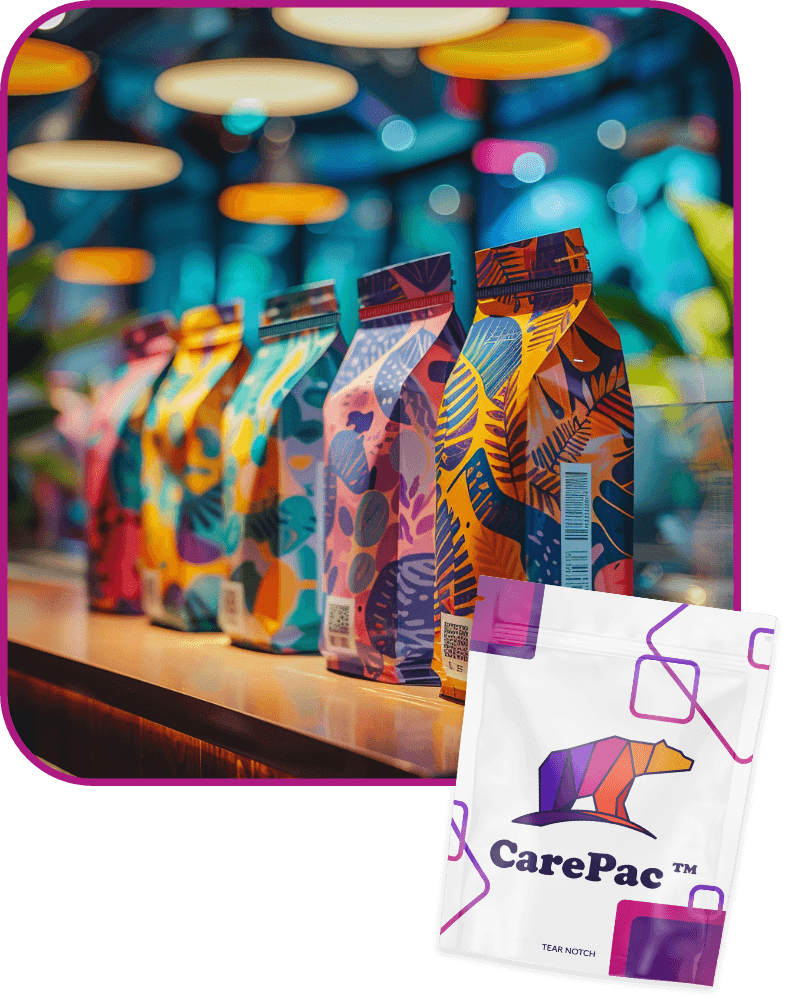
    A cardboard shipping box on a warehouse conveyor belt alongside a silver mylar stand-up pouch branded with the CarePac logo, illustrating the end-to-end custom packaging fulfillment process.A row of vibrant, custom-printed flat-bottom coffee pouches with tropical botanical designs displayed on a retail counter, next to a white CarePac-branded stand-up zipper pouch with geometric purple accents and a tear notch.

    As product packaging orders grow more complex, brands can run into critical communication issues, long response times, shifting product offerings, and quality control concerns. Small changes can turn into big delays and proofs often get misinterpreted. Logistics timelines slip, and when something goes wrong, it’s hard to course correct from halfway around the world. Between destination time zones and language barriers, working with Chinese suppliers isn’t always the best choice in the industry.

    If you’re looking for a different kind of manufacturing partner, CarePac can help. Many of our clients turn to us after experiencing the growing pains outlined above. Not because their overseas supplier was “bad”, but because they wanted tighter oversight, clearer communication, and a reputable supplier who deeply understands the intricacies of branded packaging. 

    If you’re curious about what downsides to expect when outsourcing your branded packaging overseas, here is some detailed information about what you can look out for. If you have specific questions about the various advantages working with us can offer you, contact us today to learn more.

    Pain Point #1 — Quality Inconsistency (Even After Approving Product Packaging Proofs)

    If you’ve ever opened pre-production samples and thought, “This isn’t what I approved”, you aren’t alone. It’s not uncommon for there to be inconsistency in the product or components, even after approving the essential packaging proofs. The root cause isn’t carelessness or volume. It’s the reality of overseas production without premium hands-on oversight. Materials are often swapped based on availability, and different machinery is used from one run to the next. Without someone keeping an eye on the specs or dimensions during production, small deviations can quickly add up into big problems. 

    If this happened to you, it doesn’t mean you chose the wrong supplier or didn’t do your homework. It just means the production process lacked the controls needed to ensure consistency at scale.

    Pain Point #2 — Miscommunication, Quality Control Issues, & Time Zone Delays

    Most businesses don’t understand how fragile the production process is until something goes wrong. Artwork gets misunderstood, bag sizes aren’t quite right, and simple questions take days to get answered. On paper everything looks fine, but technical packaging details leave a lot of room for interpretation, especially with language barriers and time zones to contend with. One of the things our customers rely on us for is translation. Not just of language, but of the entire packaging process. We’ll explain what decision matters and will call out issues before they turn into expensive surprises. 

    If you’ve felt stuck waiting for replies or blindsided by decisions you didn’t know were being made, these issues are for more common than most small businesses realize.

    Pain Point #3 — Production Delays, Freight Surprises & Missed Launches

    When brands plan packaging around overseas production, timelines can look solid at first. Then the scope creep begins. Production slips a few days, and those days turn into weeks. Before you know it, your freight schedules shift and your launch date is completely unknown. Much of this is predictable. Although China runs on a six-day work week, this is balanced by a few large, extended holidays when the entire country shuts down completely. Golden Week, Chinese New Year, and National Week aren’t minor slowdowns – they are complete stops. This, coupled with port congestion, port slowdowns, labor strikes, inspections, and paperwork errors can all add unpredictable delays. 

    These aren’t rare cases; they are patterns. And once you’ve missed the launch window, the cost isn’t just higher freight or delayed packaging; it’s lost momentum, lost revenue, and a detriment to your brand identity.

    Pain Point #4 — Hidden Costs That Make Overseas Packaging Suppliers Not-So-Cheap

    On the surface, overseas pricing often looks unbeatable. The unit cost is low, the quote is clean, and everything feels efficient. That is, until the real production costs start showing up. One of the biggest hidden costs is shipping container duties and tariffs. Historically, these were relatively minor but today they’ve spiked as high as 157%. Then there’s sea freight brokerage fees and custom bond requirements, which most first-time importers don’t even think about. Replacement and reprint costs are another harsh reality. When production runs late, brands often end up paying for air freight upgrades just to hit launch date. 

    These product packaging costs don’t show up in the initial quote. But together, they’re why so many brands eventually realize that overseas manufacturing isn’t cheaper – it’s just harder to see the full price until it’s too late.

    Pain Point #5 — No Accountability When Something Goes Wrong

    This part is uncomfortable, but it’s important to note. When you wire money overseas, there’s no rewind button. When errors happen, many companies simply end up eating the cost. While some suppliers suggest there are remedies, we have very rarely seen true accountability play out in practice. Communication often degrades at this stage, too. Responses slow down and messages go unanswered. A common quality issue we see involves non-functioning degassing valves. Suppliers will often offer a partial credit, but only after you send physical samples back for verification. 

    None of this is surprising if you’ve lived through it, and it’s exactly why so many brands eventually decide they need a partner who’s accountable, available, and standing on the same side of the transaction when something goes wrong.

    Pain Point #6 — Compliance Issues (FDA, Labeling, Claims)

    Compliance problems are rarely obvious until they are suddenly urgent. Brands come to us after discovering issues like incorrect weight formatting, allergen statements placed incorrectly (or completely missing), and required material disclosures that are ignored or misrepresented. These aren’t design details, they are specific requirements and not meeting them can put your brand in hot water. 

    None of this means overseas manufacturing is automatically non-compliant. But it does mean the burden of compliance will almost always fall on you. Without a partner that actively checks labeling rules, material disclosures, and facility standards, it’s easy to end up with packaging that looks good but can’t legally be used, leading to packaging waste that can be detrimental to e-commerce brands.

    How CarePac Helps Switch Buyers Transition Smoothly

    If you’re switching suppliers, it’s usually because you’ve dealt with enough headaches. The last thing you want is another complicated transition. That’s where we come in. CarePac is built for brands that are mid-stream; already selling, scaling, and ready for packaging that simply works. Communication is fast and because we’re U.S.- based, questions get answered in real time and issues are resolved quickly. We take a hands-on approach to artwork and file checks, which means fewer assumptions, fewer interpretations, and far fewer surprises when the bags arrive. What you approve is what you receive. 

    We also support lower MOQs, which gives growing brands flexibility without forcing massive upfront costs onto them. Our onboarding process is clear and guided, designed specifically to avoid downtime while you transition away from your existing supplier. 

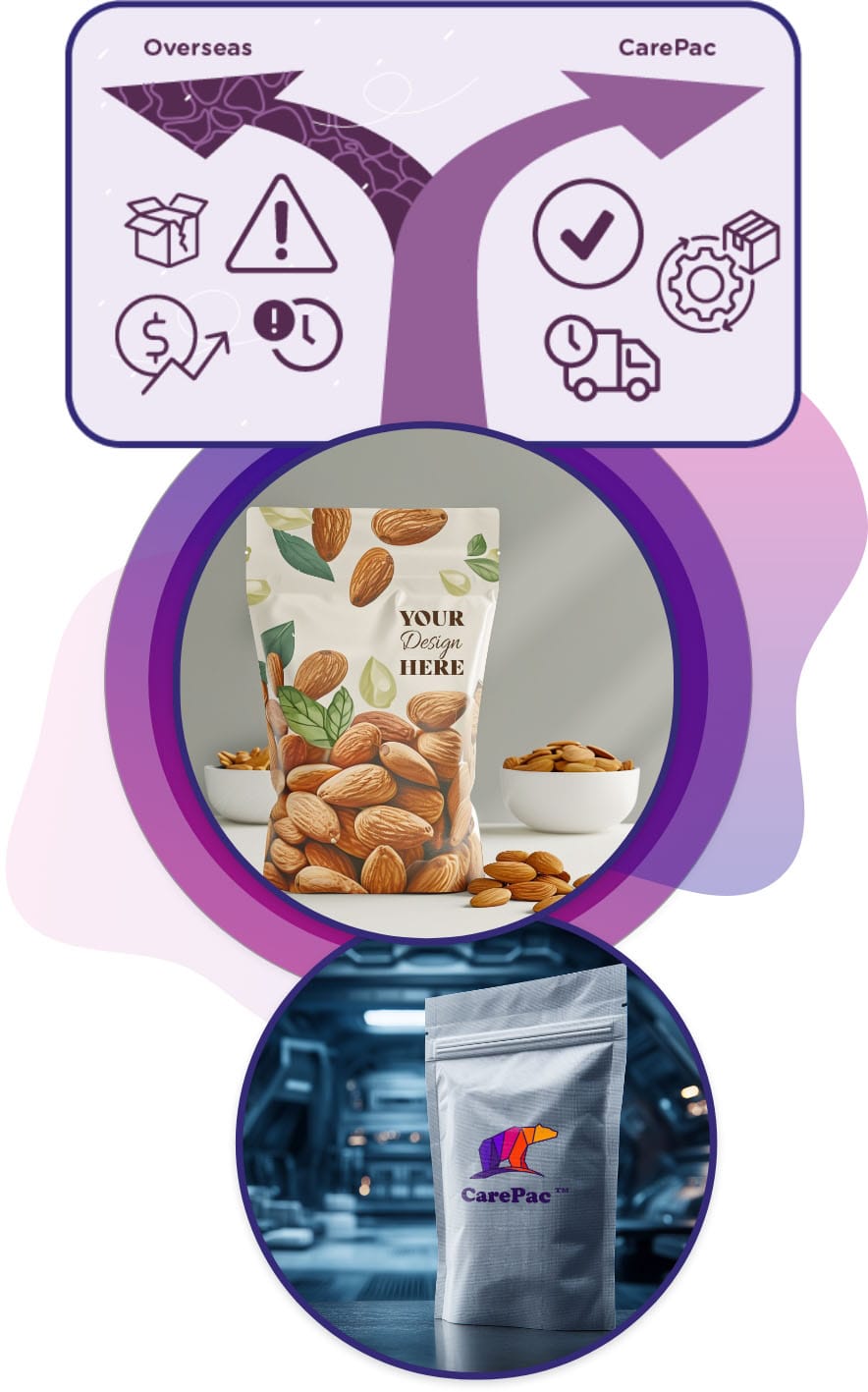
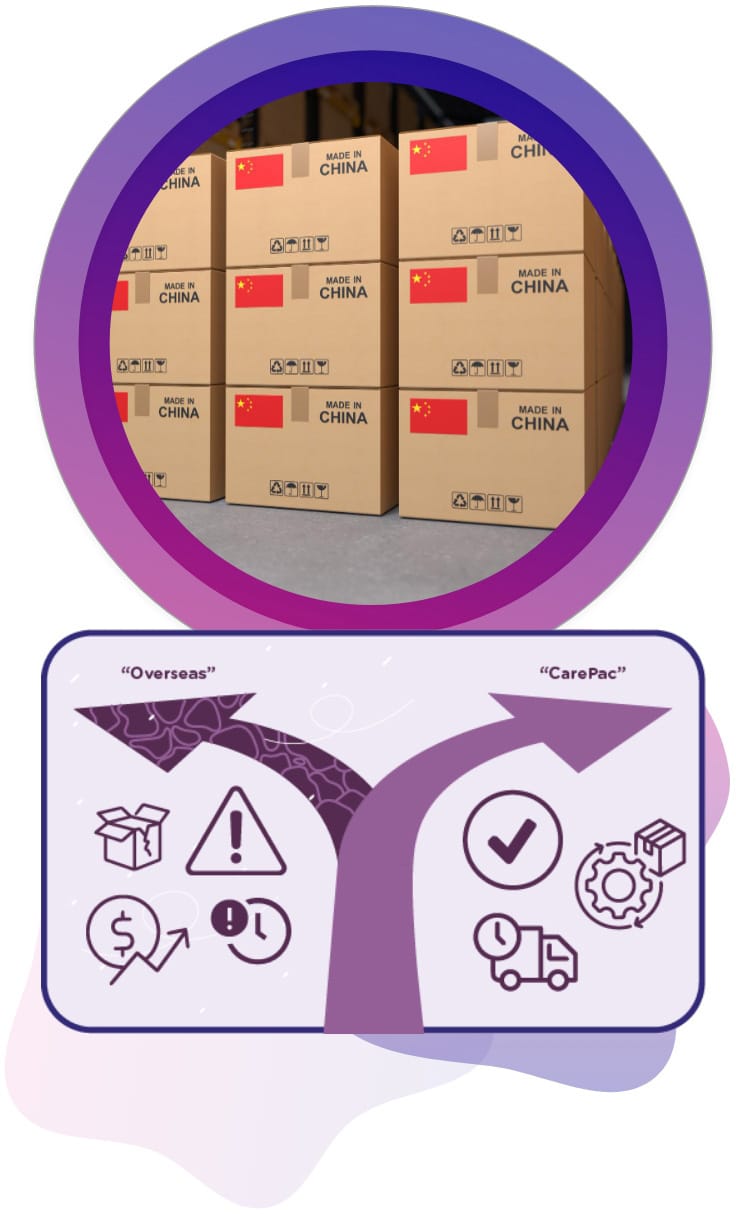
    Stacked cardboard boxes labeled "Made in China" in a warehouse above a split-path decision diagram comparing overseas packaging suppliers — showing risks like rising costs and delays — against CarePac's solution featuring quality assurance, reliable delivery, and streamlined fulfillment.

    Final Takeaway — Overseas Isn’t “Cheap” If It Costs You Time, Quality, or Credibility

    For many brands, the journey follows a specific type of pattern. Overseas manufacturing works—until it doesn’t. Early savings get offset by quality inconsistencies, miscommunication, missed timelines, surprise costs, and compliance concerns. What starts as a smart cost-saving move slowly turns into a drain on time, focus, and trust—both internally and with your customers.

    Most brands don’t switch because of one big failure. They switch after a series of small, avoidable problems that add up. Delayed launches. Reprints that shouldn’t have been necessary. Inventory you can’t use. Stress you didn’t plan for. At a certain point, the question stops being “Is this cheaper?” and becomes “Is this sustainable?”

    If you’re ready for packaging that’s predictable, accountable, and built to support your growth—not complicate it—there is an easier path forward.

    Curious what a stress-free switch looks like? Get expert guidance with your first quote.

    Lets Get Started

    Made In The USA

    Full PouchCustomization

    Scalable Printing Digital & Plate

  • How Metal Detection Enhances Packaging Safety

    How Metal Detection Enhances Packaging Safety

    How Metal Detection Enhances Packaging Safety and Supply Chain Quality

    Why Detecting Metal Is Critical in Packaging Quality Control

    Metal detection is a crucial aspect of packaging quality control because even a trace amount of metal contaminants in the food production process can create costly recalls or safety risks for consumers. To help combat this risk to food safety, CarePac has proactively added a metal detector QC stage as part of its risk-based preventive controls. The inclusion of a metal detection system to identify metal contaminants in our production process benefits both manufacturers and consumers — you’ll be better protected from liability and your customers will be better protected from harm these metal contaminants may cause when it’s present in packaged foods.

    Quality control technician using a handheld metal detection scanner to inspect sealed food packaging on a production line, ensuring packaging safety and contamination prevention in the supply chain.Gloved hands inspecting sealed flexible packaging during food safety checks, highlighting metal detection processes that protect packaging integrity and product quality.

    Whether you’re packaging products for pharma applications, frozen products, packaged foods, or any other type of food product, our system will keep contaminants out of the food production pipeline.

    How Metal Detection Systems Work

    When it comes to our proprietary metal detection system, the metal detection process is straightforward: the finished bags pass through a sensitive metal detector that can identify metal contaminants, including ferrous, non-ferrous metals, and stainless steel contaminated products. Our metal detection thresholds are calibrated for precision and speed, which prevents bottlenecks in production. Our metal detection system is integrated in the final inspection stage, ensuring contamination-free packaging before shipment. With this system integrated into our production lines, you can rest assured that your packaging will be free from metal contaminants.

    The Benefits of Detecting Metal Contaminants in the Supply Chain

    Food-grade flexible packaging being handled during inspection, representing metal detection and packaging safety measures used to prevent foreign object contamination.

    Detecting metal contaminants early in the process protects the supply chain from product recalls, rejections, or shipping delays. Detection for metal contamination also protects food processors, co-packers, and retailers who rely on safe, compliant packaging. Reliable detection of metal contaminants early in the production process can also protect your brand from regulatory issues, especially those under the FSMA and HACCP frameworks. Finally, there are downstream benefits to consider, including less waste, better traceability, and stronger consumer safety and trust.

    Integrating Industrial Metal Detection Into CarePac’s QC Process

    CarePac’s quality control workflow is designed to ensure every food-contact packaging product meets strict safety, regulatory, and performance standards. The process begins with material selection and incoming inspection, where all raw materials are verified for compliance, quality, and suitability for food applications. From there, printing and lamination quality checks confirm that graphics, adhesion, barrier layers, and structural integrity meet customer specifications and manufacturing requirements. CarePac also conducts VOC testing for emissions, validating that materials used in production remain within safe limits for food-contact environments.

    As products near completion of the production process, metal detection during final QC serves as a critical safeguard, ensuring that each batch is screened for potential metallic contaminants before it can move forward. This is followed by a final visual and lot inspection, where inspectors verify seal integrity, dimensions, appearance, and packaging accuracy prior to shipment.

    Together, these steps create a layered safety system where every batch passes through multiple checkpoints—each designed to catch issues, like metal contaminants, early on in production lines and protect the end consumer. Throughout the workflow, CarePac’s QA and PCQI-certified staff maintain rigorous traceability and documentation, ensuring full accountability and compliance with food-safety expectations.

    How Metal Detection Supports Regulatory Compliance

    Though establishing a metal detection system is not required for food manufacturers for FSMA, HACCP, or GMP compliance, the oversight ensures that preventive control measures like this meet FDA expectations. This added layer of scrutiny reinforces CarePac’s commitment to going beyond baseline requirements and adopting practices that actively reduce contamination risk. It also provides customers with greater confidence that their packaging partners are aligned with modern food-safety standards and are doing their best to avoid metal contaminants. This proactive step helps our customers demonstrate supplier verification and safety assurance during audits, supporting smoother compliance reviews and strengthening their overall food-safety programs.

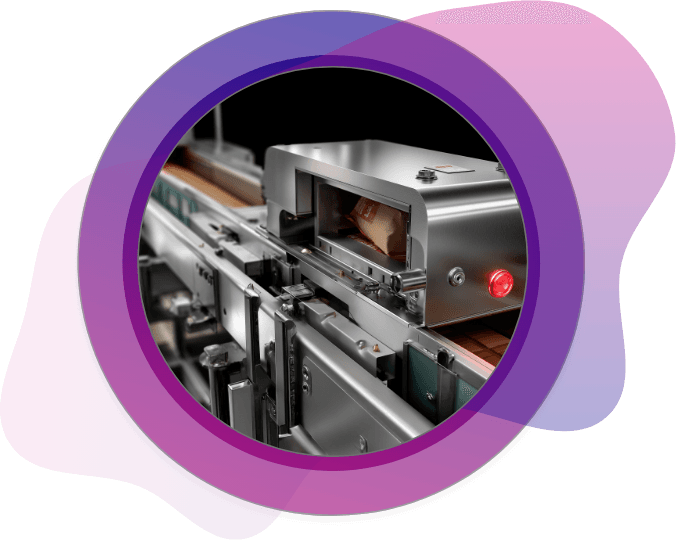
    Conveyor-based metal detection system scanning packaged food products, identifying metal contaminants to enhance packaging safety and ensure supply chain quality compliance.

    The Value to CarePac Customers Involved in the Food Production Process

    Our proactive approach to establishing a metal detection system for packaging adds values to brands and co-packers who depend on reliable packaging. Benefits of these detection systems include reduced risk of shipping a contaminated product, stronger audit readiness, improved consumer confidence, and supply chain continuity and fewer product rejections. At CarePac, we only have one focus: helping your business stay compliant, efficient, and trusted within the food industry.

    Packaged food products passing through an industrial metal detector with digital readout, demonstrating how metal detection improves food packaging safety and supply chain reliability.

    Partner With a High Performance Packaging Supplier That Prioritizes Safety

    CarePac’s multi-layered quality control system — including VOC testing, metal detection, PCQI oversight, and full FSMA/HACCP alignment — is engineered to give you confidence in every order. These safeguards play a crucial role in product safety, reduce risk, and strengthen supply chain reliability from the moment materials enter our facility to the moment finished goods ship out.

    If you want packaging backed by rigorous controls and transparent documentation, contact CarePac. Our team is ready to walk you through our QC process and show how our systems can support your safety, compliance, and operational goals.

    FAQs About Metal Detection in Packaging for Food Products

    Lets Get Started

    Made In The USA

    Full PouchCustomization

    Scalable Printing Digital & Plate

  • Food Safety Modernization Act and Why It Matters

    Food Safety Modernization Act and Why It Matters

    What Is the Food Safety Modernization Act (FSMA) and Why It Matters

    Overview of the Food Safety Modernization Act

    The Food Safety Modernization Act (FSMA) was enacted by Congress in 2011 in response to a growing number of foodborne illness outbreaks and the increasing complexity of the global food supply system. The Food Safety Modernization Act gives the Food and Drug Administration the authority to regulate the food industry and implement preventing controls, including controls for preventing intentional adulteration of food products.

    Colored bell peppers with syringes and food additive labels such as E230 and E510 representing food safety testing and FDA oversight under the Food Safety Modernization Act (FSMA).Scientist wearing gloves inspecting a grapefruit and fresh produce, symbolizing preventive controls and food contamination testing required by FSMA regulations.

    The goal of these federal regulations is to improve food safety, prevent contamination, and make the food system safer for both humans and animals. One of the biggest impacts the FSMA had on food safety standards at the time is that it focused on preventing contamination instead of simply reacting to it, effectively enhancing public health protection. Through the act, the FDA has expanded authority over food facilities, farms, and imported foods, including food producers, food production facilities, and food businesses of all sizes throughout the United States.

    Why the FSMA Is Important for Food Safety Standards

    The Food Safety Modernization Act is important for food safety standards because it shifts the focus from reacting to foodborne illness to preventing it through a proactive approach and a specific set of safety regulations. It focuses on prevention over reaction, proactive risk management, stronger regulatory oversight, accountability across the supply chain, implementing standards for imported foods, and also focuses on food defense. In the next section we’ll go over each of the seven key rules / focus areas of the FSMA that businesses in the food industry must comply with.

    Key FSMA Rules and Their Focus Areas

    Infographic outlining FSMA compliance steps including foreign supplier verification, preventive controls, and third-party certification for food safety modernization.

    Under the Food Safety Modernization Act, there are seven key rules that food safety agencies expect food facilities to meet, most of which are preventive control standards. Here are the key FSMA food safety standards:

    Preventative Controls for Human Food– Food facilities registered with the FDA must implement a written plan that outlines hazards and appropriate preventative controls they will take.

    Foreign Supplier Verification Program– Importers must verify that the vendors that are part of their global supply chain comply with FDA regulations, even if they are foreign food facilities. Imported foods are not exempt from these preventive controls.

    Preventative Controls for Animal Food– Animal food companies registered with the FDA must do the same as above, except tailored to the animal food they produce.

    Third-Party Certification– Accredited third party certification bodies administer voluntary consultations and regulatory audits to help companies prepare for audits or achieve certifications.

    Produce Safety– This establishes minimum standards for growing, harvesting, packing, and storing produce, including at farmers markets.

    Food Defense– This aims to avoid intentional adulteration of food. Food facilities must assess their contamination vulnerabilities, put together a hazard analysis, and document a mitigation strategy for each vulnerability outlined in the hazard analysis.

    Sanitary Transportation– Requires food businesses that transport food, including shippers, receivers, loaders, and carriers to comply with specific requirements outlined by the Food and Drug Administration and other government agencies.

    Preventive Controls for Human and Animal Food

    Preventative controls for human and animal food involve monitoring, keeping records, and performing hazard analysis in reference to both human and animal food. For human food, this means food facilities must implement comprehensive food safety plans that address hazards specific to their operation. This includes implementing specific controls that focus on allergen and sanitation controls, as required by the FDA’s rule for Preventive Controls for Human Food. 

    For animal food, the specific rules and requirements differ from those for human food. The underlying principle of preventing hazards for animal food remains the same, but the detailed regulatory requirements are tailored to animal food.

    Scientists performing food safety testing with lab equipment and inspecting fresh produce in grocery settings to ensure FSMA standards for safe food supply chains.Fresh produce including peppers, apples, and lettuce injected with syringes symbolizing testing for contaminants and chemical safety under FSMA food protection standards.

    Produce Safety Rule and Farm-Level Practices

    Through the Produce Safety Rule, the FSMA extends to farms throughout the United States. The FSMA conducts food safety audits to verify that farms have appropriate preventive controls in place. The goal of conducting food safety audits is to ensure that agricultural and food processing facilities focus on training, water testing, hygiene, and safe agricultural practices that will help protect the food supply chain. This focus on farm-level practices impacts both small and large producers and aims to significantly minimize foodborne illness and food safety risks that may occur at the growing and production level.

    The Foreign Supplier Verification Program (FSVP)

    Some mistakenly believe that the FSMA only focuses on food grown or produced in the United States, but foreign food facilities comply with it as well. Under the Foreign Supplier Verification Program, all qualified importers must verify that their suppliers meet FSMA rules. The importer is responsible for inspections, record keeping, and certification, and the goal of the FSVP is to ensure that all food imported into the United States meets the qualifications and regulations outlined by the FSMA.

    World map carved on a wooden surface surrounded by fresh vegetables, representing global food trade, FSMA import safety programs, and international compliance efforts.

    How This Food Safety Law Impacts the Packaging Industry

    Packaging plays a critical role in the food safety ecosystem—a fact recognized within FSMA’s preventive approach to keeping food safe from contamination. At CarePac, we design and manufacture packaging that supports these same goals. Our food-grade materials, controlled manufacturing environment, and robust QC processes—including VOC testing—help ensure every pouch, roll, or film aligns with FDA and FSMA expectations for safety and compliance.

    Whether you’re building a preventive control program or preparing for an audit, CarePac’s regulatory understanding and quick turnaround make it easy to stay compliant without slowing your operations. Contact us today to discuss FSMA-aligned packaging or request QA documentation to support your food safety program.

    Staying Ahead with FSMA Guidance and Updates

    FSMA guidance continues to evolve as the FDA refines its approach to preventive controls, traceability, and food-contact safety. Manufacturers and food facilities should stay informed by following the latest updates, training programs, and best practices published by the FDA and industry partners. For ongoing reference, consider bookmarking the FDA’s official FSMA resource page.

    Image of the FDA Food Safety Modernization Act logo over fresh food products, highlighting the importance of FSMA in protecting public health and ensuring food safety.

    Talk to Our Packaging Experts

    At CarePac, we understand the importance of packaging that not only protects your food product but also aligns with FSMA and retailer quality standards. Our team combines deep regulatory knowledge with fast, reliable turnaround times—helping you stay compliant with accredited third party certification bodies without slowing production. Whether you need QA documentation, VOC data, or packaging materials that are fully compliant with federal regulations, we’re ready to support your food safety program.

    Contact us today to discuss your compliance needs or request supporting documentation.

    FAQs About the Food Safety Modernization Act

    Here are some common questions we receive about the Food Safety Modernization Act.

    Lets Get Started

    Made In The USA

    Full PouchCustomization

    Scalable Printing Digital & Plate

  • CarePac’s QC VOC Testing: Verify Low-VOC Packaging

    CarePac’s QC VOC Testing: Verify Low-VOC Packaging

    CarePac VOC Testing: How We Verify Low-VOC Packaging

    What Are VOCs?

    VOCs, or volatile organic compounds, are a group of carbon-based chemicals that easily evaporate into the air at room temperature. VOC emissions come from a wide variety of products, including cleaning products, paint thinners, and industrial solvents, building materials, household products like new furniture, and even natural sources like vegetation. 

    When it comes to product packaging, certain VOCs can be found in packaging inks, adhesives, and solvents. VOCs are known to cause adverse health effects and allergic reactions, which is why CarePac aims to minimize total volatile organic compound emissions and contaminants from all our finished bags.

    Illustration showing the VOC acronym for volatile organic compounds with a molecular structure graphic, representing chemical emissions and air quality concerns in packaging production.

    Why CarePac Tests for VOC Emissions

    CarePac performs VOC testing using advanced equipment on all our products for two reasons: it helps us stay compliant with certain regulations and because we care about the environment and health of our customers. VOC testing helps reduce odor risk and certain industries with higher regulations (i.e., food, coffee, supplements) actually require that their packaging meets a certain VOC threshold. If packaging comes in contact with food, especially, it must be free from VOCs and other pollutants.

    VOC testing also provides better outcomes for customers: packaging handling is safer, it provides a better shelf experience, and helps brands remain consistent with their perception and reputation. Plus, it can help customers avoid lingering health issues from repeated exposure to VOCs.

    Scientists wearing protective lab gear conducting volatile organic compound testing using advanced lab instruments under controlled conditions to monitor packaging material emissions.

    Our VOC Analysis & Testing Procedure (Step by Step)

    At CarePac, quality and safety are top priorities, especially when it comes to many VOC emissions, which is why our quality control process includes thorough testing for volatile organic compounds (VOCs). To ensure our packaging meets the highest standards and environmental regulations, CarePac performs VOC testing using the FD-60 Meter. During the final boxing stage, three finished bags are randomly selected from each production batch. Before testing begins, the specific VOC meter is carefully zeroed out to ensure accurate readings. Each sample is then placed under the meter for 60 seconds, allowing the instrument to measure VOC content with precision down to 1 part per million (PPM). 

    This step-by-step procedure helps us make informed decisions and confirm that all products leaving our facility are clean, compliant, and safe for our customers’ end use.

    Industrial VOC detector with digital display and handheld remote, used for monitoring volatile organic compounds and ensuring safe air quality in packaging production facilities.Two floral printed flexible packaging pouches on a sunlit surface, symbolizing sustainable and low-VOC design choices for environmentally friendly packaging solutions.

    What VOC Results Mean for Your Product

    It’s difficult to discuss what the VOC results mean for your product, as different products have different thresholds for the amount of volatile organic compounds are acceptable. Generally speaking, though, a low reading implies a lower risk for odor and indoor air quality considerations. It’s important to make this note about the limits of VOC testing: testing pertains to emissions, specifically, and is not a guarantee of the absence of organic chemicals.

    Compliance & Customer Requirements

    VOC data plays an essential role in helping brands maintain consistency, compliance, and trust across every stage of their packaging supply chain. By understanding and documenting the volatile organic compound (VOC) levels in packaging, brands can verify that materials meet their own internal quality standards, adhere to retailer specifications, and comply with applicable regulatory requirements for product safety, airborne pollutants, and emissions. 

    This data-driven approach not only supports transparency but also helps prevent potential issues such as product odor, contamination, or non-compliance during audits by the Environmental Protection Agency. CarePac encourages buyers to share their VOC limits and internal specifications with our quality control team so we can align our testing process accordingly—ensuring that every batch of packaging meets your brand’s exact standards and performs safely in the marketplace.

    Manufacturing professional using a tablet in a factory environment to inspect packaging processes and verify VOC compliance for air quality and safety standards.

    Applications & Materials We Test

    CarePac offers a variety of flexible packaging formats to meet diverse product and branding needs, including stand-up pouches, flat pouches, and roll stock film. These formats can be customized using a range of high-quality materials such as PET/PE laminates, metallized films, and kraft paper laminates, each chosen for their barrier strength, shelf appeal, and compatibility with different product types. 

    Because inks and adhesives used in the lamination and printing processes can be potential contributors to VOC levels and lead to adverse health effects with repeated exposure, CarePac maintains strict process controls and sourcing standards upstream in production. This ensures that all packaging components—from raw materials to finished goods—consistently meet low-VOC expectations and align with both regulatory and brand-specific requirements.

    White CarePac stand-up pouch displayed on a reflective surface, representing sustainable flexible packaging solutions engineered to minimize volatile organic compound emissions.Variety of CarePac food-grade pouches including vacuum seal, fin seal, and 2-seal designs, made from low-VOC films for safe and sustainable food packaging applications.Roll of CarePac branded flexible film labeled “Roll Stock,” showcasing sustainable low-VOC packaging materials for high-volume manufacturing and printing applications.

    Talk to Our QA Team

    With decades of experience in custom packaging and a robust quality control program, CarePac offers configurable testing services and full documentation to meet even the most stringent brand and retailer standards. Our team is ready to support your audits, vendor approvals, and ongoing compliance needs with confidence and transparency.

    Contact us today to discuss your VOC requirements and how we can help.

    Two engineers in a factory setting discussing packaging production improvements and strategies for reducing volatile organic compound emissions in flexible film materials.

    FAQs: VOC Testing Services at CarePac

    Lets Get Started

    Made In The USA

    Full PouchCustomization

    Scalable Printing Digital & Plate

  • The Environmental Cost of Overpackaging

    The Environmental Cost of Overpackaging

    The Environmental Cost of Overpackaging: How to Reduce Waste Without Compromising Protection

    What is Over Packaging in Online Shopping?

    As the name implies, over packaging refers to using an excessive amount of packaging material, often plastic packaging or plastic containers, that exceed what’s necessary for a product’s protection, transportation, and sale. Some real-world examples of excess packaging include receiving a small item in a larger container, individually wrapped produce items (particularly items like bananas and oranges), or items that are double boxed (i.e., the product has its own box, but then that is then put into another box or plastic bag for shipping.)

    How Excess Packaging Fuels Carbon EmissionsThe Environmental Impact of Overpackaging and Waste

    Over packaging and plastic waste is very common in e-commerce and the food industry. In e-commerce, products that are shipped typically undergo more handling than those sold in traditional retail settings. They may also over package with plastic packaging in an effort to improve customer experience and reduce the number of returns, but in reality this has a negative impact on their carbon footprint and global warming. In the food industry, pre-packaged foods offer more convenience and, in some cases, over packaging can be perceived as more hygienic. 

    In this blog, we’ll discuss how excessive packaging and using unnecessary materials throughout the online shopping experience has become a huge problem for the environment, and how brands can reduce packaging waste without negatively impacting the experience of their customers.

    Why Excessive Packaging Hurts More Than Helps

    Excessive packaging and plastic waste can have a negative impact on the environment and consumer perception. If you’re interested in reducing overpackaging and packaging waste, these are two areas where you’ll benefit most: looking at its environmental impact and how consumers view you.

    Carbon Emissions, Plastic Waste, and Climate Impacts of Overpackaging

    Environmental Impact

    Excessive packaging has a huge environmental impact. From the carbon dioxide emissions and the transportation costs involved with manufacturing and shipping it, to the fact that single use plastics contribute significantly to landfill waste, there are several factors at play when it comes to excess packaging and how it impacts the natural environment. Plastic packaging, in particular, is a major source of pollution in oceans, waterways, and soil, negatively impacting marine animals, and the transportation costs/carbon footprint of shipping increases with the weight of shipments.

    How Packaging Waste and Environmental Costs Impact Brand Reputation

    Consumer Perception

    In a society where natural resources are protected and consumers prefer paper based packaging over heavier plastic packaging, companies and retailers that over package and contribute to packaging waste can be seen as being careless or outdated. A growing number of consumers prefer to buy products from retailers that use sustainable packaging materials, and some are willing to switch to companies that offer eco-friendly options or use recyclable materials

    The growing environmental concern regarding excessive packaging is shaping consumer preferences and driving the demand for more sustainable packaging solutions. From using biodegradable packaging materials to defaulting to paper packaging or recyclable materials, there are several things companies and retailers of all sizes can do now to reduce their carbon footprint and protect the environment.

    How to Reduce Packaging Waste Without Sacrificing Consumer Experience

    When switching to new sustainable packaging materials or environmentally friendly products, it’s normal for brands to be concerned about how it will impact the customer experience. Yes, reducing plastic pollution and protecting natural resources is good, but the last thing you want to do is switch to more sustainable choices and have it negatively impact our customers to the point where they abandon your brand that same year. 

    Below, we’ll provide some sustainable packaging design options for your to consider as you make the move towards reducing plastic pollution.

    Use custom-sized packaging  – Not only does using custom-sized packaging reduce packaging waste, but it can also minimize movement during transit, reducing the risk of damage or the need for bulky bubble wrap. While there may be an initial investment in this type of custom packaging design, the long-term savings from reduced material and shipping costs can be substantial. Think of this switch as an investment in the future of your company. Minimalist packaging is the new norm and this is a great way to avoid excess packaging. 

    Switch to lightweight flexible materials throughout the supply chain  – Switching to lightweight, flexible packaging materials can significantly reduce costs, improve sustainability, and enhance consumer convenience. Flexible packaging, like pouches, bags, and wraps, offers numerous benefits over traditional rigid packaging or individually wrapped options. Lightweight flexible packaging is also incredibly versatile. It can be used as the primary packaging for many items, including food items, beverages, personal care items, and household goods. Depending on the material, it can also be reused, effectively avoiding single use plastics. 

    Combine branding and function in one layer  – Have you ever had to remove a plastic layer (or even multiple layers!) before you were even able to get to the actual product packaging? Why make your customers open multiple layers of packaging when you can combine them into one? The packaging provider you work with should eventually determine if this type of packaging makes sense for you, but given its environmental impact, it is certainly worth considering. Cut back on the excessive use of plastic packaging wherever you can — your customers and the environment will thank you! 

    Reevaluate inner packaging needs  – While inner packaging plays a crucial role in protecting products during transit, many companies overdo it. Instead of wrapping fragile items in layers and layers of individually wrapped plastic packaging or bulky bubble wrap, opt for eco-friendly air pillows or biodegradable packing peanuts. Evaluate opportunities to reduce the amount of packaging material, and choose sustainable alternatives to traditional plastic packaging. Strive for packaging solutions that support a circular economy

    Choose barrier films with sustainable attributes  – Choosing the right sustainable barrier film involves balancing performance with environmental responsibility. Choose recyclable barrier films (like PE barrier films or PET packaging), compostable barrier films (bio-based polymers, packaging made out of cornstarch), or bio-based barrier films (cellulose, natural fibers). The best choice depends on the specific product, barrier requirements, desired shelf-life, and end-of-life infrastructure, but a professional packaging supplier can help you choose the film, biodegradable materials, and eco-friendly option that’s right for you.

    The Role of Smart Design in Sustainable Packaging

    Good packaging design plays a critical role in reducing waste and protecting our natural resources. The right packaging can balance aesthetic appeal with its environmental impact, resulting in positive outcomes for both the business and the consumer. Case studies of the global economy show that consumers prefer companies that care about being eco-friendly. Here’s how good packaging can enhance your success:

    • Promoting sustainable packaging can help improve your reputation 
    • Improving the unboxing experience can help reinforce your brand 
    • Protecting your product during transit can help minimize damage and loss

    By strategically integrating these elements, good packaging design elevates the overall customer experience, enhances brand value, and ensures product integrity throughout the online shopping journey. 

    Cutting Plastic Waste and Carbon Emissions with Eco-Friendly SolutionsSustainable Materials That Cut Carbon Emissions

    Work With CarePac to Reduce Waste and Costs

    CarePac helps create packaging that enhances brands, protects products, and meets market demands, including those outlines by the Environmental Protection Agency. We offer fully customized options that can enhance your consumer’s online shopping experience and are proud to offer several sustainable and biodegradable material options. We’re big fans of minimalist packaging and can help you avoid unnecessary materials in your packaging. 

    Ready to get started with reducing plastic waste? We can help. Contact us today to get started.

    Lets Get Started

    Made In The USA

    Full PouchCustomization

    Scalable Printing Digital & Plate