Category: Flexible Barrier Packaging

  • Everything You Need Know About Flexible Barrier Packaging

    Everything You Need Know About Flexible Barrier Packaging

    Product packaging does more than just protect your products; it also says a lot about your brand. Keep in mind that this is the first interaction that customers have with your products, and if your labels don’t make a good first impression, you’ll probably lose them!

    Consumer behavior has significantly changed, and they no longer engage with a brand in the stores before buying. Studies also show that customers only take about 20 seconds to decide whether or not they’ll pick a product. Make this time count!

    You may have a good product, but your customers don’t know that. The only way you can pull them in is through unique and quality packaging. Here’s where flexible barrier comes into play, specially at the food packaging industry. Check out our ultimate guide to barrier packaging below.

    What Is Flexible Barrier Packaging?

    You certainly have seen this food service packaging material everywhere!

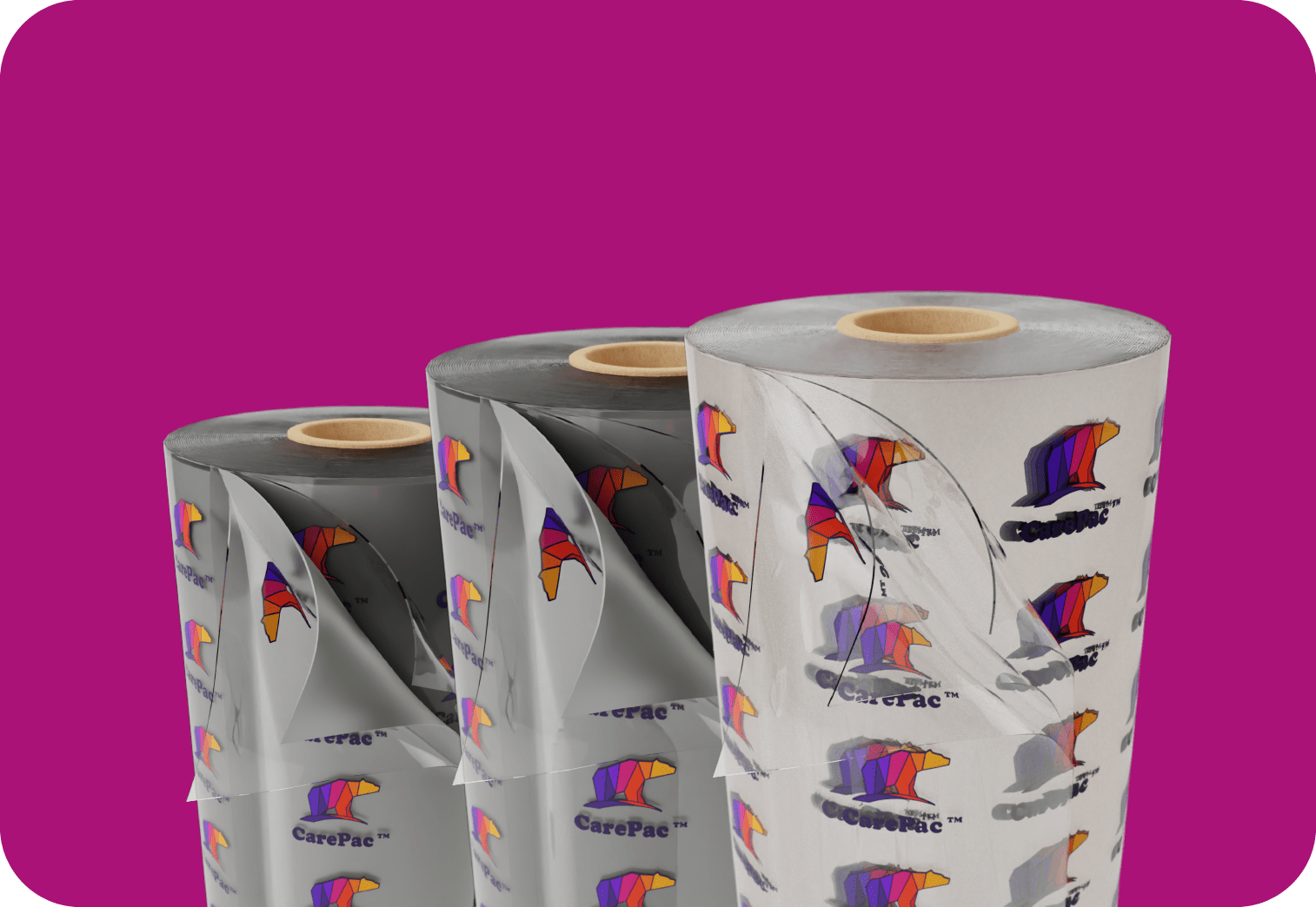
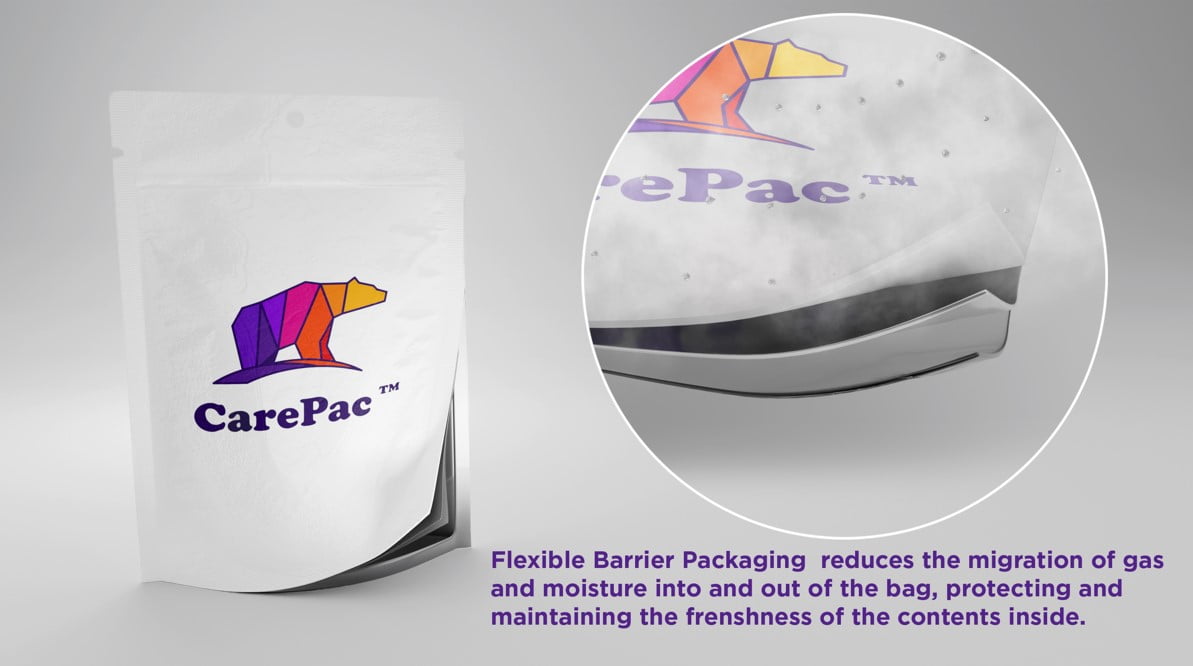
    Flexible barrier packaging is a part of modified atmosphere packaging (MAP). This is any packaging that modifies the atmosphere inside itself to preserve the goods.

    A classic example would be canning, which started in wine bottles and was taken from watching monks make champagne. They began with a pasteurization process followed by maintaining a modified atmosphere in the jar to stop the champagne from going bad. Aluminum cans were the next invention and had a wide adoption rate. They are, however, being phased out and replaced by flexible barrier packages.

    Flexible barrier packaging was born out of the space race as NASA looked for ways to cut out weight and maintain freshness. Some of the earliest products to use this packaging were MREs. As the name implies, the key difference between plastic bags and barrier packaging is the barrier.

    Plastic bags do not have an enhanced barrier which is often made from combinations of plastic films laminated together for increased strength.

    What Are the Most Common Used Materials?

    Well known as food packaging resources but these films have nearly endless applications!

    Due to the advancement of packaging technology, there are several flexible barrier films for you to choose from;
    PET

    Polyesters (PET)

    Polyester is highly preferred because it is effective and affordable. It’s made from quality film that’s perfect for packaging applications such as machine parts, food, or bags with view windows. Polyester also has a great weight to strength ratio and comes with its own barrier.

    Its dimension stability is impressive and is usually heat and tear-resistant.
    VMPET

    Metalized Barrier METPET / VMPET

    Aluminum foil is often costly, so a metalized barrier was created as an affordable solution. They are made from coating polyester with a metalized vapor or thin metallic film to fortify the barrier and make the packaging surface reflective.

    Nickel and Chromium are also options, but aluminum is the preferred metal for this type of barrier, used for multiple food packaging applications and even medical device packaging.
    Foil

    Aluminum Foil (AL) Combined with PET, MOPP, and PE

    This type of flexible barrier packaging is used when maximum shelf life or barrier is required. When employed as part of a barrier lamination structure, Aluminum foil creates what is, in essence a flexible “aluminum can”. Aluminum has a very high barrier to moisture and oxygen transmission which can be as low as .0006 grams/24h. This is a extremely low migration rate which creates an amazing barrier. 
    Nylon

    Nylon Laminations and Co-extrusions

    Nylon laminations usually combine polyester or foil with nylon to enhance barrier strength, and bag strength so the bag does not break or rip. The lamination process is usually different depending on the product requirement. Nylon Co-extrusions are mainly used for vacuuming. Due to the co-extrusion, the film is able to stretch without breaking and conform to the shape of your products when vacuumed around them.

    MOPP

    Polypropylenes 

    OPP, BOPP, MOPP, CPP are common barrier films which offer different performance characteristics than PET, PE, or a Metalized material. First OPP is generally lower in cost, and also can be used to create a matte lamination, making the bag matte. Last but not least Polypropylene when used as a cast material has a higher melting point than other plastic films commonly used for interior liners. This makes it possible to create bags that both heat seal but which can be exposed to temperatures above 100C for sterilization or boiling. 

    PE

    Polyethylene (LDPE, PE, LLDPE)

    Polyethylene by itself is a weak barrier, even when used in high build or mil thicknesses. But when combined with other plastic films, Polyethylene helps bring it all together. PE is predominately used as the interior food safe and heat sealable layer, PE promotes elasticity and has a natural “stretch” to it. Polyethylene is non-reactive to most chemicals, and can withstand high acids and bases. 

    Factors to Consider When Deciding the Packaging Material to Use

     Vapor and oxygen barrier packaging, tensile strength, UV light protection – there is a lot to consider at keeping your products safe and reducing food waste.

    The type of flexible barrier packaging you choose ultimately depends on the product being packaged. Is it a fresh consumable? Does it have to be stored for extended periods of time? Do you want customers to view the product? Is is sensitive to oxygen? While other factors are still important, the product requirements still remain the key determining factor.

    Other aspects you should consider while searching for food packaging resources include:
    Estimated Product Shelf Life

    If your products have a low shelf life, you should go for low or medium-barrier plastic film. This is because such products are usually low-value retail items that are consumed quickly, so your primary focus should be on economic packaging.

    For products with a longer shelf life, high-barrier materials are the best option for packaging reducing food loss and waste of other products. They are very stable and will keep your products fresh for a long time.
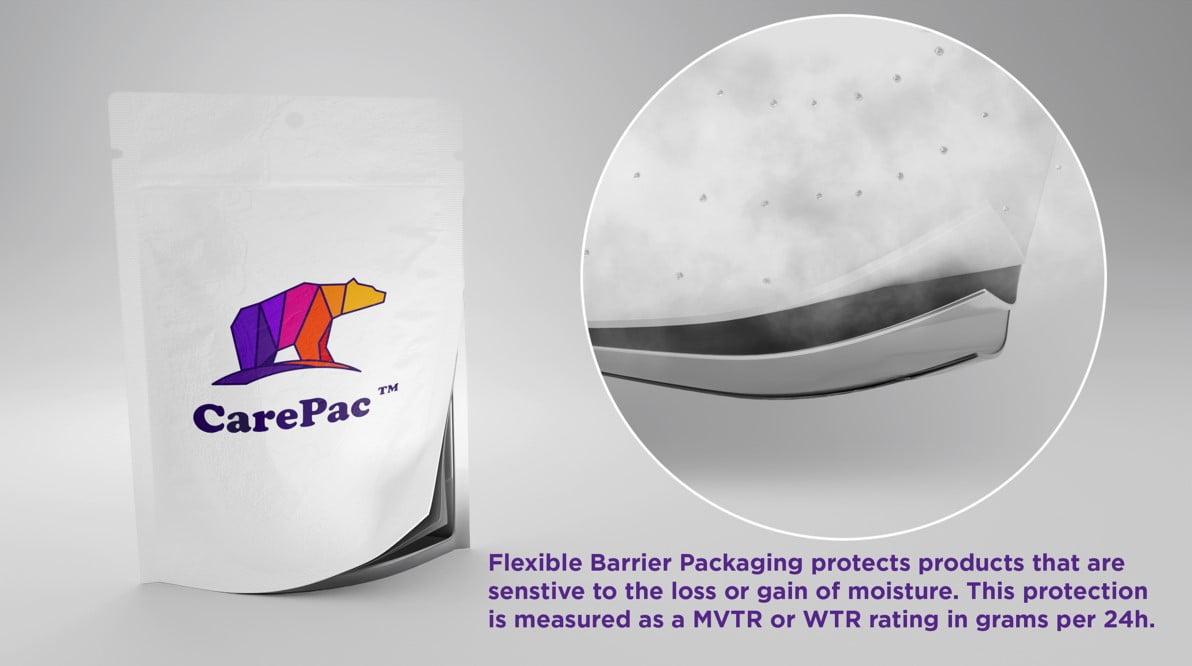
    Sensitivity to Moisture

    Some products like nutritional mixes and dry food ingredients are extremely sensitive to moisture and should be packaged in enhanced barrier plastic films. This includes high-density polyethylene and foil laminations that are effective in preventing moisture from getting into the bag.

    Sensitivity to Oxygen

    Products like chips change their taste and texture when exposed to oxygen and should be packaged in oxygen barrier packaging materials. They prevent oxygen transmissions inside the bag and extend the shelf life of your product.

    Physical Capacity

    The flexible barrier material used should be strong enough to hold your products. You should conduct a physical test to determine how well the packaging can protect your product against external elements such as light, dust, heat, and air.

    Availability

    The packaging material used should be easy to restock within short time frames after you place your order. Any delays in sourcing the packaging materials could also impact the production process and, ultimately, your sales. Enough reasons to make sure you have reliable supplier that provide automated packaging solutions.

    Other factors you should consider include;

    • Durability: the flexible barrier material should remain in good condition for long periods of time to maintain product freshness while reducing food waste.
    • Price: you should go for a barrier packaging material that strikes the ideal balance between the set budget and your desired properties.
    • Fitness of purpose: the properties of the material should be enough to serve your packaging needs.

    Flexible Barrier Is the Way to Go!

    We provide quality food service packaging that will make your business thrive.

    Product packaging strongly influences a customer’s buying decision. Studies have shown that consumers make over 70% of all buying decisions at the point of purchase, and the main aspect that determines whether they pick your product or walk away is your packaging.

    Flexible barrier packaging comes in many forms and can be customized to meet your audience’s needs. From medical device packaging to food service packaging, from cosmetics to alcoholic beverages – it is compatible with a wide range of products making it the go-to packaging solution for many manufacturers.

    If you’re not sure which packaging solutions your products need, we’d love to help you. Contact us today and get a 5% Price Match Guarantee.

  • How Much Do Custom Printed Stand Up Pouches Cost?

    How Much Do Custom Printed Stand Up Pouches Cost?

    How Much Do Custom Printed Stand Up Pouches Cost? | Cost of Custom Stand-Up Pouches & Bags

    Custom printed mylar bags and stand up pouches pricing can vary significantly based on the material, features, and size of your bag, as well as the printing method you use and the lead time you choose. Let’s break down all the variables that go into the cost of a stand up pouch.

    1. The Size of Your Stand-Up Pouches (+ Do You Need Multiple Sizes?)

    It seems fairly obvious that the larger the stand up bag the more raw materials are needed to produce the bag, therefore the cost increases as the size of the bag increases. But what you might not know is that you can save money by choosing to make your pouch from a standard stand up pouch size, versus a customized size.

    For example, if you are starting out, and don’t have strict requirements, your product may be able to fit a standard size bag, versus trying to make an exact match on the dimensions desired for your bag. 

    2. How Many Designs You Have

    First, let’s clarify what we mean by design. You may have one product, like coffee bags, but have multiple designs because you sell different variations and flavors of coffee. Maybe you sell decaf whole beans, and ground dark roast coffee. Typically each SKU will have it’s own design. The more designs you have, the higher the cost of the bags because the printers used to create your bags will have to be “reset” for each design. 

    If you are new to packaging you might be wondering how many designs do I need? You don’t really need to have a lot of designs if you are just starting out. One “trick” is to use one design and then add a small sticker to the package to delineate different flavors for example. 

    3. How Many Bags You Need

    This is also quite obvious. The more custom stand-up pouches you need, the higher the total price of your order will be. But let’s talk about the nuance here. What if you only need 5,000 stand-up pouches right now to fulfill an order, or to get your business started, BUT you could get a quantity discount if you were able to buy more bags now. 

    Of course, adding on more bags will increase the total price, but you also need to consider UNIT PRICE. If you are able to get 5,000 bags for $1,000 and 7,500 bags for $1,100, the unit price becomes 20 cents per bag and 14.6 cents per bag, respectively.

    If you are launching a new product, or perhaps a new company, you will have less direct experience with how your product will sell. Ordering might become a trade-off between the quantity discount and your concerns about using all the bags you order.

    If you aren’t sure what’s best for your company, contact our friendly packaging experts for a free consultationfree consultation.

    4. What Material & Features You Choose

    We’ve all come to expect that organic food costs more than conventionally grown foods. We can understand the additional costs required to generate a successful crop when you are not using conventional approaches. 

    It’s the same thing for stand up pouches. The materials and features you choose for your stand up pouch will affect the total cost. For example, Compostable packaging material is more expensive than traditional mylar packaging.

    Additionally the thickness of your material can drive up cost. For example, chips are typically packaged in low barrier bags because they are low margin items that move off store shelves very quickly. But if you are packaging a dog treat that might sit on the shelf for four months before someone purchases it, then you need a higher barrier material.

    5. Zipper types

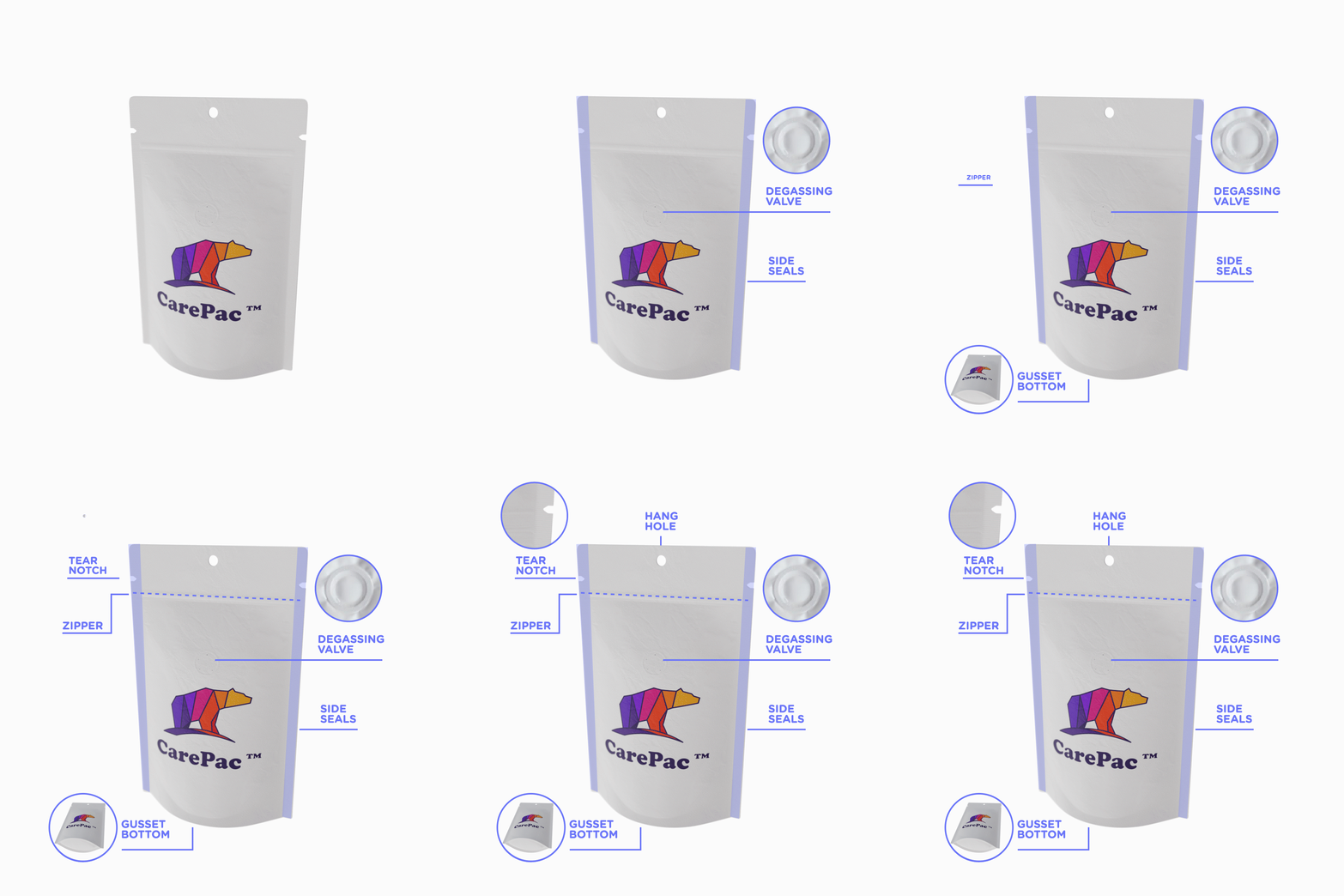
    Lastly, the features you choose can impact the price of your bags. If you want child resistant zippers that will cost more than a simple zipper. There are eight different types of zippers, all of different purposes, that can all affect the price of your bag.

    Child Resistant

    Zipper

    Heavy Duty Flanged

    Zipper

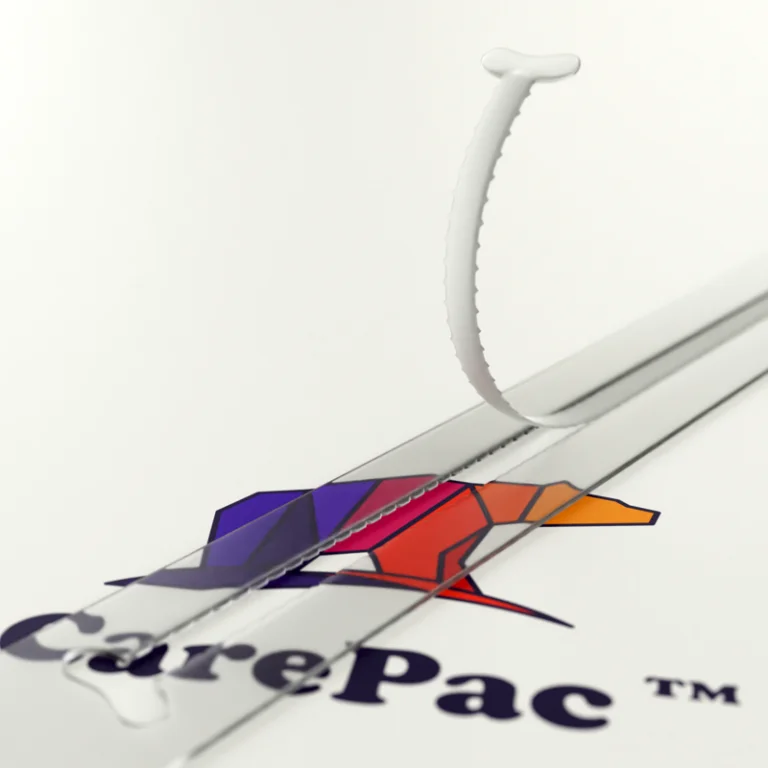
    Pull-Tab Style Zipper (Insert Style Zipper)

    Powder 

    Zipper

    Standard Flange

    Zipper

    String

    Zipper

    Hook and Loop

    Zipper

    Wide Flange

    Zipper

    6. How Soon You Need Your Bags

    You know those shipping options you have to choose from when ordering your favorite products online? Next Day Shipping is always going to cost you the most because a lot more planning and careful execution must occur to ensure your package arrives on your doorstep when you expect it.

    In the packaging industry, we refer to “how soon do you need it” as Lead Time. As with anything that is custom made, it takes time to print your bag. The more of a rush job, the more you can expect to pay because the production schedule will have to be altered to fit in your urgent need. And those changes cost money. 

    Alternatively if you are a planner you can save money by choosing the longest lead time, knowing your bags will arrive on time. If you call your packaging manufacturer the day before you run out of bags, expect to hand over a pretty penny to get those bags printed, and shipped to you. 

    At CarePac we manufacturer in the United States. This allows us to control lead times, shipping costs, and reliable delivery. If you are new to packaging we suggest avoiding all the pitfalls of ordering from China because you will likely be hit by unexpected delays through customs (even if you were promised a short lead time), high shipping costs and additional taxes you hadn’t planned for. 

    7. Printing Method

    This is by far the least understood aspect of packaging cost. And there isn’t one printing on method that is better than the other. In fact, unless you are in the custom packaging business you wouldn’t be able to tell which bag is plated printed and which bag is digital printed. The process of printing is the difference. You can always ask for pouch sample first. 

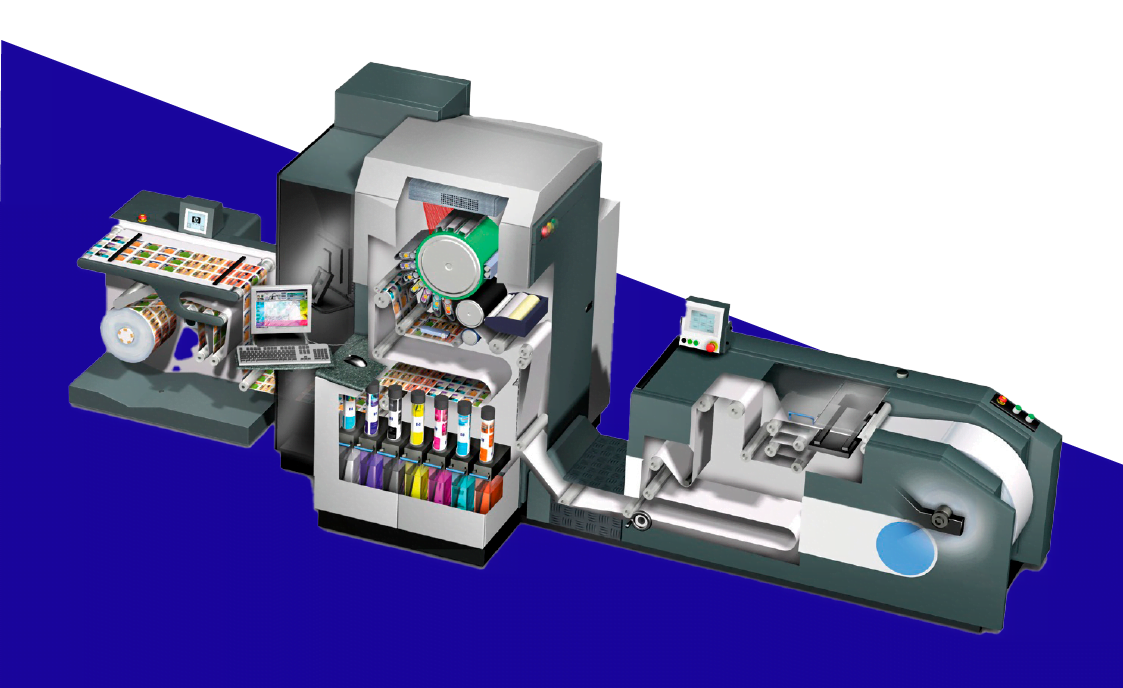
     Digital printing is the process of printing digital-based images directly onto your package.


    Plate Printing uses a thin copper plate to transfer your design onto the pouch. With plate printing, artwork is separated into four ink colors: cyan, magenta, yellow and black (CMYK) — EACH COLOR REQUIRES A PLATE.

    Get an Quick Quote for a Custom Printed Stand Up Pouch

    No matter how crucial this product launch is to your company, you do have a budget. Whether you’re a start up, bringing a new product to market, or restocking an existing product, you want the best bang for your buck.  

    CarePac is happy to discuss material types, printing options, and additional features that will help you decide what bags are best for you. You’ll receive great bags while staying on target!

    We will match any competitor’s price within 5%, guaranteed. That means you don’t have to settle for an inferior product just to save money.

    You can have the BEST stand-up pouches on the market – along with our legendary customer service – for practically the same price!

    5% Price Match Guarantee

    Now You Really CAN Have The Highest Quality at the Best Price
  • Stick Pack Packaging: Does the Packaging Work for Your Brand?

    Stick Pack Packaging: Does the Packaging Work for Your Brand?

    Stick Pack Packaging: Does the

    Packaging Work for Your Brand?

    You’ve been weighing your options regarding stick pack packaging solutions and services. Now you have to make a decision: how do you choose the right pack packaging stick pack solution for your brand? It all boils down to whether you want to make your own bags or use the finished ones. 

    CarePac provides two types of powder stick pack packaging: flow wrap or form fill stick packs and finished stick bags. Not sure which one suits your packaging needs? Read on to weigh the advantages and disadvantages of stick packs packaging before a final decision.


    1. Flow Wrap Packaging

    Flow wrap stick packs are where you get a roll stock or tubing, and you use a machine to form and fill the stick all at the same time. An excellent example of flow wrapping or form filling stick packs include traditional candy bar wrappers

    Before ordering these products, be sure you weigh its advantages and disadvantages.


    Advantages of stick pack packaging

    Some of the benefits that come with flow wrap products include:

    Great for high volume and speed of filling

    If your foremost consideration is high filling speed and volume, a flow wrap solution will often be more advantageous than filling premade pouch. So flow wrap or form fill is suitable if your company is large and produces thousands or millions of small packaged products. Combining these packaging and new technologies (that come will completely robotic infeed, servo drives, and other features) makes this benefit possible.


    The cost of roll stock and tubing will be lower per-unit

    The type of stick pack film is among the many variables that come into play when determining the cost of packaging materials and products. Choosing to go with flow wrap packaging for your products helps you cut down on the cost of tubing and rolling in the long run. You see, roll stock is more flexible because you’re not forming specific types and sizes of bags. So using it for multiple bag sizes becomes cheaper.  For more tips on how to reduce packaging cost, check out our full article here. 

    Disadvantages of stick packs

    However, flow wrap stick packaging also comes with some drawbacks:

    Bag-making costs 

    When talking about flow wrap packaging for your products, you assume the responsibility of making your bags in-house. This means you’ll need employees to load the supplied roll of material onto the form-fill-seal (FFS) machine and monitor the creation of those pouches.

    Everything from loading the roll stock to film tracking to sealing has to be accurate. So you’ll have to equip the employees with extensive technical knowledge to set up the machines properly and monitor changeover.

    Therefore, if yours is a small business, the flow wrap or form fill is not going to be a suitable solution due to the high cost of machinery, equipment, and labor, last but not least FFS machines can be upwards of $100k for FDA uses. 


    Impossible to make advanced bags

    You’ll have to sacrifice some flexibility if you need to achieve high packaging speed. So form fill machines and packaging are not flexible enough to help you come up with unique branding styles and designs for your products. It’s only suitable for higher output and longer runs where you need only 1 to 4 standard pouch styles and sizes. 


    Excess packaging waste

    The in-house bag-making process will eventually lead to excessive concentration of the rolls and tubing in your facility. You’ll also start noticing product and packaging waste from the packaging machine.  So be sure to invest in waste disposal around the machine to avoid contamination of finished products.


    2. Finished Stick Bags

    CarePac can also sell you small finished bags, which you can fill using a hopper filler. So the cost of designing and creating them is not your responsibility. 


    Advantages


    A wide variety of pouches

    If you need a myriad of bag styles, sizes, or shapes to suit your brand, consider using finished packaging. The option also allows you to change the packaging varieties multiple times on the same day, thanks to its flexibility regarding short runs and artistic designs. 


    Low labor cost 

    Choosing finished bags means that you’ll not have to bear the cost of making them- CarePac will fabricate and deliver the bags to your company. The remaining work will just involve loading the pouches into the machine’s bag magazine, eliminating the need for technical expertise.

    And if you have invested in robotic pick and place systems, you can say goodbye to manual labor. You’ll only need few entry-level employees to load and operate the machines without much help. 


    Minimal Scrap

    You’ll also not have to pay for product and packaging waste disposal (unlike the form filled stick packaging) because waste and scrapes are minimal. You see, disposing of scrap from premade bags is left in the hands of CarePac, as the creation of the bags doesn’t happen in your facility.

    Another thing is that the finished bag machine allows you to set up, calibrate, and carry out changeovers without running the product. That means you can recycle the bags for the final production. 


    Disadvantages


    Slow Speeds and Lower Volume

    One drawback of this solution is its slow speed. Yes, the industry has fast hopper filling machines, but they’re still lagging. 

    However, it’s worth noting that faster is not always better- While speed is crucial, it may not be the most critical consideration. It would be best if you looked into your unique needs when deciding on packaging products. 


    High initial investment on flexible packaging films 

    The cost of purchasing a premade pouches’ machine can be high. Beyond the upfront costs, be sure to consider other cost factors that will impact your machine’s total ownership in the long run. For instance, using finished bags can leave behind a lot of inventory if the product is discontinued. 


    Conclusion

    Let’s face this: There is no one-size-fits-all answer regarding the right stick packs for your brand. Many factors come into play when choosing the best solution:

    • Company: think size of your company, length of runs, types of products, and volume of products

    • Logistical factors: think about your product’s shape and weight plus their relationship with the shipping expenses. Can you easily palletize or pack your products for shipping?
    • Budget and cost constraints: what has your organization leadership decided regarding packaging costs? 
    • Your employees’ technical skills (maintenance staff, production crew, and operators): you may decide to go for a solution that complements your existing crew’s technical knowledge if you don’t want to invest in new or highly-trained employees. 
    • Marketing department’s requirements: think shelf presence, artistic styles, aesthetic appeal, and ads area.
    • Consumer base requirement: think messaging on the package, convenience, portability, and easy-open and re-sealable options.

    Whether flow wrap or finished bags are suitable for your brand, consider CarePac, a reputable company that will make your products fly off the shelves. Get an instant quote now.

  • 12 Questions to Ask Your Flexible Packaging Provider Company

    12 Questions to Ask Your Flexible Packaging Provider Company

    Bag Manufacturer Questions

    To succeed in the manufacturing industry, you need to be a team player. One significant member of your larger team will be your flexible packaging manufacturer. As you design your bags, it is good to think about the person you will entrust to make them for you. Here’s a few qualities your flexible packaging manufacturer should have and some essential bag manufacturer questions you should ask before purchasing packaging solutions.

    In this article, we will guide you on the 12 essential bag manufacturer questions to ask about their manufacturing process and technologies before buying. With the answers to these bag manufacturer questions, you will determine if a bag maker can give you a good deal or not. You’ll also learn a little more about their packaging technologies  and solutions. If you’re interested in learning about mistakes to avoid when designing your own packaging, check out our article here where we round up the top 10 mistakes companies make when creating packaging dielines. 

    Here are the questions you should ask you flexible packaging supplier or flexible packaging company today.

    Custom Cosmetic Packaging FAQs

    Whether you are new to custom printed packaging or a seasoned pro you may have a few questions about our products and process.

    Q: What Minimum Order Quantity Can I Place for Packaging?

    At Carepac, we give our customers two choices for the minimum quantity orders they can place. If you are ordering digital printed bags, we allow a minimum order of as few as 100 pieces. (yes 100 printed bags!) 

    In addition, when ordering the plate printed bags, the least number you can order is 5,000. If you want to know how much your order will cost you, we have an Quick Quote to give you your price.

    Q: Can You Fully Customize? Are You Flexible?

    Unlike most of our competitors, who do not allow a fully customized bag, we will let you choose your unique design to suit your taste and budget. When you pick from set sizes, you may pay more for features you do not need, making your bags more costly in the end. Whether you’re looking for flexible beverage packagingsustainable food packaging, flexible food packaging, flexible plastic packaging, or flexible cosmetic packaging, this is important. 

    At Carepac, we understand your products may be unique, needing unique packing, or you may have a special request from a client to package for them in a particular way. That is why we allow you to choose your design, and then we customize your bags.

    Q: Are Your Bag Making Raw Materials and Practices Approved?

    Carepac uses only FDA-approved materials.

    Q: How Many Bags Do I Need to Buy to Get to XX Price Per Unit?

    Do you have a specific amount to spend on bags? Are you thinking about the cost of your bags per unit? Whatever you have in mind regarding the cost of your order, we have a solution for you. Using the Carepac Instant Online Calculator, you will know the estimated cost of your order or your price per unit. 

    Q: Does Your Company Offer Help With Design Services? If So, May I Ask the Fee? 

    Carepac does not charge a consultation fee for your art. We offer free consultation and art setup support for our customers.

    Q: How Soon Can I Have The Bags in Hand from the Provider?

    When placing your order, you can choose if you want the bags done in 15 or more working days, depending on the urgency of your order. However, this may not be inclusive of the shipping time, which may depend on your location and the shipping company.

    Q: What does Production Time Include?

    Production time includes the time we take to complete making your bags. The time it takes for the order to leave our premises and get to your door is not included. 

    This is because we may not control the shipment of your order since that largely depends on the efficiency of the shipping company. As you order your bags, we advise you to factor in freight time so that you do not run out of supplies awaiting the bags to arrive.

    Q: Can I Talk to Your Representative about My Order? Is All Communication Through Email only?

    Carepac understands your design is important to you and that you want it done right. We, therefore, offer free consultation so that you can explain what you want to our designers. 

    Our bags experts are always available to discuss your order to ensure you get your art right. You can call, email, or visit our offices for a free consultation with them.

    Q: Do I Need to Have an Art File to Get a Quote from Your Business?

    An art file may help us to give you a more accurate quote. However, even without an art file, you can get a free estimate using our quick online calculator.

    Q: What Type of Format Should My Pouches Design Be in?

    Industry best practices demand the use of Adobe Illustrator for the best results. You may use other formats like Inkscape, Photoshop, EPS, SVG, and Canva, but they do not give the best results. 

    We also advise you to use vector files do not lose configuration when enlarged or minimized. They produce uniform results on big and small pieces. Here are some of the design mistakes you should avoid.

    Getting in touch with Carepac

    What kind of bags do you need to package your products? Maybe you already know, or you are not yet sure. Get in touch with CarePac bag experts for a free consultation on your bag design art.  

    We will also give you free art setup support to help you get it right. You can also visit our website to calculate your unit price or the estimated cost of your order. We offer pocket-friendly rates while upholding high qualities for all our orders. Besides, we offer low minimum orders, unmatched customer services and a 5% price match guarantee. If your business is especially bootstrapped, we’ve compiled tips for how to reduce packaging costs here.


    Contact us now!
  • Real Cost of China Sourcing: Hidden Costs & Fees

    Real Cost of China Sourcing: Hidden Costs & Fees

    Real Cost of China Sourcing: Hidden Costs & Fees

    Unquestionably, China sourcing looms large for American importers. Even if we didn’t know the numbers, we can see that sourcing truth every time we shop. In fact, about one-fifth of U.S. imports are sourced in China, although it is true that several categories loom very large (electrical and other machinery, furniture, outdoor equipment, and plastic parts).

    Walmart, of course, is everyone’s iconic example of a great U.S. business empire built on sourcing Chinese imports (more than three-quarters of Walmart goods) because Walmart is about volume and price—and price is the usual allure for “going to China.”


    But the “price” an American firm pays for sourcing goods made in China can be far less important than the “costs”— fully and honestly calculated. Those costs are not as easy to ascertain as a price on a sticker, but Carepac attaches real importance to calculating it. And one consequence is that at Carepac, today, we emphasize in-house production in all phases of packaging design, planning, and production.


    Here is a look at why we do that.

    Packaging is not all about price, fee, or charges

    Many buyers new to packaging approach it as a kind of afterthought—something you worry about when your product is “ready.”  Because innovative, distinctive packaging is our business, we know that the right packaging can make the difference in preserving quality, in packing and transportation costs, and, above all, the crucial point-of-sale impact of your product. Packaging is about your brand and the impression it makes not once but every time.

    Some real fees of a product “going to China”

    Granted the benefits of “going to China” for some companies of a given size, doing a given volume of business in certain product lines, you also must face the true costs-monetary and otherwise. From Regulatory problems, working condition, to post sales follow-up and support with ensuring your bags are done right, buying from china has several hidden costs. 

    China sourcing fees: Lead times for products

    For example, even after you locate and vet a supplier in China, there is a lead-time of 8-12 weeks (in ordinary times”) between placing an order and receiving your goods if you decide to go with China sourcing. Today, though, given delays at U.S. and international ports of entry, shipping time may add 45 days, or, in the worst case, as much as 75 days. We can hope that this situation clears up, in due course, but given the long-term politics of U.S. – China relations, another crisis cannot be ruled out.

    The communication barrier (a true hidden cost)

    Many Chinese are ardent businessmen, who work to accommodate their buyers, but a significant language barrier remains. You will not only deal with the sales representative who takes your order (and gives you that “price” you love) but, as questions arise about shipping, insurance, production, costs and billing, and, yes, packaging, communication becomes, as we know, the key to efficiency, quality, and a good supplier-buyer relationship. All this depends upon coping not once but over and over again with the challenge of communication.

    This article is not about Walmart, of course, but in a sense Walmart’s success actually reinforces this point. Walmart built a vast infrastructure and staffing in China on its road to success, and, of course, now has Walmart stores all over China. That is a solution to the communication problem that most of us do not enjoy.

    Real-time supplier contact for troubleshooting

    We all know about those times when a question must be answered right now – or a change in instructions must be communicated as soon as feasible. U.S. buyers are not in the same time zone as China, of course, so work hours do not automatically overlap—not even close. Do you have someone you can reach at your China supplier any time during your workday?

    Tariffs and shipping costs & prices

    In addition to these supposed non-monetary costs, there are costs that may be hidden from the new potential buyer who is getting a rate from a Chinese supplier. For example, tariff costs of importing your goods—tariffs (typically a flat fee) substantially increased during the Trump administration—can approach one-third of their value (averaging 29% of your total cost) Obviously, this must be taken into account in any projection of your actual costs and money spent.

    If you buy $10,000 worth of bags in China you will pay a rate of at least $2,900 in duties and tariffs. 

    A related cost that always is involved in sourcing from abroad is shipping. Depending upon volume and weight of what you purchase in China, these costs become significant because they are repeated perhaps many times a year.

    When the order arrives

    When your bags are delivered from an agency in China (which is likely the first time you see the actual product), what if they are defective? Say, the printing is misaligned or blurred your bags don’t close well? Are you sure that you have adequate recourse with your Chinese supplier, even given that you are willing to wait through the new lead time and shipping lag?

    The Carepac commitment to in-house production

    These are just some considerations that over the years have caused Carepac to put a high premium on in-house production, where we have optimal control over design, materials, manufacturing machinery and processes, quality control, and overall production scheduling to meet deadlines.

    Your first step in discovering what the Carepac process can mean to you is to visit our website for an instant quote. Then, talk to our team of packaging experts about how Carepac can manage your packaging needs from design to manufacturing to quality control to shipping. We will discuss the real costs to you and how we guarantee quality and satisfaction.


    Be sure to check back here regularly for information, insights, and updates and a wealth of information about creating packaging the protects your product, keeps your price down, and impresses your customer at point of sale.


    And join us any day on Twitter for new offers and new insights into what packaging can mean to your business.

  • I’m Just Starting: How Much Packaging Inventory Do I Need?

    I’m Just Starting: How Much Packaging Inventory Do I Need?

    Packaging Inventory Management: How to Manage a Packaging Inventory System

    How many months of packaging inventory should you carry?
    That is a concern for almost any business because inventory ties up money but running out of inventory can mean lost sales—especially if getting a large order is contingent on rush delivery.

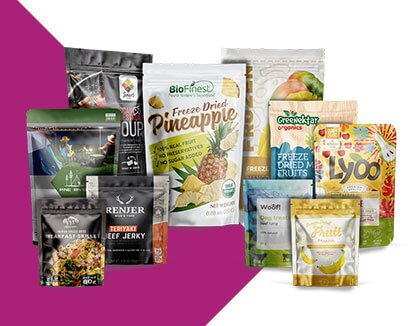
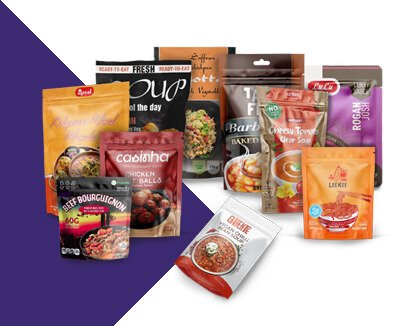
    A family group shot of Printed Dried Fruit Pouches Freeze Dried Fruits Flexible Plastic Doypack Packaging

    In the start-up phase of your business, figuring out your packaging inventory management is tough. There are plenty of formulas for calculating packaging inventory, plenty of rules about weeding out stale inventory, but using those inventory management formulas depends upon experience–a track record. And a track record, especially with warehouse operations and inventory tracking, is what your start-up does not have, as yet. And, if you are like most starting businesses, there is too much to do with too little money, so you don’t want to solve the inventory problem by “being on the safe side” (that is, overstocking raw material).

    Inventory management basics

    These are a few of the basic often cited for getting a handle on inventory:

    Use QuickBooks to manage vendor invoices and supply

    Use an inventory-tracking system with software suitable to the size of your business. One of the best-known management systems is QuickBooks, but there are many others. Your accountant can give you a hand here. There are inventory systems designed for small businesses. You and others in the company should become expert in using whatever system you choose.

     Fine-tune your managed inventory 

    You will want to fine-tune your forecasting once you have a track record. This way you never have too many corrugated boxes, and your vendors aren’t sending you an oversupply of products. 

    Brush up on packaging engineering terminology

    There are standard measures such as “identify low-turnover stock.”  The so-called Pareto principle says that about 80 percent of your sales will come from 20 percent of your sales items. That is something you can learn, and use, when you have more experience.

    Track inventory systems in real-time

    Today, you can quite easily track your stock in real-time with software that registers incoming inventory and sales. When this system is providing the required feedback, you can make orders for resupply automatic when inventory sells down to a certain point.

    Slash the lead-time for your boxes

    Slashing supplier lead-time, as we discuss, means that you can purchase new inventory closer to the time that you actually need it. But be sure that your supplier can deliver according to the promised schedule.

    But keep in mind that whatever handle you get on ordinary inventory needs, the arrival of the holiday season probably demands a different plan and different calculations. Many businesses do a surprisingly large percentage of their entire annual business in the weeks around the holidays.  To be caught short of inventory then presents a double dilemma. You can’t sell what you don’t have and your suppliers are under pressure during the holiday season just as you are.

    Your packaging inventory

    At Carepac, where our business is designing and manufacturing bags, we see new firms struggling with these problems all the time. If your product requires packaging—then, no packaging, no sales. What is more, designing the right package not only protects the quality of your product (freshness, protection from moisture); the right package is pivotal to good marketing and especially the “point of sale” appeal of your product.

    Retort Pouch Ready To Eat Flexible Food Packaging

    As a start-up, simply do your best at budgeting and forecasting, but you can do it better with help from your accounting, marketing, and sales colleagues. Given your financial expectations for the first month, six months, and year, how many bags will you have to sell? Your business may not have a track-record, as yet, but other businesses of similar size with similar products in your market do have experience that you can extrapolate to your situation. There are local organizations such as your Chamber of Commerce and literally hundreds of online groups where small businesses of every kind, in every field, regularly exchange information and hash out problems they all face together.

    Also, your salesmen and advertising consultants probably have goals. Are they approaching potential buyers for large orders? What do they see as the prospects?  And, if you get those accounts, will you face a long lead-time in delivering because your packaging is not ready?

    Warehouse lead time

    Lead-time also can be significant in other ways. If possible, when ordering your bags or other inventory, you want to avoid a premium charge for rush jobs. Most suppliers, and certainly Carepac, have a backlog to fill in the order received. Make no mistake, the supplier wants your business. At Carepac, we make every effort to accommodate deadlines on orders; but we also want to be fair to our current customers.

    Let our highly experienced professionals discuss with you a lead-time for ordering that is neither unnecessarily long nor unrealistically short. We take packaging seriously, of course, as should you, and we advise an early consultation to leave time for innovative design that speaks to meeting your distinctive needs, care in manufacturing and quality control, shipping, and any changes you might want to discuss when you receive your order. We are there at every step in the process and when you get in touch, you talk with a real person at any time you wish.  We reserve email, online chat, and other avenues of communication for more routine matters.

    The consultation is free, the online price estimate is free, and we are ready to talk whenever you are ready. The challenge of supply chains and controlling inventory for the lowest cost and greatest sales effectiveness never changes—but how you choose to deal with the challenge certainly can change. We want to discuss how we can help in your own stage of business development from start-up to maximal growth.

    Getting in touch with Carepac

    Your first step is to reach out to Carepac for a wealth of information on every aspect of packaging, for your free estimate, and for consultation with our specialists on all phases of producing the right packaging for your product—and getting it to you when you need it.

    Contact us now!

    And be sure to check back here regularly for information, insights, and updates on these and many more issues.

    For a quick daily “hello” and update, follow us on Twitter for new offers, reports on new developments in the field, and tip about conditions affecting the challenges we both face.

  • Stand Up Pouch Manufacturing 101: How Stand-Up Pouches are Made

    Stand Up Pouch Manufacturing 101: How Stand-Up Pouches are Made

    Stand Up Pouch Manufacturing 

    101: How Stand-Up Pouches are

    Made

    The first stand-up pouch was manufactured via stand up pouch manufacturing in 1963. Originally two flat sheets were sealed together, but that basic design has gone through a series of improvements as companies pursue durability and aesthetics that make the packaging attractive to consumers.

    Stand up pouches use fewer resources than conventional packaging such as boxes and cartons. They can also be highly personalized making them the truly modern way to package products.

    These bags are air and watertight which makes them ideal for packaging food, chemicals, some types of clothing, etc. They also give companies an avenue to market their brands. That’s why packaging suppliers are always coming up with new features to accommodate branding needs.

    The latest features on these bags include zippers, spouts, and top holes that make pouring liquid or powder content less messy.

    So how is a stand up pouch manufactured to achieve durability, functionality, and even preserve the environment? Read on to find out and email us to get started! Continue to learn more about what to expect from stand up pouch manufacturers. 

    The Process

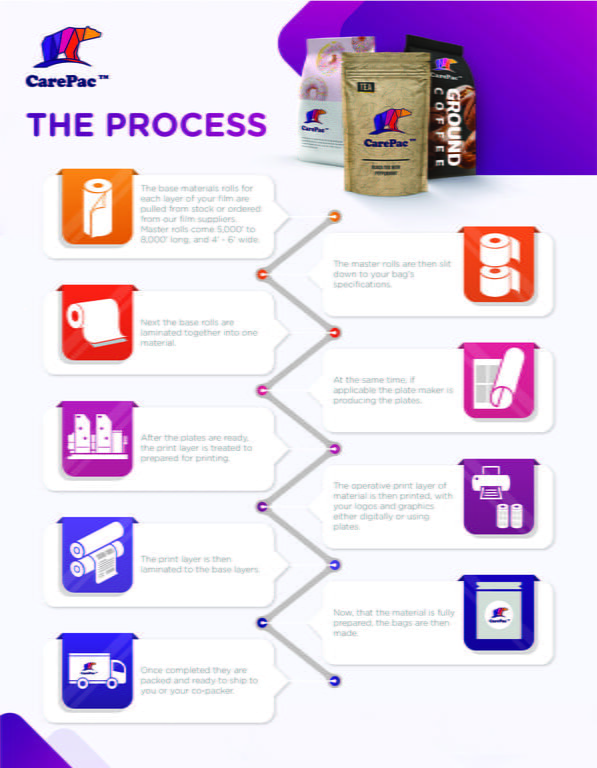
    Continue to read to learn more about the pouch manufacturing process. Stand up packaging bags are built from plastic composed of a resin of granular polyethylene. This composition makes it easy to melt and flatten into different shapes.

    This material is then used to create a long polyethylene tube. This tube can be over a mile long, but the cloth used to make it has a width of less than a tenth of a millimeter. This tube is allowed to cool before being flattened by a series of rollers into a long strip of plastic. The strip is wound on a cylinder to form a sheet.

    Each bag has several films with each one made with materials that play into the water-proof and airtight features of the bag. Manufacturers select the materials carefully to ensure the packs are also durable.

    The innermost layer keeps the content quality intact. It also comes into direct contact with the pack’s content. Therefore, it is made of the polymer LLDPE which is FDA-approved.

    The outermost layer often bears the company name and other branding messages. Manufacturers use alcohol-based ink to print words and images on these packs.

    When the middle layer material is not made of clear material, it serves as a protective and branding layer. To achieve this, manufacturers opt for aluminum or films infused with metal or resin.  Some companies choose kraft paper material for the outermost layer because it looks natural. Kraft material is also durable and has a texture designed to make branding easy.

    These layers are then cut into different sizes and shapes then stuck together through sealing by applying heat. A large conversion machine receives the finished film roll. The film is cut into various parts as it goes through the system, forming the top part, rear, and underside of the stand up pouch. 

    Gussets are the bottom part and the reason a stand up pouch can stand. Part of the material used to make the rest of the bag goes through a machine that folds a perfect W-shaped gusset.

    Functionality features are added separately depending on the pack. For example, spaces for handles are created through cutting with stamps. Zip locks are bound to the pack through heat.  Perforations indicating where to cut are also added at the last bit in the process.

    The layers must be cured in a special high-temperature drying chamber after the lamination process. If laminated films are not properly cured, they can peel apart days or weeks after the bags are completed. Drying takes 2–4 days, and regardless of the deadline, this part cannot be rushed.

    However, not all stand up packs are of good quality. Like with every other products, the cheaper they are, the poorer their quality.

    In the United States, stand up bags use is rapidly on the rise. Traditional packaging techniques, which are bulkier, more expensive to manufacture, less consumer-friendly, and consume a lot of resources, are rapidly being replaced by these bags.

    Printing Pouches

    There are many kinds of stand-up bags such as, shaped, spouted, liquid, printed, box, retort, foil barrier, inverted, wicket, frangible seal, multi-compartment, EZ-stand and reclosable pouch which breaks into the zipper, hook & loop, slider, and press-to-close categories.

    All of them go through different kinds of printing depending on market needs. The following printing methods are widely used to print logos, names, and other aesthetics on stand-up bags.

    Plate Printing

    The most economic and versatile way to print stand up pouches is with Rotogravure plate printing. Thus, most stand-up bags go through plate printing to add the desired look and information of the top part. The printer has different cylinders which contain different colors that make up the entire design.

    Plate printing offers a very wide color range. Digital printing uses direct surface printing ink  which only uses cyan, magenta, and yellow, black and white. Moreover, with plate printing, you can play around with a mixture of gloss and matte.

    Digital Printing

    The ink used in digital printing does not permeate the substrate being printed on in many cases. It instead forms a thin layer on the substrate, which it adheres to further with UV curing or laser heating.

    The main disadvantage of digital printing is that it is a more expensive method of printing on a basic level; as a result, digital printing is not recommended for long runs. Another significant limitation is its inability to match PMS colors. You can’t have a mix of gloss and matte either. You can only go all matte or all gloss.

    The digital printing method is not economically viable for big runs of up more than 5000 pieces. Multimillion-dollar firms may afford it but smaller firms are left to choose between the cost of buying raw materials and ordering attractive packaging.

    If you’re planning a high-color-count, a short-run project like trial runs, digitally printed stand-up bags are a good option. They are useful too when dealing with a constantly changing regulatory climate or have a lot of SKUs.

    Flexography Printing

    Loosely called flexo, flexography is a printing technique that employs a flexible (rather than a solid) plate. It’s a more recent version of relief printing. Flexo printing is a popular method also used to print graphics, text, and images on stand-up pouches. Flexo printing is often used by a manufacturer on compostable bags to print directly on an outermost paper layer. 

    Get Your Custom Printed Stand Up Pouch Design Made Here

    Now, you know more about the pouch manufacturing process. In a world where first impressions are everything, we’ll help you step it up and get custom pouches for your products regardless of your industry. Contact us today to order samples and get an quick online quote. Email today! We’re a top manufacturer in the country. How Stand Up Pouches are Made - Bags 101 (1)

  • Why Do My Bags Blowout? The #1 Unfortunate Reason Why

    Why Do My Bags Blowout? The #1 Unfortunate Reason Why

    If you’re wondering why you’re dealing with bag blowout, you are not alone. This issue is both frustrating and costly, yet an exceedingly common issue faced by many customers.

    • Do you see ripped or torn edges? 
    • Do you have tears in the middle of the material or along the sides of seams, or along crease lines? 
    • Is the film next to the seal tearing away? 

    If so, you have a classic bag blowout. The two most common factors that cause bags to fail or “blowout” (i.e. tear or rip due to internal pressure) are: 

    • inadequate film strength for the application and/or 
    • logistical path issues.

    It is important to consider the thickness/strength of the film vs. the weight of the product.

    • Weight and density of your contents
    • Reactivity of your contents
    • Do your contents out gas?
    • Are the contents prone to transferring weight loads (powders, and liquids) or are they more absorptive of impacts?

    Since most pouches are also used for marketing, it’s important to keep the cosmetic aspects of the film in mind as well as the strength.


    Film Strength


    Film strength is one of the first things to consider when reducing bag blowouts. The number of layers and composition of lamination layers. Choosing structures with layers that are specifically included for strength, like Nylon or EVOH, PFRA, etc will also help strengthen the pouch to handle the weight of the product inside and transportation pressure. We recommend doing appropriate in-house testing to determine the suitability of a new film to your product’s application before going into production.


    [sitetitle] Can Help

    We offer small runs of as low as 5,000 bags per size to allow you to perform testing on new configurations or materials before going into full scale production environment.

    bags blowout


    Logistics Path:

    You should evaluate the logistical path your bags are taking:

    • How many pouches are having “blowouts”? Is it only a handful relative to the size of the order?
    • Double check that master packaging standards are in place and being followed
    • Always put the same number of bags per box.
    • Inner packaging is the same in each box.
    • The bags are being filled with the same exact weight of product.
    • Protective packaging procedures, are the bags being protected from drop loads in transit?
    • If out-gassing is an issue, consider adding a de-gassing valve.
    • Air freight; low pressure environments cause pouches to expand if you have not gas flushed.

    Certain logistical paths (most notably amazon.com) are very hard on pouches. They can experience drops, rough handling and abrasions. Pouches must be protected from abrasion and built for expected drop loads.


    The logistical route the pouch takes can also influence the state of the pouch between the time of filling and when it eventually ends up in the end user’s hands. We advise that you “build” your pouch for the worst case scenario in the logistical path (this includes a thoughtful consideration of the film strength mentioned above, along with feature placement, seal width, and bag weight).


    Bag Blowouts Can Be Prevented

    We sell flexible barrier packaging for hundreds of applications, each with unique characteristics: storage conditions, handling, loading, subsequent transport, method or equipment used to seal, or vacuum, and the composition or reactivity of contents placed in the bag and end user use characteristics. We can help you determine which materials and films are best for your project.


  • How to Reduce Packaging Costs

    How to Reduce Packaging Costs

    There is a lot that goes into running a business that is efficient and successful. Running a business takes passion, persistence, dedication, and, of course, money. From paying salaries and rent to product testing and marketing, the obvious expenses are big and add up fast. If you are not careful and never minimize or reduce packaging costs, you might be overwhelmed.

    Luckily, there are several areas to consider when it comes time to be more efficient and cut costs. One of the areas to consider is reducing your cost for stand-up pouch packaging. Here is a guide on 10 easy great ways you can make an impact and save money on stand-up pouch packaging and other custom packaging.

    1. Print In A Single Color to Reduce Packaging Costs

    First in this guide is choosing different colors for your packing materials. From a logistics standpoint, it makes your packaging attractive which means you may sell more product. A 2013 study revealed that attractive packaging stimulates the brain’s reward-seeking areas that are linked with impulse buying.

    However, it is important to note that when you have a multiple-color design, you pay more. This is because more ink will be used, and mixing several colors for your mailer is also costly.

    The good thing is that even one-color designs will look great if you pick the right color. Spend some time identifying the colors used in your industry so you know which colors attract more customers and will set you apart from your competition. 

    .stand-up pouch packaging

    2. Using Plate Printing for Your Packaging

    Digital printing is all the rage but you can often save money by using plate printing. Plate printing uses a thin aluminum plate to transfer your design onto the pouch. Most jobs can be completed with four plates for less if you use limited colors. This is one way to optimize how much you spend on packaging and flyers. 

    3. Print Fewer Bags & Minimize Order Amount

    Printing more bags is always cost-effective, but what is the point of having more if you end up not using all of them. If you are a startup and unsure how much product you will move, the best approach would be to print the Minimum Order Quantity (MOQ). That way, you won’t spend as much initially and can reorder as needed. At [sitetitle] we have low MOQs, only 5,000 bags, allowing you to optimize your order value. 

    4. Be Aware Of Government Standards for Packaging

    Staying compliant with the state’s laws on any type of packaging is very crucial to avoid hefty fines that can leave your business crying for help. For example, if selling weed, a state like Alaska will require your stand-up pouches to be child-resistant and opaque. Colorado requires displaying a specific message on cannabis products. Not meeting requirements by states can be costly to your business in the long run. Government standards are not to be messed with if you want to run your business peacefully.

    5. Choose The Right Material for Your Packaging

    The material you decide to use for your operations and manufacturing can be the difference between spending more and saving money on stand-up packaging. That is why it is crucial to be certain about the material you want to use, as some materials are more costly than others. For example, does the use of CareSilver mylar save you money? Or will clear material do? These are some of the questions you need to ask yourself to choose the right material.

    6. Know How Heavy the Product You’re Packing Is

    When moving cargo from a warehouse, its size, and weight can help you pick the right vehicle for the task. Similarly, when it comes to stand-up packaging, your products’ size and weight are key to determining the material needed for packaging.

    If packing heavy products, that will mean going for packaging materials that can hold more weight. The same applies if your products are light. Get stand-up pouches designed from material that can hold them intact during transit and limit the amount of bag blowouts.

    7. Decide What Features You Want To Be Included

    Additional features (zip locks, pour spouts, tear notches, etc.) added to your stand-up pouches come with an extra cost. The good news is that your pouches can still be functional with only critical features, like hang holes. Our team at [sitetitle] can help you decide which features are crucial.

    8. Plan Ahead & Reduce Failed Deliveries

    Rushing the last minute is not recommended in business unless it is very urgent. Ensure you have enough time and plan ahead to avoid steep shipping costs for rush jobs on your stand-up pouches. Be sure to call our team when you notice your bag supply running low and we’ll help you get the best price. You might also want to consider carbon neutral shipping. 

    9. Reduce The Costs Of The Artwork

    A well-designed stand-up pouch looks amazing and can boost sales as the right colors and design stimulate impulse buying. But the truth is, your pouches don’t have to be filled with artwork to attract buyers. A well-thought out design can grab the attention of customers. Save money by working with a designer familiar with packaging design as they can help you focus on what is vital to your business. Keep in mind that the more artwork is included in the design, the more you will pay.

    10. Go With Stock Pouches As A Last Resort And Print Your Packaging Label for Deliveries

    Stock stand-up pouches will save you money if you are just starting out. The best thing with stock stand-up pouches is that they are readily available and can be shipped to you in a few days. It will let you test various designs and find out which products customers like best. If you go this route we recommend making sure your label is well printed and you test it on your bag before you print a whole batch of labels.

    High-quality, customized stand-up pouches can make your products fly off the shelf faster than those of your competitors. [sitetitle] has stand-up pouches for your product no matter what you are selling. Whether you need 2-seal pouches, square bottom pouches, or stand-up pouches, [sitetitle] is the packaging supplier you can count on. Get an quick online quote today tailored to your budget and watch your products fly off the shelf like never before — all at a reduced rate and sent direct to your door.