Category: Other Packaging Topics

  • The Carepac Difference

    The Carepac Difference

    The Carepac Difference

    You Only Get One Chance to Make a Good First Impression

    We Offer the Best Quality AND Price

    We know you’re passionate about your products. That’s why it’s important to choose the right packaging, but not on price alone.If you simply go the cheapest route, it might just cost you the price of your brand’s reputation. We all know you get what you pay for, and quite often those overseas “affordable” options are riddled with issues.

    This is what we hear from our customers that went that route:

    “The bags don’t seal correctly.””The labels are poorly printed.””The quality is terrible and the bag rips easily.”And the worst part is that they are stuck with a container load of bad packaging because they were forced to order a huge quantity to get the best price. But that’s STILL not the worst of it.

    Packaging sets the tone for products and might be the first physical contact you make with customers.

    So if you’re going to make a good impression, you need solid packaging, with a fast turnaround time—and, if possible, a great price.

    That’s why we’ve got a deal our competitors can’t beat: we match any competitor’s price within 5%. Plus, we have legendary customer service to keep your business rolling, and we’re located right here in the U.S.A.—so you don’t have to worry about nightmare overseas delays. After partnering with us, you’ll never go back to those cheap knock-offs that left you holding the bag.

    Free Packaging Consultation

    If you’re thinking about packaging for your product, you’re probably ready to gather as much information as possible. That’s why we’re now offering FREE Packaging Consultations

    During your call, our team members will provide clarity on:

     – Best materials for your packaging

     – Sizing and features

     – Pricing ideas

     – Lead-time options

    Design services

    Not only will you walk away with an action plan for your packaging, but you can explore if CarePac is a good fit for your products.

    Add Us to Your Address Book

    P.S. If you haven’t done so already, be sure to add Carepac to your address book so you don’t miss out on exclusive updates, promotions, or exciting new features.

    What Others Are Saying…

    “The bags are terrific! We were hand-labeling for years and it was time to take it to the next level with professionally printed pouches. We had our design in place and knew our size. With that in hand, the Carepac team took over with great pricing and communication from start to finish. I’m delighted with the finished bags and they’re helping us sell more product.”

    —Jeff Ozark, Funky Fido Dog Treats

    5% Price Match Guarantee!

    Your first step is to reach out to Carepac for a wealth of information on every aspect of packaging, for your free estimate, and for consultation with our specialists on all phases of producing the right packaging for your product—and getting it to you when you need it.

    Got a new project? Email us about it.

    And be sure to check back here regularly for information, insights, and updates on these and many more issues.

    For a quick daily “hello” and update, follow us on Twitter for new offers, reports on new developments in the field, and tip about conditions affecting the challenges we both face.

  • CarePac Top 10 Tips

    CarePac Top 10 Tips

    Save Time & Money

    Skip the Trial and Error

    Congratulations on creating an awesome product—and kudos for taking the time to thoroughly consider your packaging options. Customizing your pouches or bags to fit your brand’s unique visual identity is the best way to make your product stand out on the shelves.With all the different packaging companies out there and so many pouch configurations and materials to choose from, what starts as a fun and creative project can quickly turn into an inventory nightmare—if you’re unprepared.We want to keep the process fun and simple for you. So, without further ado, here are our top ten must-read blog posts for those new to the custom packaging industry.

    Choose the Right Material

    The type of flexible barrier packaging you choose ultimately depends on your product. It’s important to learn more about how moisture, oxygen, and different packaging materials might affect your product’s shelf life. Here’s Everything You Need to Know About Flexible Barrier Packaging. Flexible Barrier Packaging.

    Go Custom & Increase Sales

    Maybe you’ve decided on the quantity and size of your bags… but have you thought about which colors will resonate with your customers’ emotions? Is your package designed to be displayed on a shelf and hung on a hook? Learn these essential money-making details you may be overlooking.

    Sourcing From China: Think Twice

    We all know that if a price seems too good to be true, then it probably is. We’ve heard so many stories of regret from customers who previously worked with Chinese manufacturers that we felt compelled to put together a list based on their most common complaints. Heed their warnings of going into business with these “cheap” overseas companies.

    Know All of Your Pricing Factors

    Many variables impact the price of a customized stand-up pouch. The size and quantity of your bags and the urgency of your order are the first things that come to mind, but secondary factors such as materials and printing methods can also significantly affect your costs. View a breakdown of every financial factor and get an idea of what you can expect to spend on your order.

    Consider Eco-Friendly Options

    Packaging your product with biodegradable material may be more achievable than you think. Learn more about the latest sustainable packaging trends and see a transparent overview of the traditional versus green packaging dilemma.

    Ask The Right Questions

    Are you still in the research phase of finding your flexible packaging provider? Review this list to make sure you’re asking all the right questions when you start consulting with bag manufacturers.

    Avoid Common Design Mistakes

    There are a few traps that are easy to fall into when designing your first custom printed bags, such as creating a bag design that you like as opposed to creating a design that your customerswill respond to. Save time and money by reading this list of mistakes we catch all too often.

    Forecast Your Inventory Needs

    So you have an awesome product that’s designed to fly off the shelves—but if this is your first batch on the market, it can be tough to know how soon you’ll need to restock. We’ll help you find the balance between tying up too much money in inventory and missing out on sales due to lack of supplies.

    Shop Around

    Don’t settle for the first packaging provider that you find (even if it’s us). During your research, you’re almost guaranteed to come across two of our competitors: ePac and Roastar. View our competition overview to quickly see each company’s available materials, bag configurations, and printing options compared to ours.

    Cut Cost Where It Makes Sense

    When our friends or family ask us for the inside scoop on how to save money on packaging, we tell them exactly what’s in this article—so why would we tell you anything different? We want you to be happy with the bags you order, even if it means scaling back your initial orders and ultimately spending less money with us. Do what’s best for your business!

    If you read these 10 tips alone, then you’re already ahead of the game. Looking to go the extra mile? We have several other blog posts to provide you with even more insight. And if you still have questions about packaging your specific product, we’re here to help. Give us a call and talk to a real person to discuss your options or fill out our inquiry form.

  • How to Properly Seal Your Mylar Bags for Food Storage

    How to Properly Seal Your Mylar Bags for Food Storage

    How to Seal Mylar Bags for Food Storage

    Tips for Sealing Bags

    How to Seal Mylar Bags for Food Storage

    How to Seal Mylar Bags Easily for Long Term Food Storage Custom Printed Stand Up PouchesSealing your mylar bags after loading them is the critical last step before your bulk product is ready to leave your facility and journey to your customer. If your printed mylar bags are not properly or adequately sealed, your product could fall out of its container or prematurely go stale in the pantry, neither of which is ideal for your customer.

    Types of Food Storage Sealing Options 

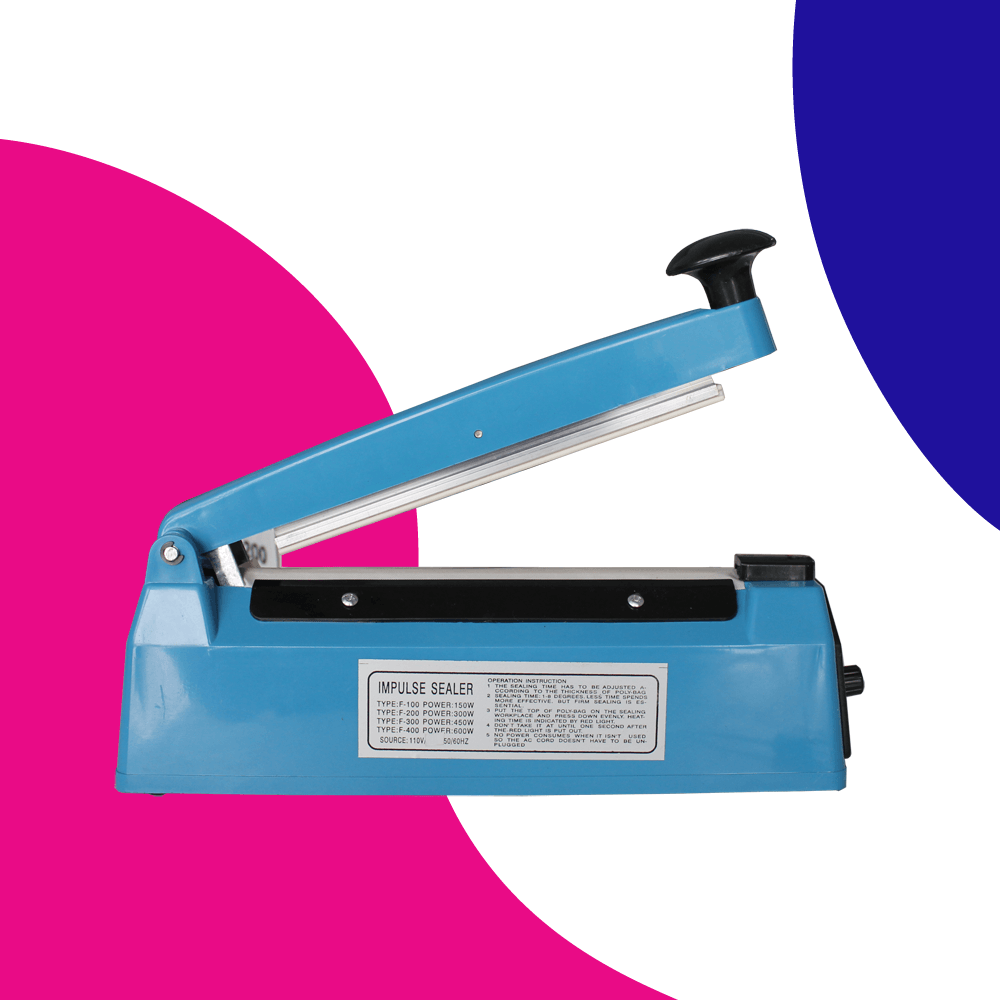
    When it comes to properly (and professionally) sealing mylar storage bags for storinglong-term, there are four different options: impulse sealing, direct heat sealing, band sealing, or chamber vacuum sealing. Each has its own pros and cons, which you can learn more about below.Manual Heat Sealing Packing Machine for Plastic Bag Heat electric sealing machine impulse sealer

    Impulse Seal

    Impulse seals are inexpensive (starting at around $30 – $100) and provide a quick seal using a pulse of energy through the seal bars. Impulse sealers only turn on when the sealing bars are lowered onto the vacuum seal rolls.

    Positives

    Negatives

    Inexpensive

    Less control that band sealers

    Instant Sealing

    Small Seal zone

    Best for occasional use

    Manual bag line up creates inconsistent seals

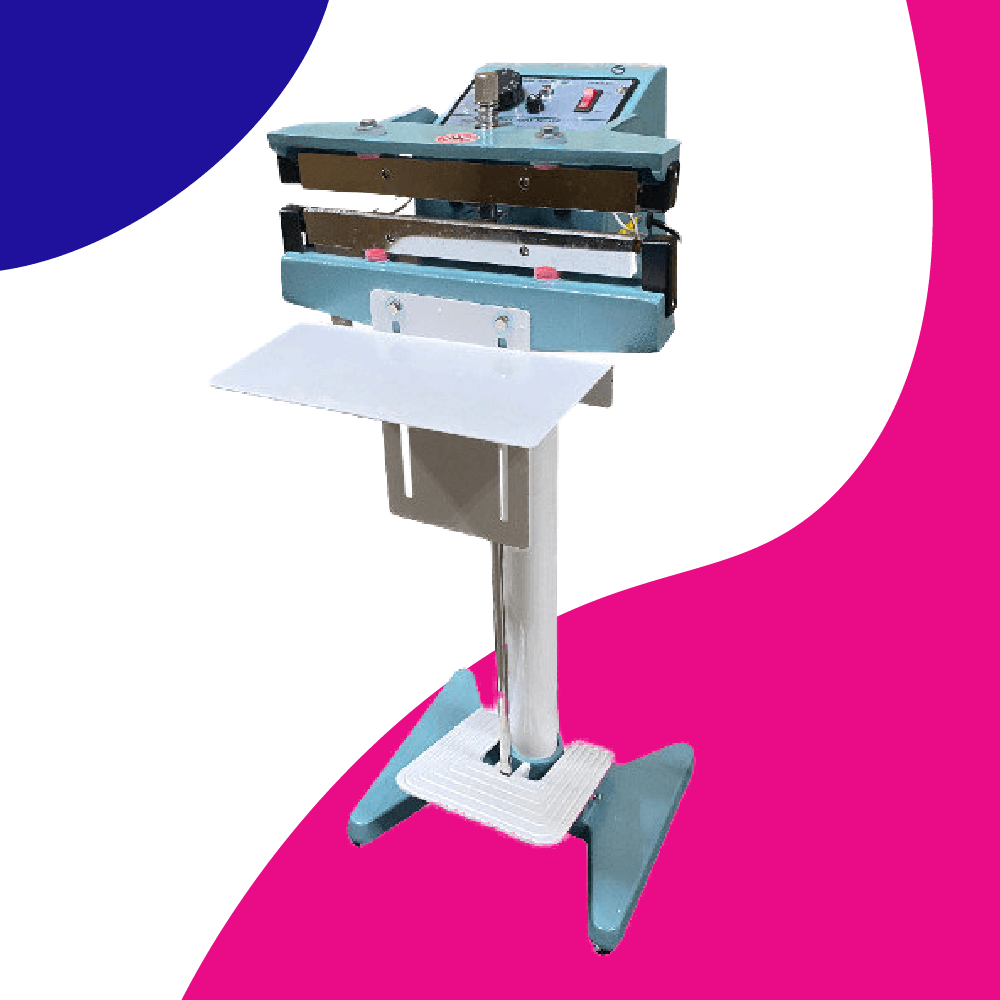
    Manual Foot Pedal Sealing Machine Direct Heat Sealer for Bags and Films with Printer and Heating Sealing Machine and Impulse Sealing Machine

    Direct Heat Manual Seal

    Direct heat sealers maintain consistent and constant heat as long as they are turned on. This can allow for better heat penetration and better seal tack.

    Positives

    Negatives

    Best for thick materials

    Cannot seal polyethylene

    Industrial bags o irregular bags

    Slower than band sealers

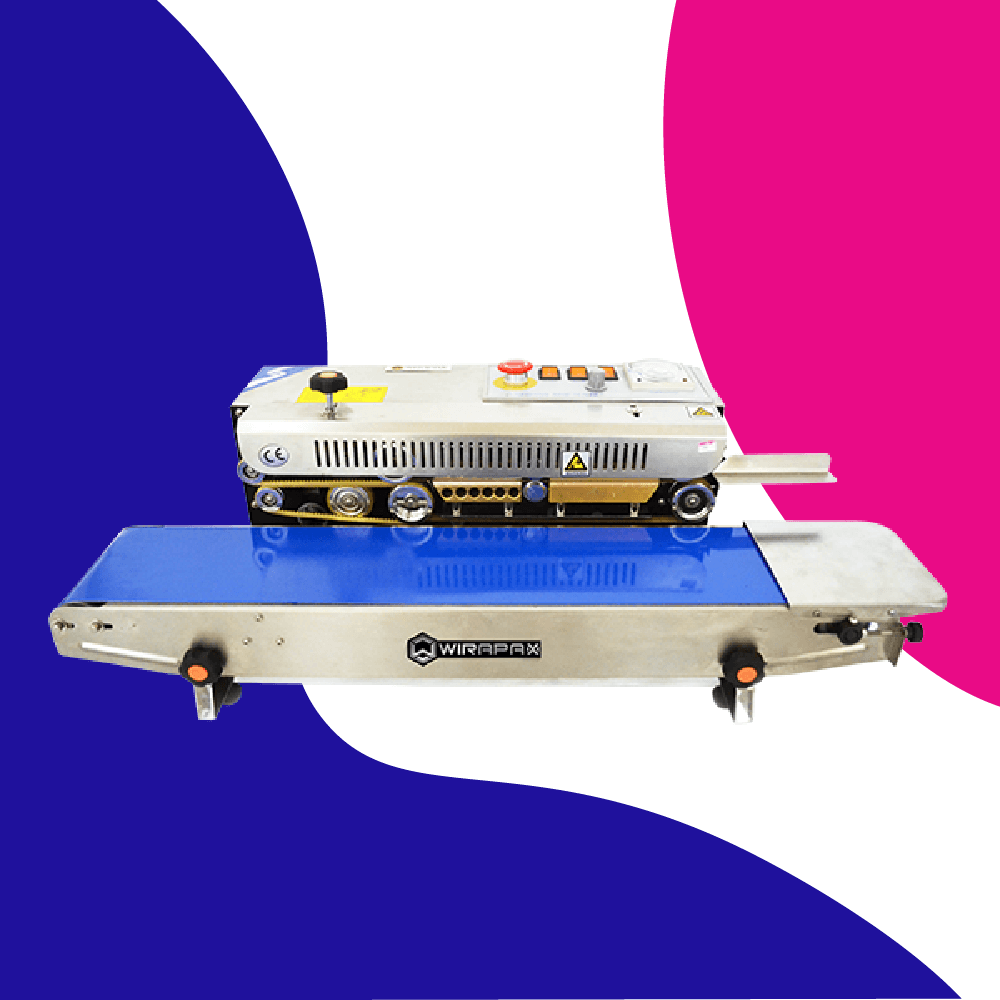
    Heavy Duty Continuous Band Sealer Sealing Machine Automatic Band Sealer Machine Horizontal Packing Machine

    Band Seal

    A band sealer is a semiautomatic sealing machine. Unlike a manual sealer, a band sealer contains both heating and cooling elements. The hot and cool elements combine to create strong, durable, and professional seals on your bags. These direct heat-style sealers typically have separate controls for both temperature and dwell time. A small conveyor with speed controls will pull your bag through the sealing mechanisms, and once set up, hundreds of bags can be processed at one time. 

    Positives

    Negatives

    Very consistent seals seal hundreds of bags in a single use

    More expensive $500+

    Accessories such as date code, serial number stamping

    Not ideal for sealing a few bags occasionally 

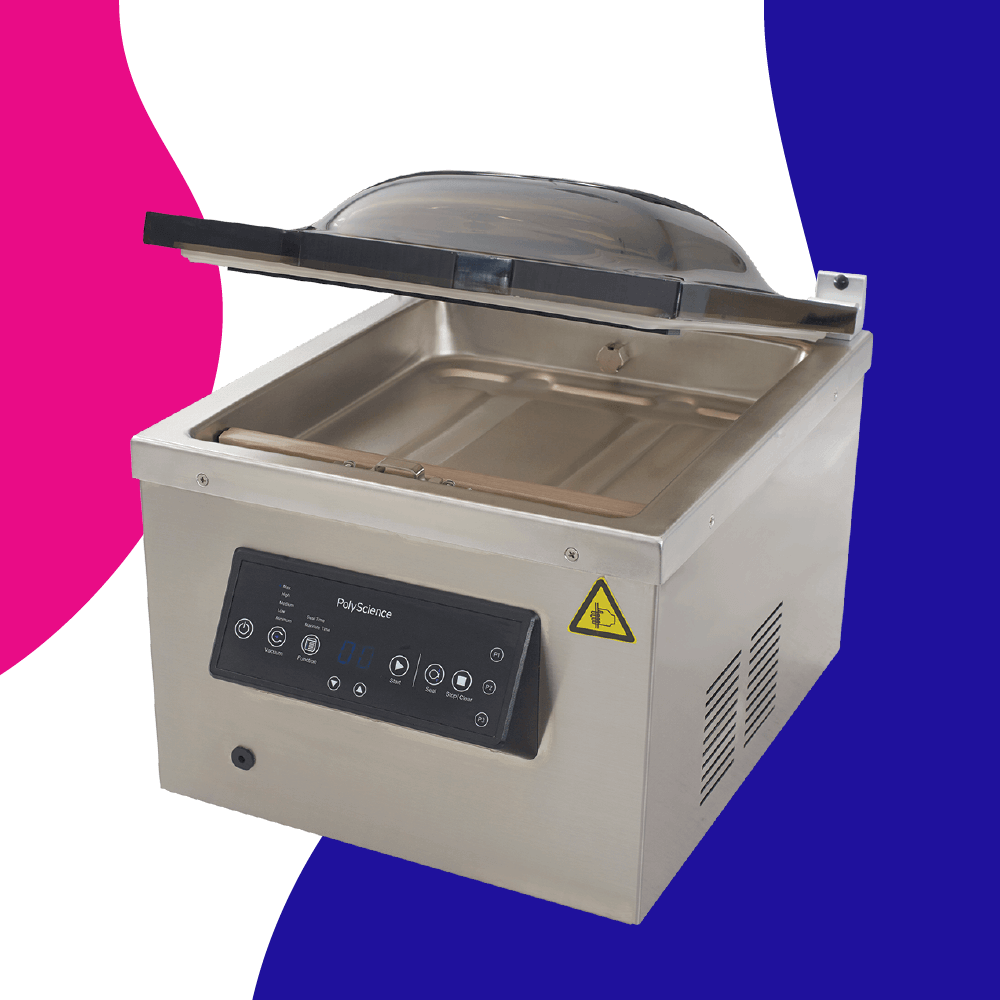
    Chamber Vacuum Sealer Kitchen Food Chamber Vacuum Sealer Packaging Machine Sealer for Food Saver, Home, Commercial

    Chamber Vacuum Seal

    Chamber vacuum sealers can be used to seal certain types of mylar bags. These machines are different than the traditional “at home” or food-saving type vacuum sealers that are used by preppers in their home kitchen to vacuum seal bags. A chamber vacuum sealer will both vacuum out most of the air from the bag and also heat seal it at the same time.

    Positives

    Negatives

    Removes oxygen from the pouch extending shelf life. 

    Not compatible with all materials. 

    Print can get distorted when the bag is vacuum sealed. 

    Quality chamber sealers start at around $850. 

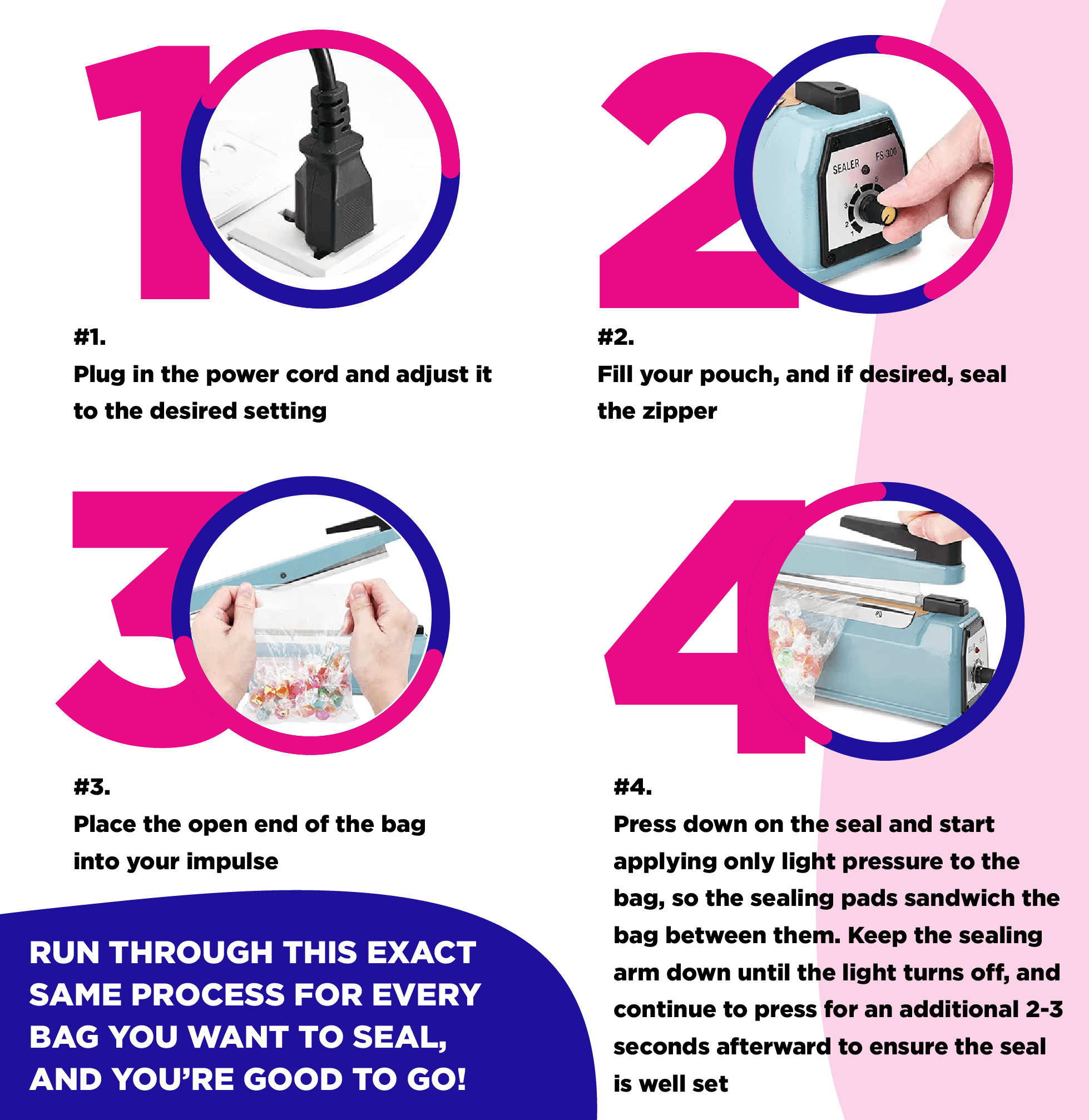
    Sealing mylar bags with an impulse sealer

    If you have an impulse sealer, here’s a visual of how you’d use it to seal a mylar bag. We’ll walk you through the process step-by-step below.Manual Heat Sealing Packing Machine for Plastic Bag Heat electric sealing machine impulse sealer

    Heat Sealer Heat Setting- Food Storage

    The question is often asked “What temperature setting do I use to seal my bags?” This question is pretty straight forward but the answer to it can be effected by many variables. Setting your heat-sealing machine to the right temperature is only one factor. Other factors include how long heat is applied to the material (dwell), and how much pressure you apply while sealing. One temperature, Dwell, and PSI setting is not uniformly recommended for each material. For example a better seal can sometimes be obtained with a lower temperature allowed to dwell longer allowing the sealant layer polymers to fully melt together.

    Material

    Temperature Setting Range

    PSI

    Dwell Time

    CareSilver (VMPET)

    350F – 400 F

    40 PSI

    1 Sec

    CareFoil (Aluminum) 

    400 F – 450 F

    40 PSI

    1 Sec – 1.5 Sec

    CareFoil-N (Nylon)

    450 F – 500 F

    40 PSI

    1.5 – 3 Sec

    CareKraft (Kraft Paper)

    400 F 425 F

    50 PSI

    2 Sec

    CareClear (PET)

    350 F – 375 F

    40 PSI

    1 Sec

    Factors effecting heat sealing settings to use

    Many customers focus on the machine settings when dialing in their heat seal settings, but all the factors below should come into consideration to get the highest strength heat seal.

    Material Type

    Seal strength, and sealer machine settings will be adjusted to the physical properties of the material  being sealed to. Clear PET based material generally will use different settings than nylon or foil based material. The material thickness, flange or surface design, physical pouch configuration, size, and feature placement will also be considerations. Some materials like Carefoil reduce the amount of heat that can get through to the sealant layer so they require more heat or long dwell time. Material Thickness can effect the overall mount of dwell that is required. 

    Dwell

    Dwell time relates to how long heat is applied to the pouch. Heat and dwell time are not independent variables, they go hand in hand and should not be evaluated separately. Dwell time requires adjustment based on the same factors that effect temperature. Some heat sealable flexible barrier materials require lower heat for a longer time to properly sell. While you can “seal” a bag with high heat for a short duration. The sealant layer may not form a high strength bond. 

    PSI

    The pressure at which heat is applied to the pouch can effect bag seal strength.The amount of pressure applied by the heat-sealing equipment will create differences in the heat and dwell settings.  Thicker materials and those which are more rigid such as CareKraft require more pressure, while with thinner materials if too much pressure is applied the heated selant layer can be pressed too thin. 

    Fouling

    Fouling can occur during the loading process particles, dust, or liquid we left in the sealing zone. If so, these contaminates can affect the settlings required on your sealing machine to seal the bag properly. Foreign material in the seal zone can also reduce the seal effectiveness. Powder products are notorious for causing fouling. Dust acts like corn meal on the bottom of a baking pan inhibiting the polymers from adhering to each other. 

    Type of Machine

    The type and condition of your heat-sealing machine will create another variable to consider.  There are several types of heat-sealing machines and how these machines apply heat. Types of heat sealers include Impulse sealers, roller sealers, platen seal.  

    External Environment

    There isn’t going to be an exact specification because proper temperature will vary widely based on the conditions mentioned in this article. But here are some of the settings that have been reported to us by customers, as well as our own understanding. 

    Tips for Sealing Mylar Bags

    If you’ve never sealed mylar bags before, here are some tips that can help:

    • The exact dial setting will vary depending on the thickness of your mylar bag, the ambient temperature, and whether there has been any fouling (foreign debris) that got into the seal area. 

    • Start with a lower setting and work your way up. You’re looking for a “just right” temperature where the inner sealant layer of the mylar bag fully melts together, but not too hot where the bag is deformed or fully melts. If the seal is too cold then the sealant layer will not fully melt together, and you’ll have a very weak seal.  

    • If you pull too much of a vacuum on your mylar bag, you’ll rip the bag. To create a high vacuum, certain types of mylar material like CareSilver-PVNP must be used.

    • Some products are very oxygen-sensitive, and exposure to oxygen causes oxidation and spoilage. An oxygen absorber can extend the shelf life of these products. 

    • An optional step to seal your mylar bags is to perform a nitrogen flush. With nitrogen flushing, the sealing machine will first vacuum out most of the air from the pouch, then replace it with.

    Mylar Bag Sealing: FAQs

    Here are a few of the questions we get a lot about sealing mylar bags for food storage. For more information, feel free to contact us directly. 

    Q: What thickness of seal should be used?

    Impulse sealers typically offer 2mm, 5mm, or 10mm seals. While thicker is usually better, you’ll want to adjust the thickness based on the type of product and bag. A 2mm seal is usually only suitable for thin polybags, most mylar bags should have at least a 5mm seal applied to it (for prospective ¼” is about 6.35mm), a 8mm or greater seal is often required to prevent bag bursting.

    Here are some typical considerations:

    1. Matching the other seals on your bag.

    2. Sealing the entire “top” of the bag is sometimes required. 

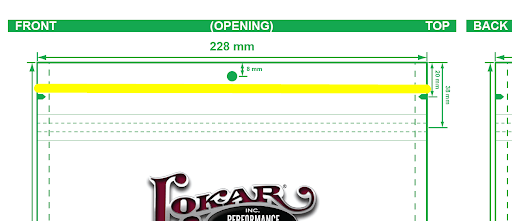
    Note: make sure that you never seal through or below the tear notch. Doing so will make your bag unable to be opened except by using scissors. 

    What thickness of seal should

    Q: Do you have to vacuum seal mylar bags for food storage?

    No, you don’t. 

    Q: What foods cannot be stored in mylar bags?

    Although most foods can be stored in mylar bags, there are some exceptions. Foods high in moisture or oil (raisins, nuts, granola, cookies, chocolate, crackers, brown rice) are not good candidates for storage in a mylar bag.

    Q: Do you need a special vacuum sealer for mylar bags?

    Yes, you’d need a chamber vacuum sealer. At-home food saver sealers cannot seal these mylar bags because they require the bag to have an embossed pattern to fill the air.

    Q: How much heat does it take to seal a mylar bag?

    It varies. You will likely need to go through a period of trial and error before determining what amount of heat is required.

    Q: Do you offer custom sized beauty packaging?

    Sealing bags for food storage is similar to sealing bags for retail. The key consideration includes investing in an inexpensive impulse sealer and adding oxygen absorbers, if necessary. 

  • Weed Measurements

    Weed Measurements

    How is Cannabis Sold By Weight | Cannabis Weights

    The most common cannabis measurements 

    Across the world, cannabis flower is usually measured in increments within an ounce – a gram, an eighth, a quarter, a half, and an ounce. Although cannabis can also be sold in another amount, like pounds, this is typically reserved for industrial spaces, as purchasing and possessing cannabis of this weight is illegal in most recreational, health, and medicinal markets in the United States. Yes, cannabis flower may be legal in one way or another in most states, but there are still regulations on the quantity and weights one can purchase on sale. 

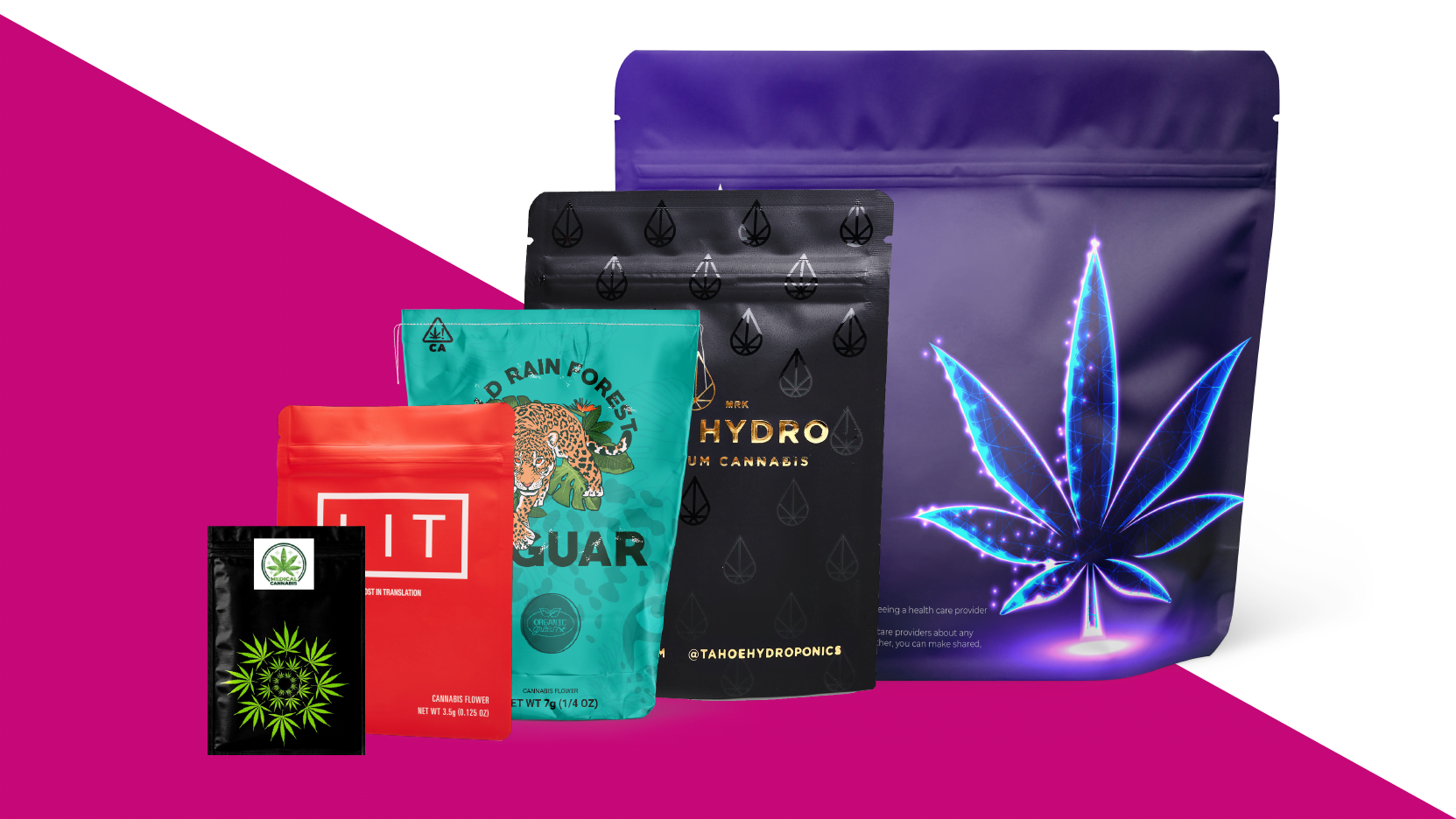
    Group picture of Stand Up Pouch" with  bottom gusset, rounded corners, zipper and tear-notch.

    At CarePac, all our CBD and THC packaging is made-to-order for dispensaries, meaning it can be purchased in any size, color, or material. For the purpose of this article, we’ll discuss the most common cannabis measurements so you can purchase the cannabis packaging in the size that’s right for your weed quantities. 

    Weed measurements 1: Gram 

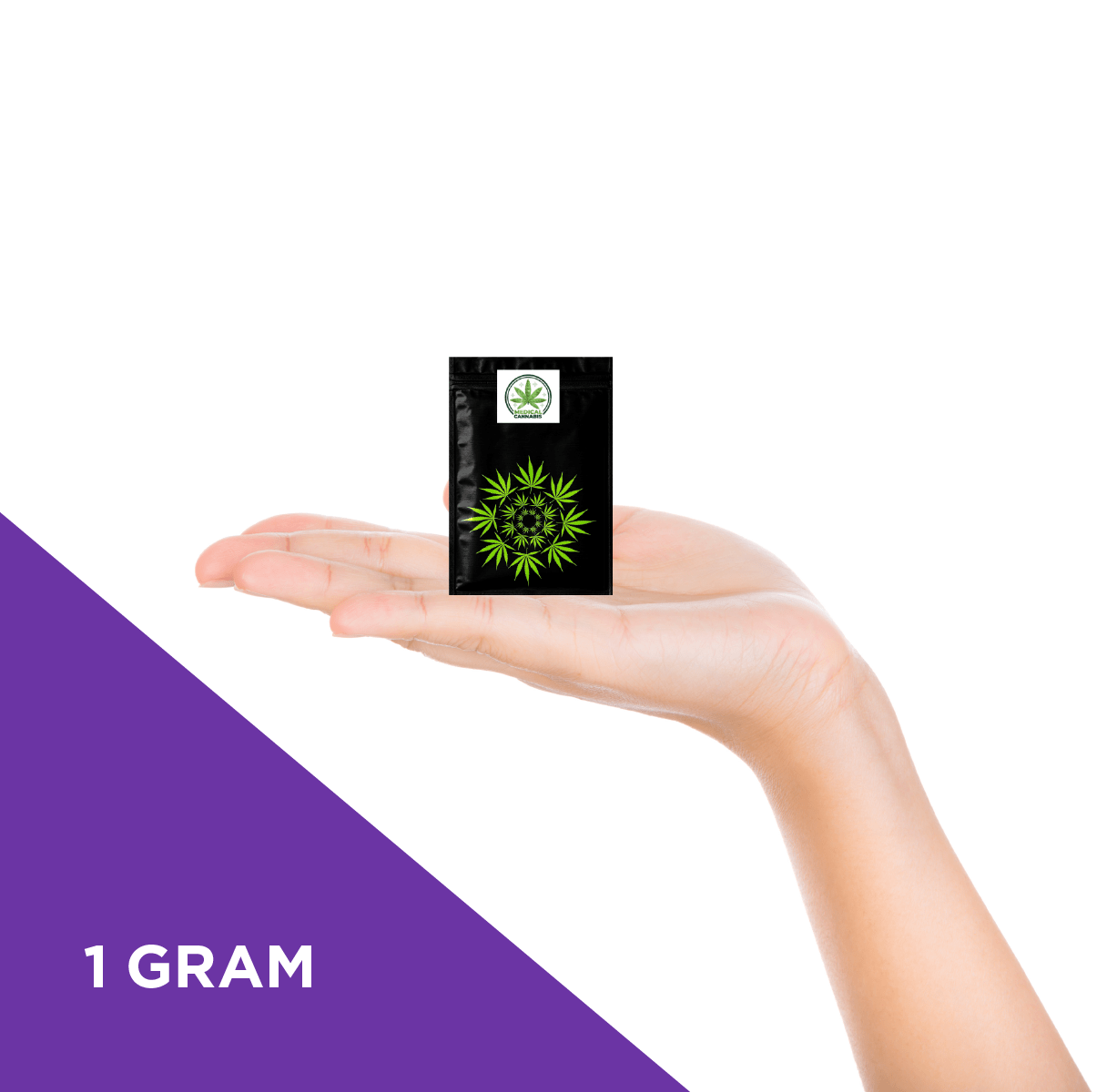
    Outside of one-hitters, a gram is the smallest weight of flower a customer can purchase at recreational or medical dispensaries. This size is often reserved for new customers to try something new, without having to waste money in case they don’t like the strains, taste, or product. This amount will fit into the palm of your hand and is enough marijuana to fill one average-sized joint or two smaller ones. 

    It’s important to note that all cannabis sizes, grams included, are measured by weight — so a very dense nug of cannabis flower will weigh as much as a few fluffy pieces of cannabis. Additionally, pre-rolled joints are often sold in one-gram sizes. Inform your customers that all your marijuana is weighed for accuracy, as this is a common misconception in the industry. 

    Custom cannabis packaging flat bags with glossy surface 1 gram dried flower1/8oz Child Resistant Weed Packaging Mylar Bags Red Pouch Round Corner Front Logo Design

    Weed measurements 2: Eighth 

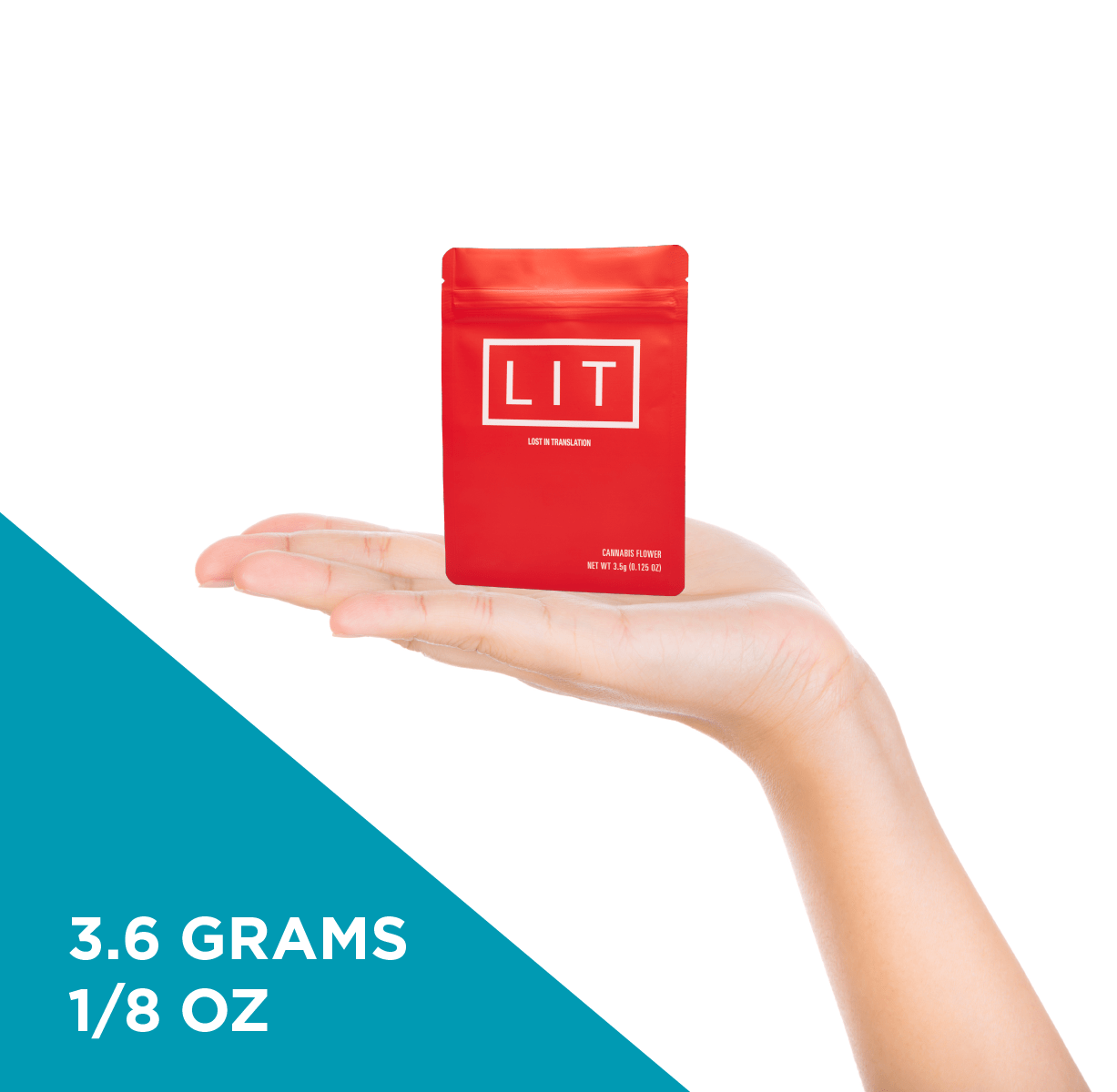
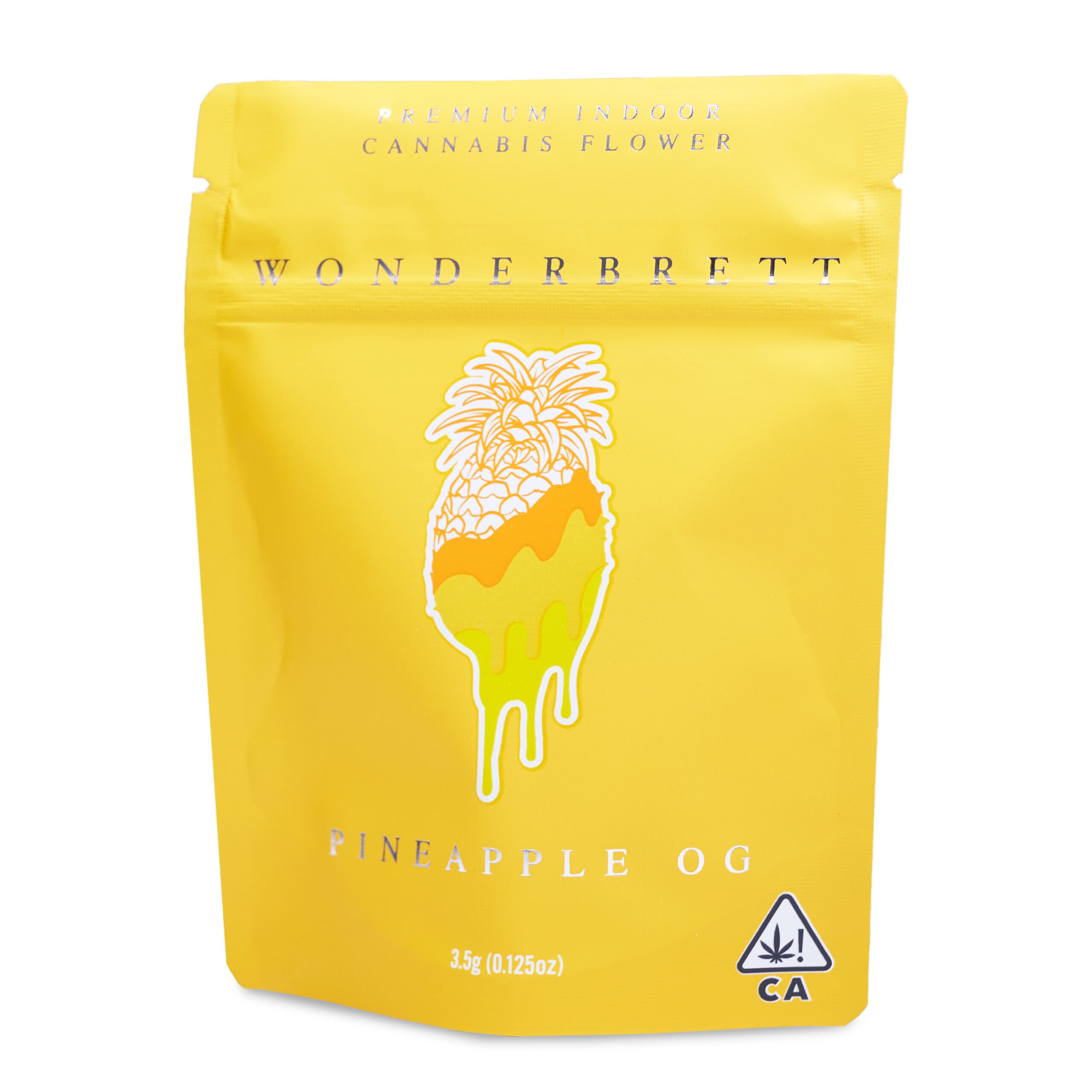
    An eighth of marijuana equals 3.5 grams, and this is the perfect amount for the average cannabis user. It may seem small compared to a quarter, half an ounce, or a full ounce, but it is the most popular amount purchased in the United States. So, if you’re shopping for CBD and THC packaging, you’ll definitely want to stock up on eighth-sized packaging. 

    The reason it’s popular at dispensaries often comes down to freshness. Many customers don’t consume cannabis daily, so this amount is enough to last them up to a few weeks. To enhance the freshness of your cannabis and preserve those precious terpenes and cannabinoids, make sure to purchase cannabis packaging that has a built-in zipper. 

    Weed measurements 3: Quarter 

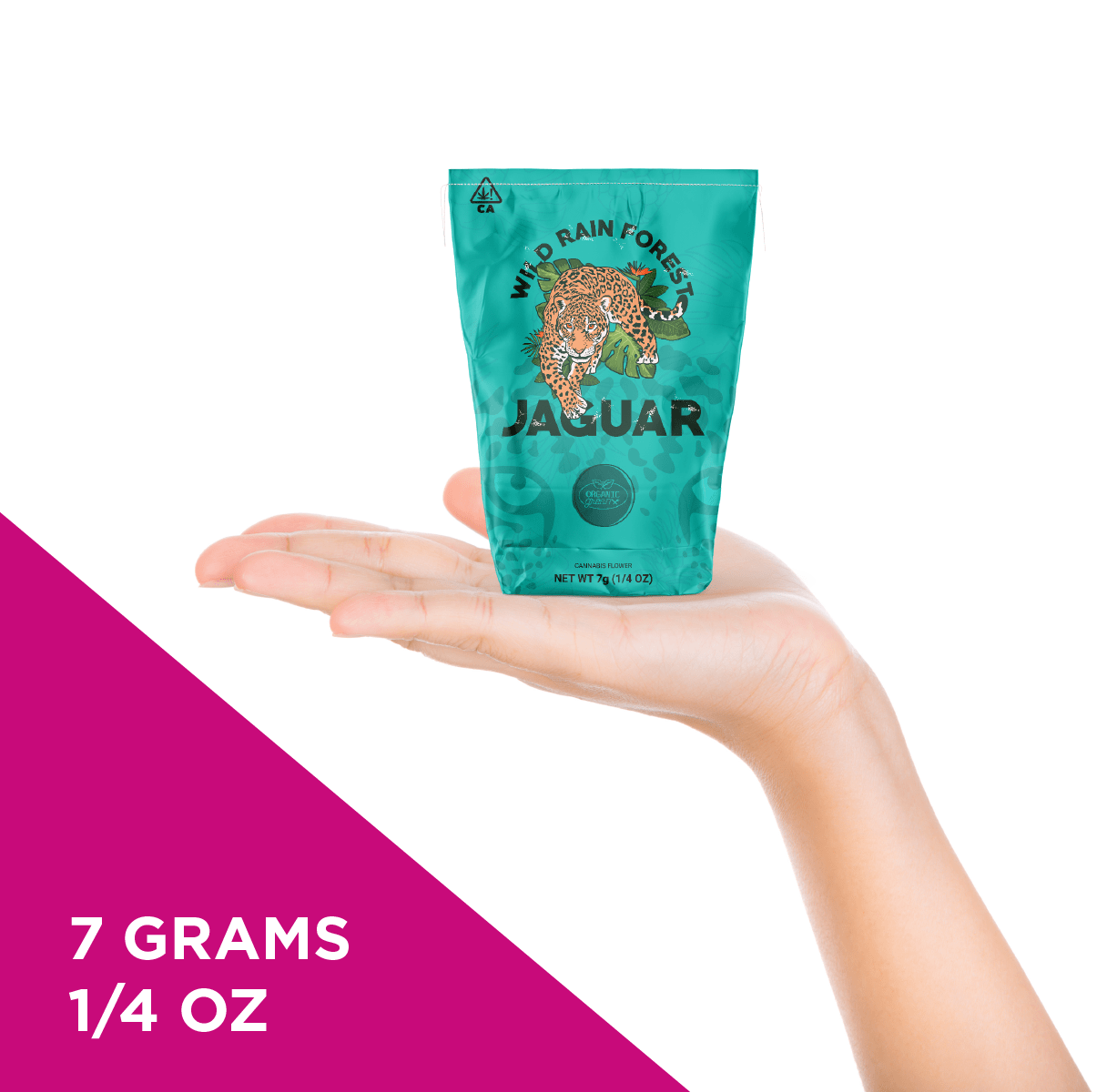
    As you probably guessed, a quarter ounce of weed is double that of an eighth — so 7 grams if you want to get technical. A quarter ounce can fill about 7 joints or 10 bowls, depending on the size of your customer’s pipe or bong. This is also a great amount for customers who are interested in making home made cannabutter for edibles, as cannabutter does require more cannabis than you’d think! 

    Cannabis flower bag design Odor Proof Bags Stand Up Pouch Printed Weed PackagingCustom Printed 1/2 Oz Mylar Bags - Hemp Graphics | Cannabis packaging Stand Up Pouch Matte Finish Glossy Spot

    Weed measurements 4: Half 

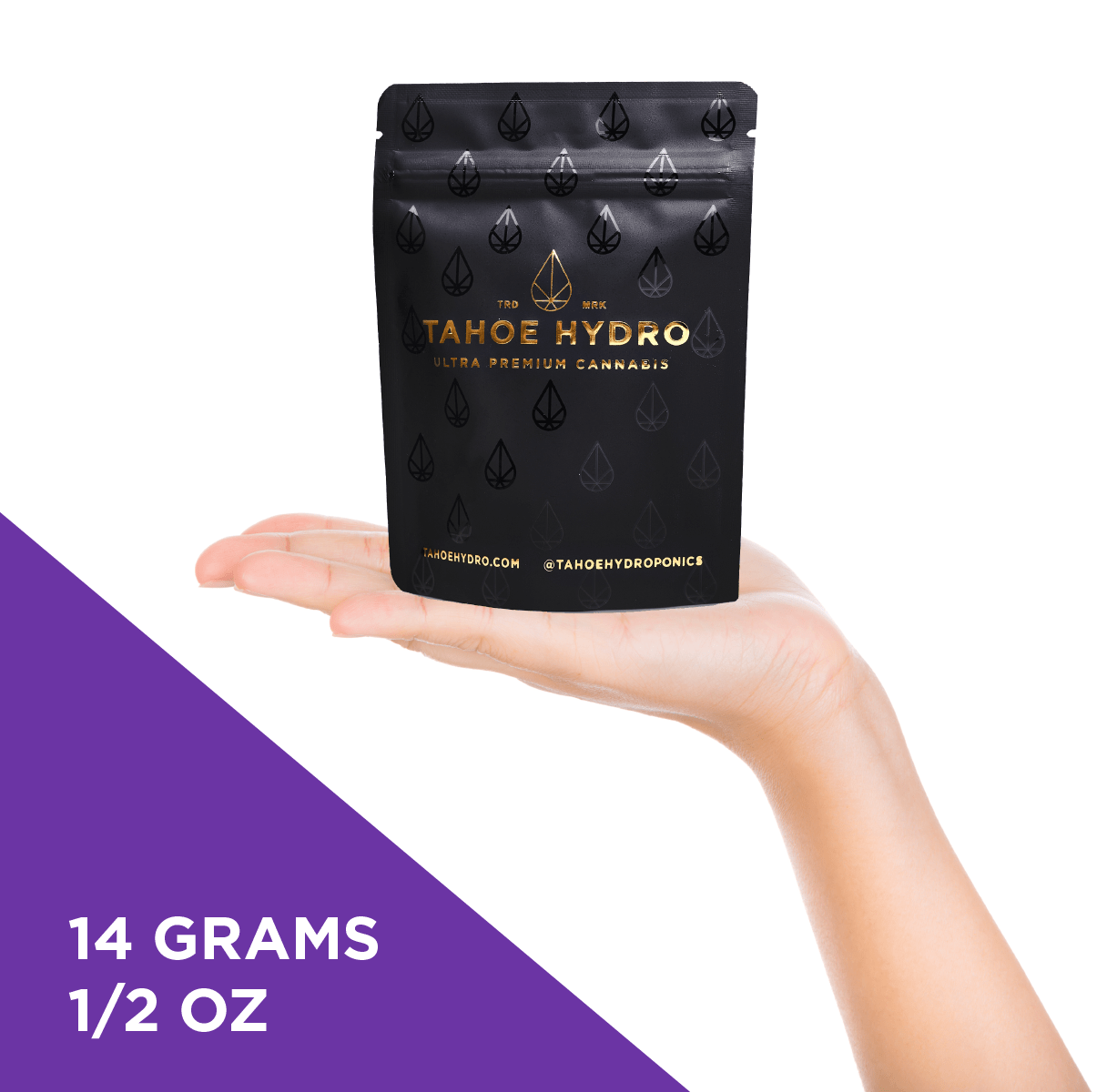
    A half-ounce is 14 grams of cannabis. This is a pretty substantial amount of cannabis and is often purchased by customers who consume cannabis daily. If you’re purchasing cannabis packaging in half-ounce sizes, a built-in zipper is essential for freshness.

    Weed measurements 5: Ounce & Pound

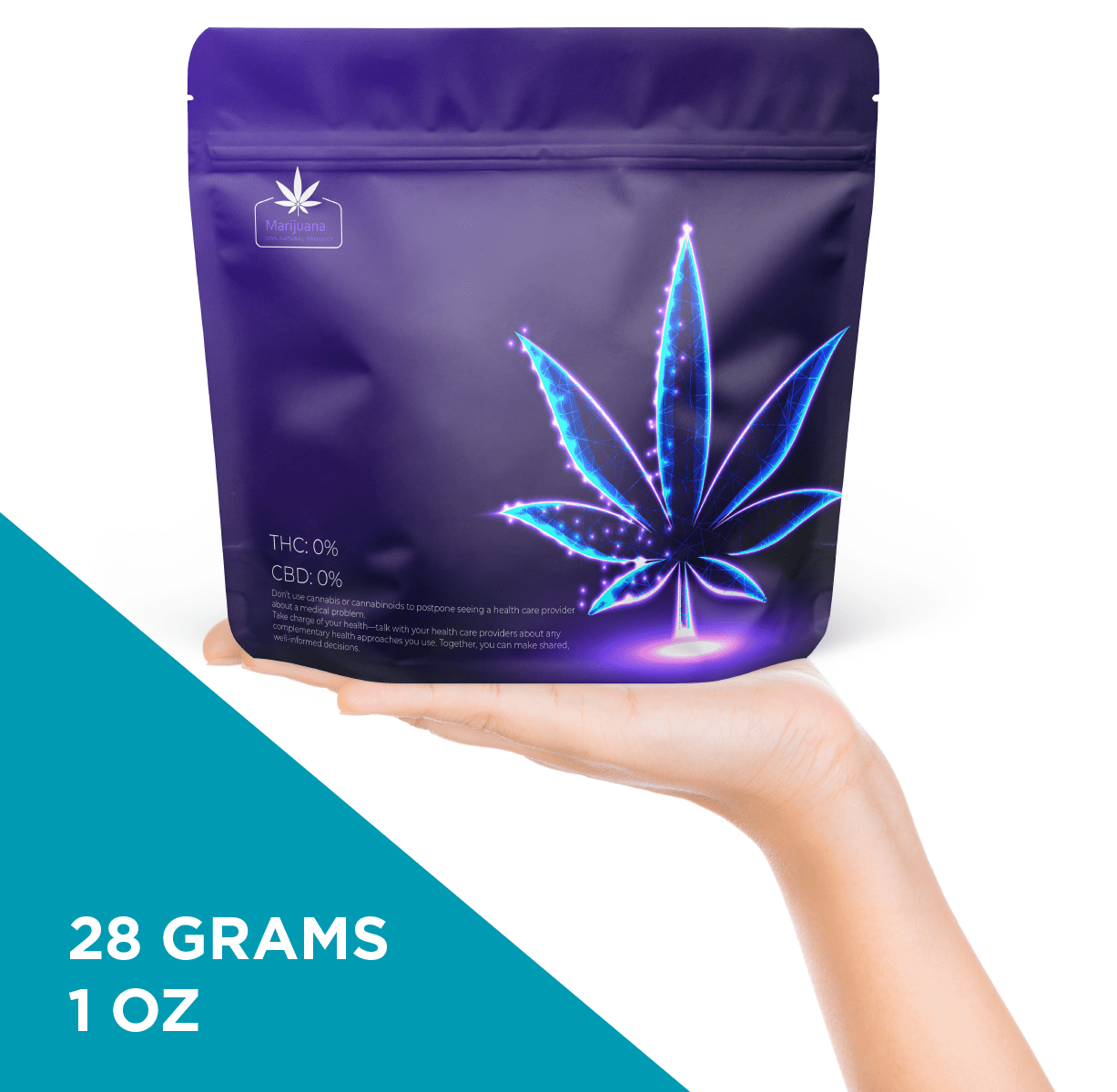
    One ounce of flower is 28 grams, and this is usually the highest volume a customer can purchase at one time. An ounce is commonly called a “zip” because this amount of flower usually fills a small Ziploc bag. Often times dispensaries don’t have an ounce bag — they’ll divide the cannabis into multiple smaller bags. Fortunately, CarePac does sell ounce-sized bags, so you can impress your customers with one bag for their ounce purchase. 

    We do also sell 1-pound-sized stand-up pouches. As mentioned previously, this is best reserved for wholesale cannabis companies that sell their products to buyers or dispensary owners. 

    Customized Printed 1oz Weed Herb Packaging Smell Child Proof  Bag with Ziplock Matte Black Resealable Aluminum Foil Ziplock Mylar Bags

    Features to include in your cannabis packaging 

    As a leading manufacturer of cannabis packaging, there are a few features many of our clients include in their packaging products, including: 

    Packaging product for cannabis mylar bags CBD Printed Packaging Black Stand Up Pouch Ziplock with Hang Hole

    Opaque properties

    Security Bag use for Cannabis Stand Up Pouch with Tamper Evident Zipper Round Corner Printed White with Green Details

    Tamper-evident packaging

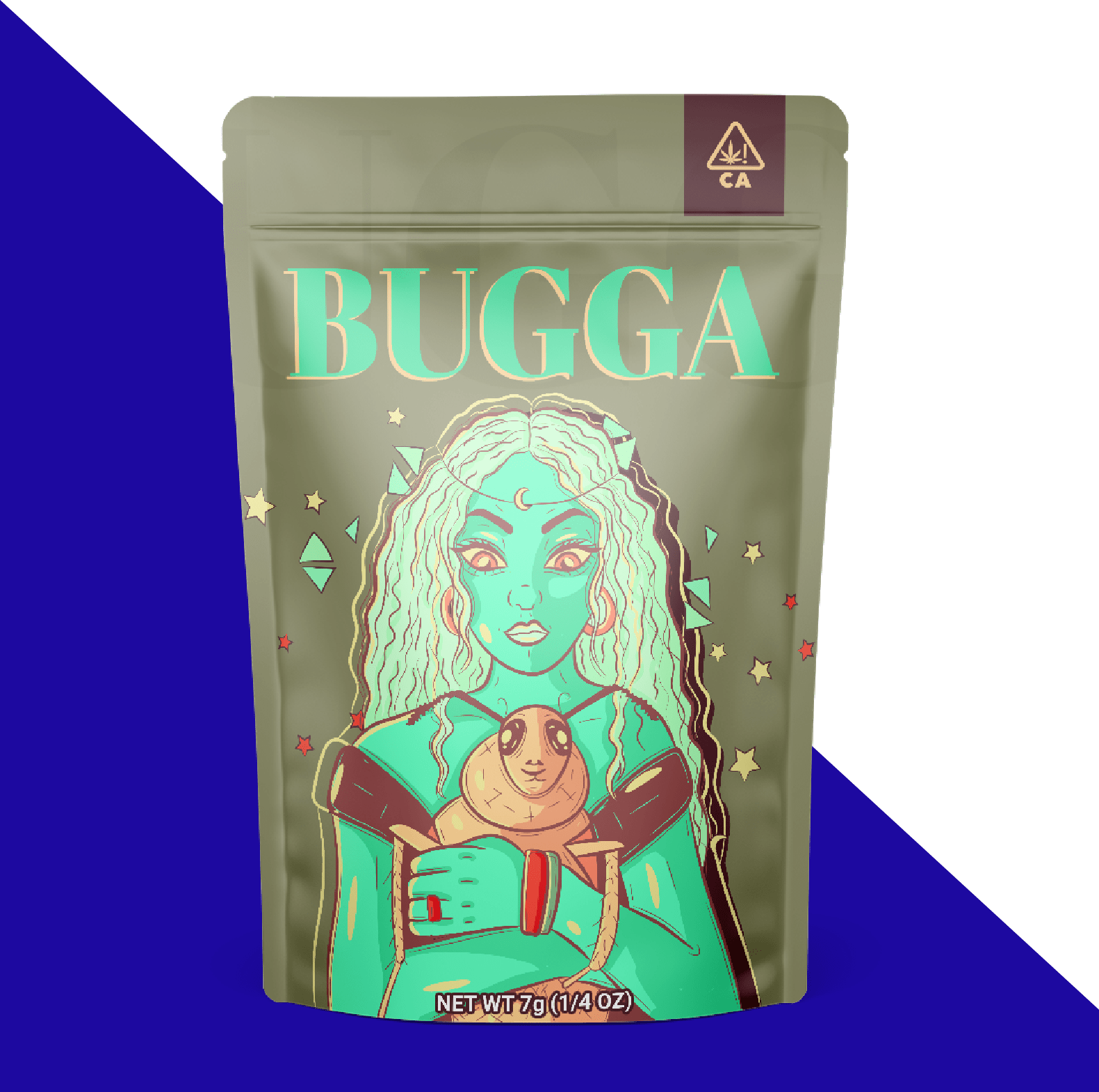
    Ziplock Pouch Bugga Customized Stand Up Resealable  cannabis bag Childproof Pouches

    Resealable options

    Glossy White Child Resistant Pouch Exit Bags   Smell Proof Child Resistant Mylar Bags

    Child-resistant properties

    Holographic Printing Packaging Bag for Cannabis Pouch Holographic Mylar Stand Up Bags Scent Proof and Child-Resistant - Marijuana  Packaging Solution

    Design features like holographic elements or soft-touch materials

    To learn more about our custom cannabis bags, click here. 

    Trust the experts in cannabis packaging 

    As you can see, there’s a lot to consider about cannabis packaging – including the size. Fortunately, we’re here to help! As a trusted cannabis packaging manufacturer, we’ll help you every step of the way. We’ll help you select the right size, font, and colors to make your flower packaging shine! Curious to learn more about our weed measurements and bags? We’re just a phone call away! 

    Ready to get started?

    Get an Instant Quote today! 


  • Montana Cannabis Laws

    Montana Cannabis Laws

    Montana Cannabis Laws

    Montana has a long history of legal cannabis legalization, starting in 2004 with medical. But then back-and-forth made Montana medical marijuana harder to get. In the US state of Montana, marijuana has been legal for both medical and recreational use since January 1, 2021, when Initiative 190 came into effect. Prior to the November 2020 initiative, cannabis was illegal for recreational use from 1929. Medical marijuana was legalized in 2004 in an attempt to vote. [1]

    The labeling and packaging rules apply to marijuana and marijuana products that are for ultimate adult-use cannabis sales to a consumer, registered cardholder, or their designated purchasers. Please note: cannabis legalization is not currently national and this blog and the policy information in it is specific to Montana. 

    Montana Cannabis Laws – Marijuana Packaging Requirements

    Protect: Cannabis packaging must protect the product from contamination and not impart any toxic or deleterious substances to the marijuana products. This means you should use FDA approved barrier packaging, like flexible barrier packaging.

    Resealable:  If the package contains more than one serving, it needs to be resealable, meaning it needs to have a recolorable zipper.

    Not ‘primarily’ appeal to children.

    You cannot include depictions (pictures, illustrations, or other graphics) of children. 

    Your graphics and packaging, cannot include images, drawings, or other portrayals of objects, images, celebrities, or cartoon figures that “primarily appeal to children” or are “commonly used to market products to children”. This can be dicey territory, but generally avoid all cartoon characters.

    Finally the state includes a subjects catch all provision that doesn’t allow packaging or labeling that otherwise has special attractiveness for children beyond the general attractiveness for adults.

    Use of Trademarks

    The regulations prohibit trademark infringement. So unfortunately you can’t be the McDowell’s of Montana Cannabis.  and this section is similar to several other states like Maine and Oklahoma, the state of Montana very much limits the use of trademarks or graphics that resemble trademark, or and this is a bit of a distinction  between it and other states, which “bears any reasonable resemblance to” the trademarked or “characteristic packaging of any commercially available product, including but not limited to candy, snacks, baked goods, or beverages. 

     In this way it appears the legislative intent of this section was to prevent confusion of marijuana products with non-medicated products, and not encourage knock off marijuana versions of unmedicated products. 

    Exit Packaging

    Montana is a exit bag state. Exit bags or exit packaging is a required for all marijuana and marijuana products at the point of sale. This means that at the point of purchase all marijuana products have to be put in “exit packaging” which is:

    • Child Resistant
    • Opaque
    • Includes required warnings. 

    Child Resistant Standard in Montana

    In the state of Montana the child resistant standard is found in ARM 42.39.102(8). The standard of child resistance is defined by reference to the Federal Consumer Product Safety Commission (CPSC) and 16 CFR 1700.20. 

    Labeling Requirements for Legal Marijuana

    The general labeling requirements for Marijuana products in Montana are found in ARM 42.39.314. These basic requirements are in addition to specific requirements that are set for Flower[2], Edibles[3], Topicals[4], and Concentrates and extracts[5]. 

    • Unobstructed and Conspicuous: All required information needs to easy to access. The state does allow  multiple labels, booklets, accordion flaps, just as long as they can be easily access and not permanently obstructed from viewing. 
    • Font: The state of Montana merely requires a “legible font” but do provide some examples (Times New Roman, Arial, or Helvetica) , which if we were you, we’d stick to what they suggest. 
    • Font Size: The primary font size requirement is that the letter “o” must be at least 1/16th” in height. This is very unusual and as far as we can tell, specific to Montana. Most states that prescribe font size use standard language like “6pt font”. 
    • Contrasting Color: The required text must be in a contrasting color to the background.
    • English Language: You must put all required text in English. There is no requirement for dual language warnings.  

    PRO-TIP: For required warnings, use Times New Roman, in a minimum 4mm font size (Adobe Illustrator). 

    Required State Information List 

    • Strain Name: They don’t state how specific you must be with the strain. 
    • Common name: This is an interesting one, they want the package to include the “common” name for the product, so what the laws refer to as ingestible Marijuana-Infused Products” you must include “edible” or Marijuana cookie on the package as applicable. 
    • Names:  of the dispensary, and license number of the cultivator, manufacturer. 
    • ID Number: ID number from the seed to sale tracking system. 
    • Date: Harvested, or manufactured. 
    • Net Quantity: They are very specific on weight / net content, it must be stated first in “U.S. Customary” and also Metric (SI) units with the metric in parentheses. For example. 1/2OZ (28g). 
      • If Solid or Semi Solid: Net quantity  is expressed by weight, and must be prefaced with “Net Weight”, or “Net”.
      • If Liquid: use fluid measure and include the preface “Net Contents” or Net”.
      • Number of Servings: You must also include the number of servings. 
    • Testing Statement: “”This product has been tested and meets the requirements of the state of Montana.”
    • QR Code: QR Code must link to the products certificate of analysis, and statement telling the user they can scan code for “additional product information”

    PRO-TIP: Here is an example of a good net weight statement. 

    Net Weight: 2 oz. (56.7 g) (10 cookies));

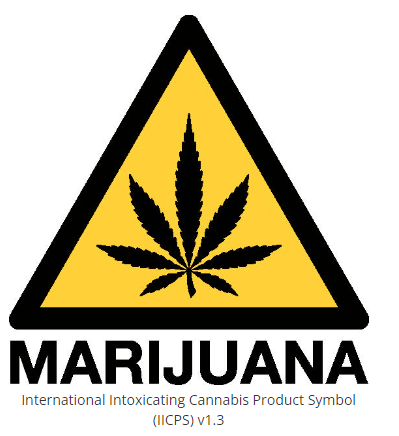
    Montana’s Universal Marijuana Symbol

    Ah yes, the ever-present “universal symbol” which as we have discussed before, is anything by universal… In the case of the state of Montana though, they did op for the International Intoxicating Cannabis Products Symbol (IICPS) which is a step in the right direction towards “universal”. 

    The state requires the symbol will be at a minimum .33″ x.33″ in size. 

    Below we have included press ready, vectorized copies of the three symbol versions available on the state’s website. 

    Download the Montana Marijuana Warning Symbol Vector format.

    Required Warnings Label Text

    Basic Warnings:

    Montana’s required warning labeling for Marijuana products is found in MCA 16-12-215. And is as follows: 

    (1) “WARNING: Consumption of marijuana may cause anxiety, agitation, paranoia, psychosis, and cannabinoid hyperemesis.(2) “WARNING: Consumption of marijuana by pregnant women may result in fetal injury and low birth weight.”(3) “WARNING: Consumption of marijuana by nursing mothers may result in infant hyperactivity and poor cognitive function.”

    The format required for the Montana warning is found in MCA 16-12-208

    Additional Warnings:

    • “Keep out of reach of children and pets
    • “This product may be addictive”
    • “This product may have intoxicating effects. Do not drive while under the influence of marijuana.”

    Ingestible / edibles warnings

    “The intoxicating effects of this product may be delayed by two or more hours.”

    Medical Use Warnings

    If the product is for medical use card holders only, there are two additional warnings: 

    – “For medical use only”; and

     – “This product is not approved by the U.S. Food and Drug Administration to treat, cure, or prevent any disease.”

    Flower Specific Requirements 

    Each package of marijuana flower must include a marijuana fact’s panel which must indicate the percentage of concertation of:

    Must Include:

    • Total potential psychoactive THC;
    • THC;
    • THCa;
    • CBD; and
    • CBDa

    May Include: 

    • the percentage concentration of each additional marketed cannabinoid or terpene, if applicable[6]

    Edibles Specific Requirements

    Ingredient List

    Edibles and other ingestible products must have an ingredient list which must include all ingredients listed.

    • List all ingredients
    • Use common names
    • list ingredients in order of predominance by weight. 
    • use the word “marijuana” before the part of plant (flower, trim) or type on concentrate (oil, infused butter, etc). 
    • Trace, insignificant amount that doesn’t serve a technical purpose, or have any functional effect does not need to be listed. 

    Allergen Statement

    Declare the presence of all major food allergens that may be present. No specific format is required other than the use of “plain language”

    Marijuana Facts Panel

    The milligrams per serving size or dose of:

    • THC;
    • THCa;
    • CBD; and
    • CBDa;

    The number of servings or doses per package; and For multi-serving packages, the total milligrams per package of:

    • THC;
    • THCa;
    • CBD;
    • and CBDa;

    Additional Warning required for any ingestible product:

    “The intoxicating effects of this product may be delayed by two or more hours.”

    Lotions, Patches, & non-ingestible product Specific Requirements 

    The requirements for non-ingestible products is substantively similar to that of ingestible products. With the exception of there is no requirement for Allergen list, or delayed effects warnings.  

    Extracts and Concentrate Specific Requirements

    The legislation requirements for extracts and concentrates are substantively similar to that of ingestible products. Food allergen statement can be omitted if the product is not intended to be cooked with, eaten, or otherwise swallowed or digested.  

    Additional warning regarding delayed effects is also required. [7]

    Frequently Asked Questions About State Law

    Q: What is the THC limits for recreational marijuana products?

    Montana’s THC limits are found in 16-12-224. any product that exceeds the threshold must be labeled as “for medical use only” and “This product is not approved by the U.S. Food and Drug Administration to treat, cure, or prevent any disease.”

    • Flower:  1 ounce of usable marijuana. The total potential psychoactive THC of marijuana flower may not exceed 35%.
    • Capsules: Maximum 100 milligrams of THC per capsule and no more than 800 milligrams of THC per package.
    • Tincture; Maximum 800 milligrams of THC;
    • Edible or food product:
      • Single Serving maximum 10 milligrams THC
      • Maximum 100 milligrams of THC per package.
    • Topical product: Max concentration 6% THC and 800 milligrams of THC per package;
    • Suppository or transdermal patches: Maximum 100 milligrams of THC per suppository or patch and maximum 800 milligrams of THC per package
    • Maximum total for any marijuana product, no more than 800 milligrams of THC.

    Q: If the marijuana product DOES NOT require heat to administer must the marijuana facts panel contain total THC or total potential psychoactive THC values?

    No, these items are not required on the facts panel for non-heat products. 

    Q: Does Montana require the method of manufacturing and solvent used be listed on the label?

    Yes, the method of manufacturing, and if chemical extraction was used, the solvent used in the manufacturing process must be listed on the label. 

    Q: What is the packaging is too small to fit all the required compliance information?

    You can (if approved by the department) display the information in a legible font that otherwise does not meet the minimum size requirement. 

    Labeling and Packaging Template

    Montana labeling and packaging templates can be found here.

    Conclusion 

    States with a lot of open land, natural resources, and a fertile environment for agriculture, such as Montana. There are about 28,000 ranches and ranches in the state, each averaging 2,000 acres. Cannabis farms have sprung up all over the state over the past few years. In 2019, Montana farmers planted a total of 22,000 acres of hemp across the state, averaging half a million dollars per farm. Medical marijuana, like cannabis, is not accessible to everyone and cannot be thrown in a jar. After the plant is grown, harvested and cured, there are regulations that must be met for both packaging and labeling. If one doesn’t adhere to these laws, it could result in a punishable misdemeanor, fine, or felony.

    Footnotes

    [1] https://www.leafly.com/learn/legalization/montana

    [2] https://rules.mt.gov/gateway/RuleNo.asp?RN=42%2E39%2E315

    [3] https://rules.mt.gov/gateway/RuleNo.asp?RN=42%2E39%2E316

    [4] https://rules.mt.gov/gateway/RuleNo.asp?RN=42%2E39%2E317

    [5] https://rules.mt.gov/gateway/RuleNo.asp?RN=42%2E39%2E318

    [6] https://rules.mt.gov/gateway/RuleNo.asp?RN=42%2E39%2E315

    [7] https://rules.mt.gov/gateway/RuleNo.asp?RN=42%2E39%2E318

  • Weed Laws in Alabama

    Weed Laws in Alabama

    Weed Laws in Alabama

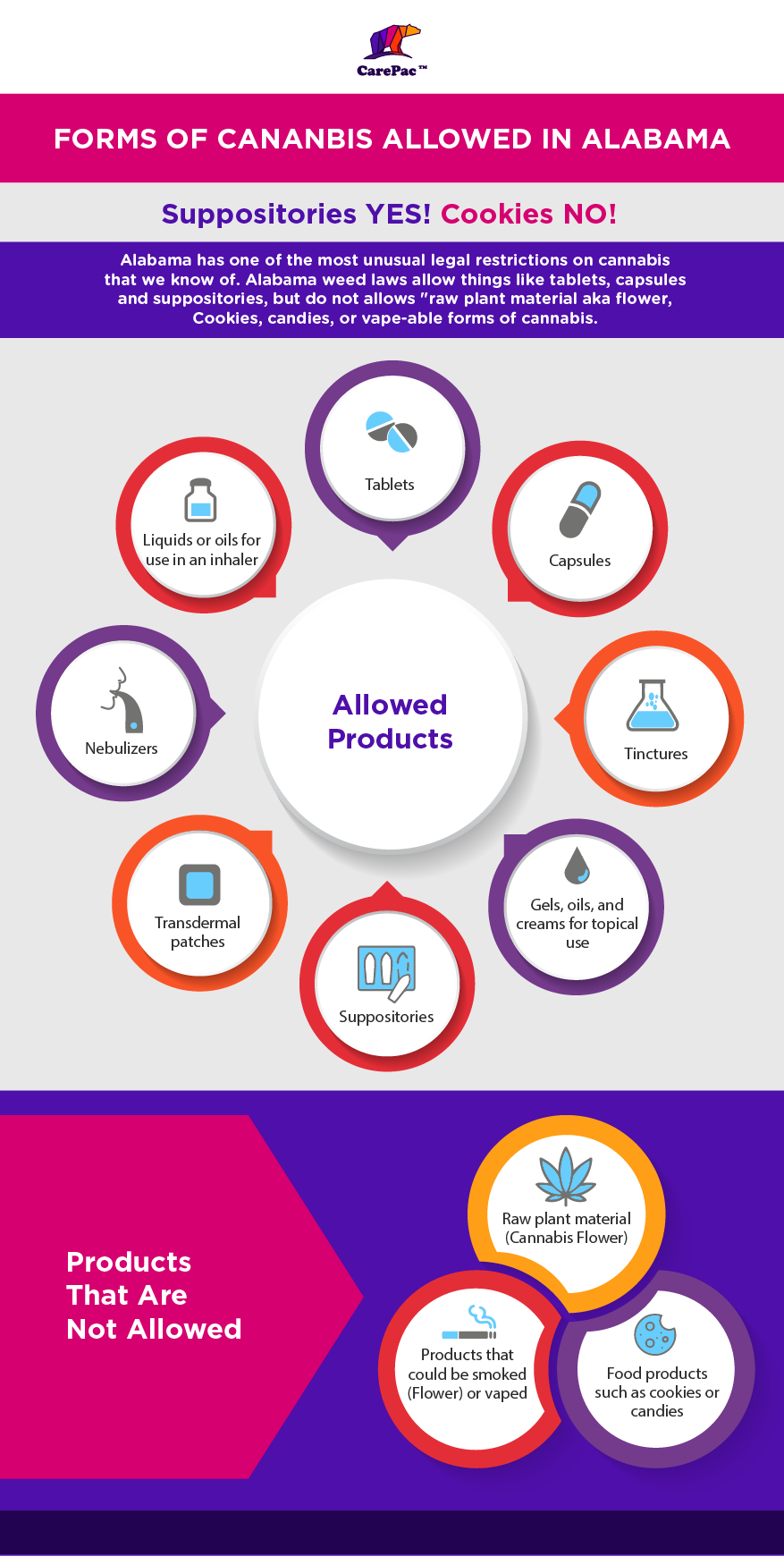
    Alabama’s weed laws are just plain strange. Where do we start? Alabama’s law and policy seems to make arbitrary distinctions between the forms of cannabis that are allowed, the amount of cannabis a registered patient or caregiver can maintain on-hand, and retain almost all the draconian punishments for recreational use and personal cultivation. The regulations even stipulate they will establish one universal flavor for all gelatinous cube, cuboid, and lozenge medical cannabis products, this is rather nuts in our opinion.

    Medical weed is legal in the state of Alabama. Medical use was legalized in 2021 with a bill that passed the legislature and was signed by Governor Kay Ivey. Previous bills passed in 2014 (Carly Law) and 2016 (Leni Law) only allowed the use of CBD oil to treat seizure disorders. 

    In juxtaposition to this, recreational use marijuana is illegal and strongly so. The first possession of personal amounts is a misdemeanor, punishable by up to one year in prison, a fine of up to $6,000 and a mandatory six-month suspension of driver’s license. Repeat offences and possession with intent to sell are felony offences and may have a mandatory minimum sentence. [1]

    ALABAMA MEDICAL CANNABIS PROGRAM OVERVIEW

    The Alabama Medical Marijuana Commission is still establishing the program. While in operation, patients will need to visit a certifying physician who can adjust the amount and form of daily dose of marijuana they can purchase.

    The law stipulates that the state cannabis commission will set details around the percentage of THC and maximum daily doses, but it also limits it to 50mg per day unless the patient has improved after 90 days or has a terminal diagnosis. In any of these cases, the maximum increases to 75 mg per day. Per the medical cannabis commission and Alabama law, under no circumstances are minors allowed to consume cannabis containing more than 3%. 

    MARIJUANA PROCESSING LICENSE REQUIREMENTS

    One of the key licenses in Alabama is the processor license. A processor license authorizes all of the following:

    • The purchase or transfer of cannabis from a cultivator.
    • The processing of cannabis raw plant material (flower) into medical cannabis which shall include “properly packaging and labeling medical cannabis products”.
    • The sale or transfer of medical cannabis to a dispensary.
    • A processor license authorizes the processor to transfer medical cannabis only by means of a secure transporter.
    • The commission shall issue no more than four processor licenses.

    You heard that right, off the bat Alabama is limiting processor licenses to four (4). Talk about giving those processor’s a monopoly. 

    GENERAL MARIJUANA LAWS & REQUIREMENTS

    All Alabama medical cannabis products must be medical grade product, manufacture using documented good quality practices, and meet Good Manufacturing Practices, such that the product is shown to meet intended levels of purity and be reliably free of toxins and contaminants. Medical cannabis products may not contain any additives other than pharmaceutical grade excipients.

    GUIDELINES FOR PACKAGING

    Most of the packaging and labeling regulations for controlled substances are similar to other states. Packaging and labels cannot be deceptive, false or contain misleading claims. 

    LABELING REQUIREMENTS

    • Lot and batch numbers.
    • The license identification number for the cultivator and processor.
    • Cannabinoids content and potency.
    • The commission may require the implementation of a digital image such as a QR for purposes of tracking medical cannabis products. The digital image must interface with the statewide seed-to-sale tracking system.
    • The commission shall determine what information from the label shall be entered into the statewide seed-to-sale tracking system. [2]

     REQUIRED WARNINGS

    • Packaging must contain a label that reads: “Keep out of reach of children.”
    • The following statement shall be included on each label, if space permits, or as an insert within the package:

    “Warning: this product may make you drowsy or dizzy. Do not drink alcohol with this product. Use care when operating a vehicle or other machinery. Taking this product with medication may lead to harmful side effects or complications. Consult your physician before taking this product with any medication. Women who are breastfeeding, pregnant, or plan to become pregnant should discuss medical cannabis use with their physicians.”

    UNIVERSAL SYMBOL

    The universal state symbol printed in color at least one-half inch by one-half inch in size. It must be present on all packages.

    POSSESSION AND CULTIVATION LIMITS

    Possession laws state that registered patients and caregivers 19 years of age or older can legally hold up to 70 daily doses of medical marijuana with a a medical marijuana card. The recommending doctor determines what the daily dose is, but cannot exceed 75mg of THC.

    Cultivation is illegal in Alabama. A person who grows cannabis plants at home for personal use may be charged with smuggling marijuana, which is considered a criminal offence. Possession of any amount of processed marijuana, with the exception of patients and caregivers, is considered a misdemeanor, with up to one year in prison or a $6,000 fine. Those convicted of possession of marijuana for any purpose other than personal use can face a felony offense and up to ten years in prison and a maximum fine of $15,000. Possession decriminalization is set to be addressed in the Senate before the corona virus shutdown in 2020.

    CONCLUSION- SEEK AN ATTORNEY

    Non-medical, recreational, adult marijuana use is currently illegal in the state. Ball possession penalties can still be harsh. The first possession of personal amounts is a misdemeanor, punishable by up to one year in prison, a fine of up to $6,000, and a six-month mandatory driver’s license suspension. There have been attempts to legalize adult marijuana for people 21 and older in 2019, but this has been unsuccessful.[3]

    When in doubt, reach out to lawyers that specialize in medical marijuana law in your area. 

    [1] https://norml.org/laws/alabama-penalties/

    [2] Ala. Code § 20-2A-63 (1975)

    [3] https://weedmaps.com/learn/laws-and-regulations/alabama

  • MAINE CANNABIS REGULATIONS FOR PACKAGING/ LABELING 

    MAINE CANNABIS REGULATIONS FOR PACKAGING/ LABELING 

    Maine Cannabis 

    Regulations for Packaging/Labeling

    In November 2016, Maine voters approved a measure calling for the legalization, taxation, and regulation of marijuana in a manner similar to how alcohol is regulated. Later, marijuana legalization bills went through numerous rewrites only to be vetoed in the first round. Then in 2018, Maine lawmakers overturned the governor’s veto and passed statutory code LD 1719, an Act to Implement a Regulatory Structure for Adult Use Marijuana. The move made Maine the 8th state to legalize recreational marijuana. The Office of Cannabis Policy under the Department of Administrative and Financial Services is responsible for overseeing cannabis use in Maine.

    Maine Cannabis Packaging Laws & THC Labeling Requirements

    Basic Packaging Requirements 

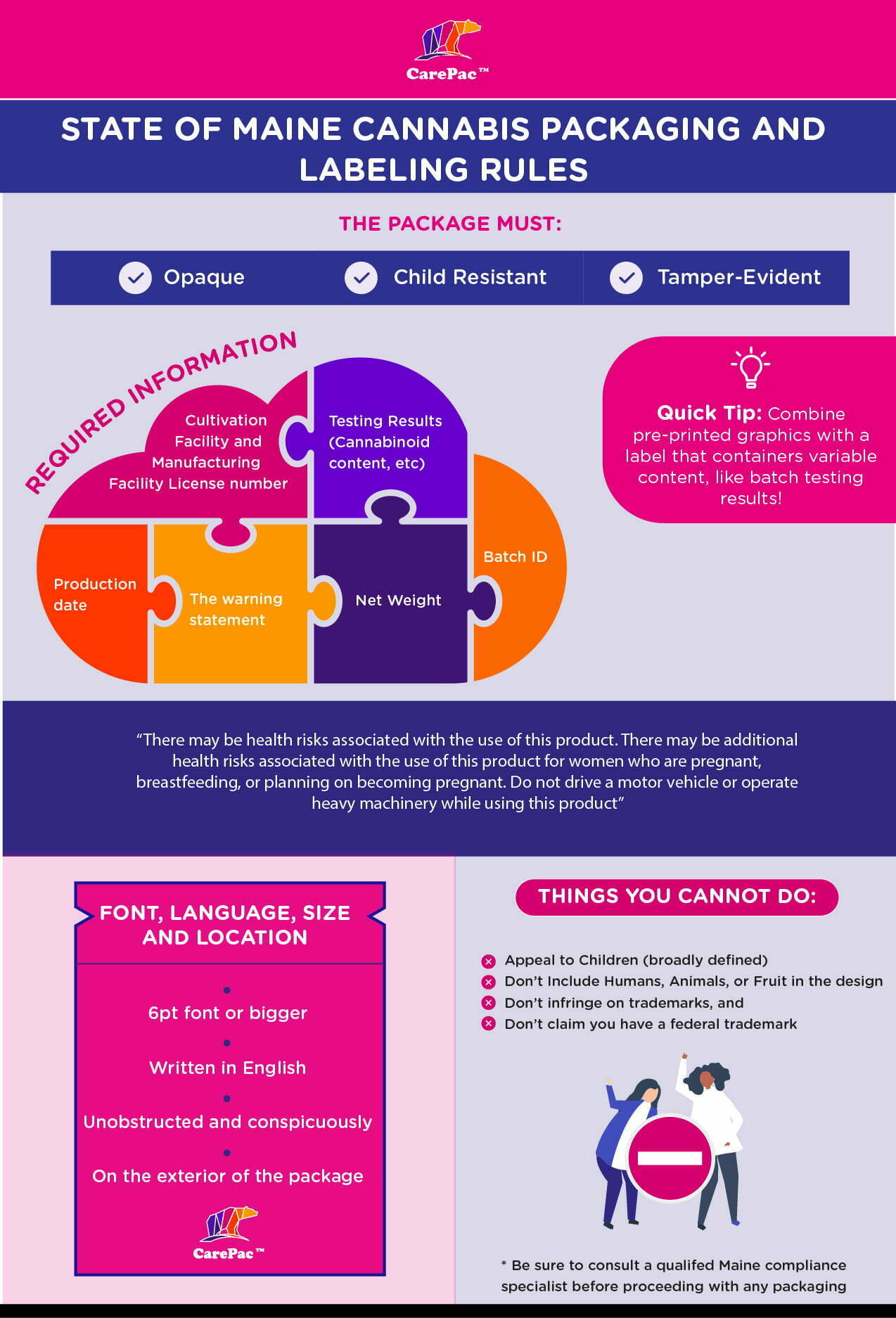
    For Adult Use Marijuana, Section 11.1 provides that all marijuana or marijuana products must be packaged in containers that:

    • Are fully enclosable: No open top containers. 
    • Are resealable: Include a child resistant zipper.
    • Protect From Contamination: use quality barrier materials.
    • No Toxic Substances: Do not impart any toxic or deleterious substance to the packaged item.[1] 

    Child Resistant and Opaque

    In addition to the basic requirements Packaging must adhere to these additional restrictions – PL 2017, c. 452, §18

    • Be Child-resistant
    • Opaque ( not see through)
    • Tamper-evident
    • If it’s a liquid: Multi-serving liquid products must include a measuring component and a CR cap.[2]

    Quick Tip!

    Typically a hybrid combination of pre-printed packaging, and labels is best. As some information is variable and other information is always know. For example. Pre-printing cultivation Facility numbers, Net weights, and required warnings, but then labeling, final Testing Results, and production date, and cannabinoid content which are variable. 

    Package Labeling Requirements

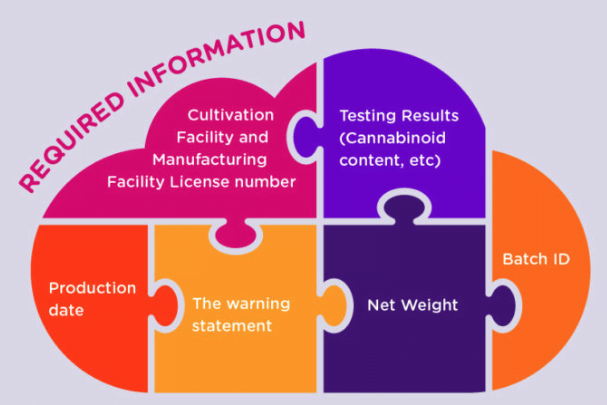
    Required ID and Stats

    • Licensee Identification: It has to be clear who the customer is buying the marijuana product from. This would include your license number. 
    • Batch ID: The unique identification number of the final batch from which the testing sample for the mandatory testing of the contents of the marijuana or marijuana product was taken;
    • Testing Results:
      • For the batch from which the individual product is derived.
      • Including cannabinoid content.
      • Performed by a licensed testing facility.
    • Cultivation Facility License Number and Manufacturing Facility: The license numbers of the cultivation facility and if applicable the manufacturing facility if it is different than the cultivation facility. 
    • The Production Date
    • Net Content / Net Weight: The packaging must include a statement of “net contents” which means it must identify the net weight of the marijuana, concentrate or marijuana product using a “standard of measure compatible with the tracking system”. Basically this typically means grams.

    The Warning Statement 

    There is a rather routine warning statement required in Maine. 

    “There may be health risks associated with the use of this product. There may be additional health risks associated with the use of this product for women who are pregnant, breastfeeding, or planning on becoming pregnant. Do not drive a motor vehicle or operate heavy machinery while using this product.”[3]

    Font, Language, Size, and Location

    All marijuana or marijuana product required label content must comply with the following:

    • 6pt font or bigger Labeling text on any marketing layer must be no smaller than size 6 font or 1/12 inch.
    • Written In English: All information included in the labeling requirements must be clearly written or printed and in the English language. There is no current requirement that we could find for bi-lingual warnings.
    • Unobstructed and Conspicuous: All information included in the labeling requirements, must be displayed on the marketing layer and must be unobstructed and conspicuous.
    • Printed on the “Marketing layer” All warnings and required language All required information must be printed directly on the packaging, or on a label or sticker affixed directly to “the marketing layer”, I.E. generally the outside.

    Things you can’t do…

    Well as any good governmental organization the Maine state government has made a good list of prohibitions when labeling, marketing, or packaging cannabis. Most of which are in 

    PL 2017, c. 452, §18.

    Trademarks

    • Trademark Law Violations: Strangely trademark violations are first on the list. This would mean, for example, you cannot call your cannabis product “Nike’s Cannabis” and use a big Nike swoosh. But more commonly, what it means is you can’t make riffs on name brands.
    • No Federal Trademarks: Ok, so in addition to no Anything that makes it look like the product has a federal trademark. Alas no claiming trademarks on your brand (at least yet!). 

    Humans Animals, or Fruit!

    In a somewhat humorously worded regulation, the obvious things like don’t make your packaging appealing to children, and don’t mislead your customer, or obscure required warnings, or pretend the product doesn’t contain THC (Who would do that?). there is also a section about not including depictions of humans, animals, or fruit, on your packaging…  

    • Packaging that appeals to children: This one is going to be very subjective, but here’s an example, again remember they are talking the “PACKAGING” so for example making a cannabis infused drink in the capri-sun pouch might be a violation. 
    • Misleading or “obscures” the required labeling: So misleading would be a very broad list of things. Here are a couple of hypothetical examples:
      • Hiding the warning in the design, so it doesn’t stand out.
      • Claiming the product came from a certain cultivation facility when it actually came from another.
    • Do not Include Humans, Animals, or Fruit on the design: Last but not least, they don’t want your package to use graphics that incorporate humans, animals, or fruit… ok it is what it is.[4]

    Other Advertising Prohibitions

    The following is prohibited for packaging related advertising adult-use marijuana:

    • Misleading, deceptive, or false advertising.
    • Advertising that appeals to those under 21 years of age: Cartoons, colors pallets that appeal to children, or for example. gummy candy that looks like candy kids eat.
    • Health or physical benefit claims: Ok so we are all probably aware of this one, but just incase you weren’t don’t make unsubstantiated health and physical benefits, you’re just opening yourself up to both the government regulators and people out to catch you. 

    Medicinal Use vs Adult Use

    Maine is home to both a medical cannabis program and an adult use industry. The medical program serves patients, while Maine’s adult use industry services consumers 21 years of age and older. Adult use cannabis and medical cannabis may not be dispensed from the same facility.[5]For use as recreational purpose the adult must be of 21 years of age but for medicinal use only those individuals who have received a patient certification from a medical professional may legally access medical cannabis from a registered caregiver or dispensary. Patients visiting Maine from another state may be able to purchase medical cannabis from a registered caregiver or dispensary if they have valid patient identification credentials (like a registry or patient identification card) and their state of residence allows them to use their state-issued credential to purchase medical cannabis in Maine.[6]Maine residents are allowed to grow cannabis for personal use. As many as three mature, 12 immature plants, and an unlimited number of seedlings are allowed per resident 21 years of age or older. These restrictions do not apply to the cultivation of cannabis for medical use by a qualifying patient, a caregiver, a registered caregiver or a registered dispensary as authorized by the Maine Medical Use of Marijuana Act.[7]

    A Note related to medical use of marijuana act is that if a registered caregiver, dispensary, or facility has information stated on the packaging related to cannabinoid potency, contaminants, or cannabinoid profile, the information needs to be verified by a Marijuana testing facility. 

    Interesting Legal Case

    NORTHEAST PATIENTS GROUP v. MAINE DEPARTMENT OF ADMINISTRATIVE AND FINANCIAL SERVICES (Docket No. 1:20-cv-00468-NT)

    In 2009, the Maine Legislature amended the State’s existing medical marijuana law to establish a comprehensive system authorizing the sale of medical marijuana. The current iteration of the law—the Maine Medical Use of Marijuana Act (the “Act”)—authorized qualified patients who had a certification from a medical provider for the medical use of marijuana to possess, use, and purchase medical marijuana. The Act also authorizes two types of entities—registered dispensaries and caregivers—to possess, cultivate, and sell marijuana to qualified patients. The Act provides that “all officers or directors of a dispensary must be residents of this State,” (the “Dispensary Residency Requirement”). 22 M.R.S.A. § 2428(6) (H).High Street a Delaware LLC entirely owned by residents of states other than Maine owns and operates three of the seven registered dispensaries in Maine’s medical marijuana program.

    Wellness Connection operated as a mutual benefit nonprofit corporation without any equity ownership, but when Maine changed its law in 2020 to allow dispensaries to become for-profit companies, Wellness Connection converted to a for-profit corporation and is currently wholly owned by three Maine residents.

    High Street states that it would purchase all of the equity in Wellness Connection if the Dispensary Residency Requirement did not prohibit it from doing so. The Plaintiffs sued the Department—which is responsible for implementing, administrating, and enforcing the Act. The court concludes that the Dispensary Residency Requirement violates the dormant Commerce Clause and hints it might strike down Maine medical marijuana residency law.

    Foot Notes

    We hope this blog article has been a entertaining introduction to the state of Maine’s Cannabis packaging and labeling rules. You’ll always want to make sure to have your packaging and graphics designs reviewed by a qualified compliance consultant, like a state of Maine cannabis attorney. 

    [1] https://www.maine.gov/dafs/ocp/sites/maine.gov.dafs.ocp/files/inline-files/Administrative_Rule_18-691_CMR_ch1-Adult_Use_Marijuana_Program_Rule.pdf

    [2] https://www.mainelegislature.org/legis/statutes/22/title22sec2429-A.html

    [3] https://www.maine.gov/dafs/ocp/sites/maine.gov.dafs.ocp/files/inline-files/Administrative_Rule_18-691_CMR_ch1-Adult_Use_Marijuana_Program_Rule.pdf

    [4] https://www.mainelegislature.org/legis/statutes/22/title22sec2429-A.html

    [5] 28-B M.R.S. §1501(1)(C)

    [6] 22 M.R.S. §2423-A, Id. §2423-C, Id. §2425-A

    [7] 28-B M.R.S. §1502(1)

  • USDA Organic Labeling

    USDA Organic Labeling

    USDA Organic Labeling

    Introduction to USDA Organic Label Requirements | Organic USDA Labeling

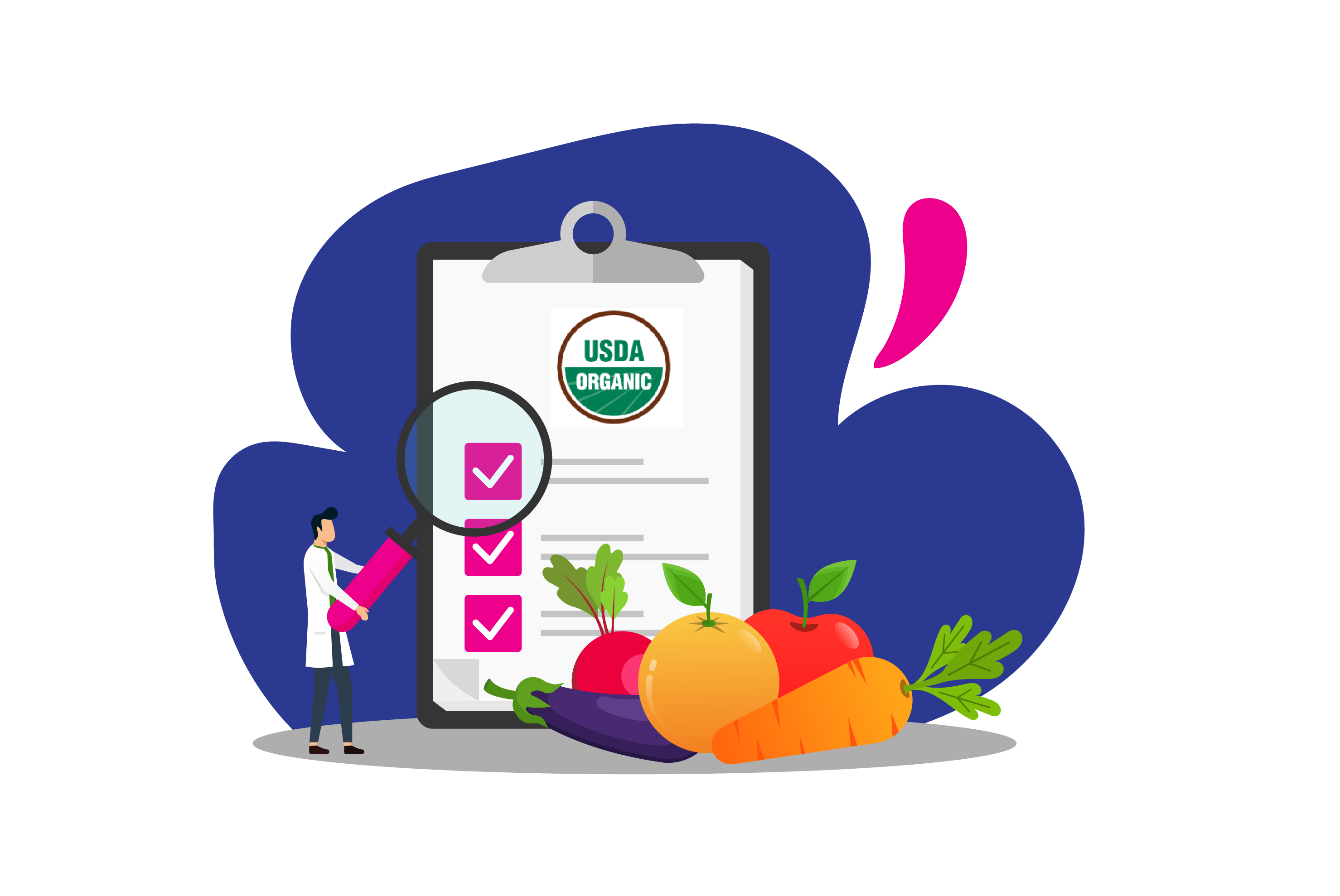
    The ‘Certified Organic’ label was developed to help consumers make decisions when purchasing food, and other items which claim to be organic. Claiming that you sell certified organic products has proven to be a long lasting source of consumer loyalty and preference. This blog is a basic overview of the USDA organic programs, and the use of the USDA organic seal on packaging. 

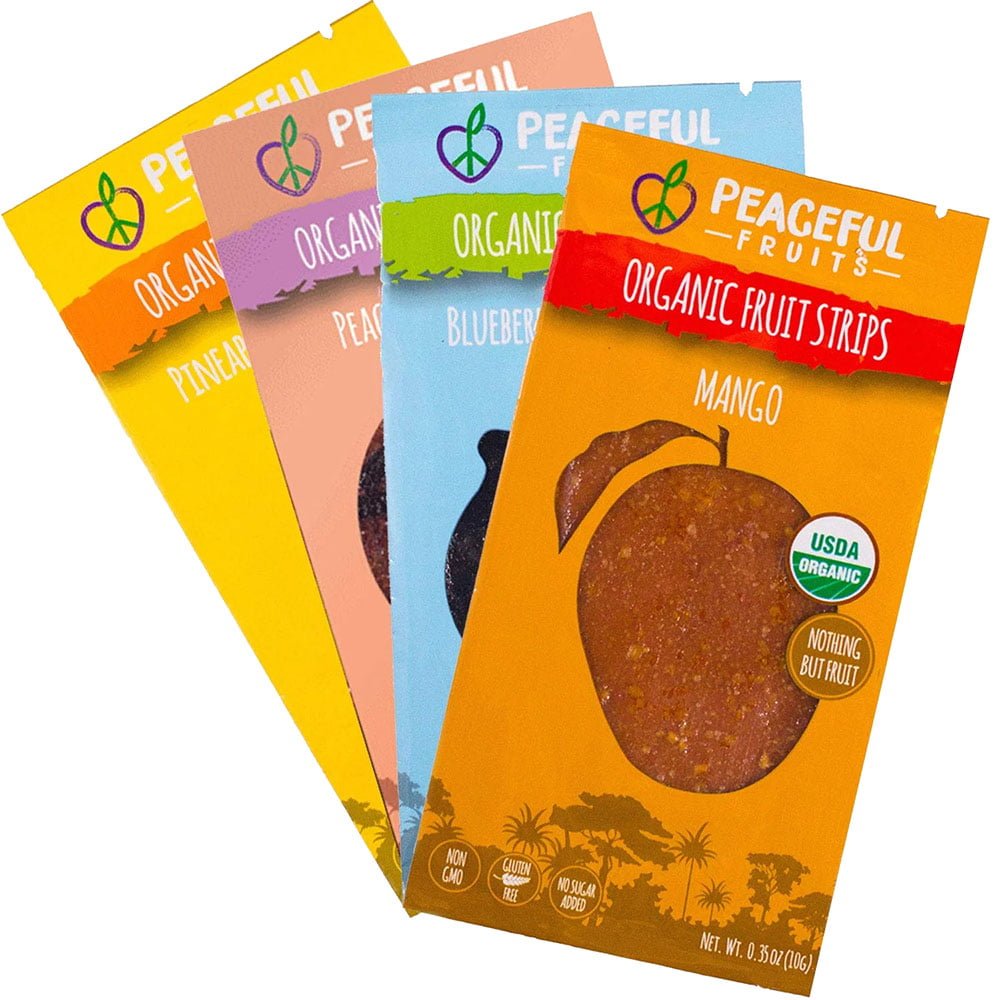
    Peaceful Fruits Packaging

    The information contained in this blog is believed to be generally accurate as of the date of its creation. This blog is intended as general educational content about USDA organic  products and the rules surrounding them. If you are developing packaging, use this blog post as a starting point for your own Investigation, and confirm current USDA requirements and guidance for your particular situation (which may fall within an exception, exclusion), which can change over time. It is always recommended to consult a compliance specialist. Official rules, regulations, and guidance about  USDA organic labels can be found at www.usda.gov. Alright, with that said let’s dive in!

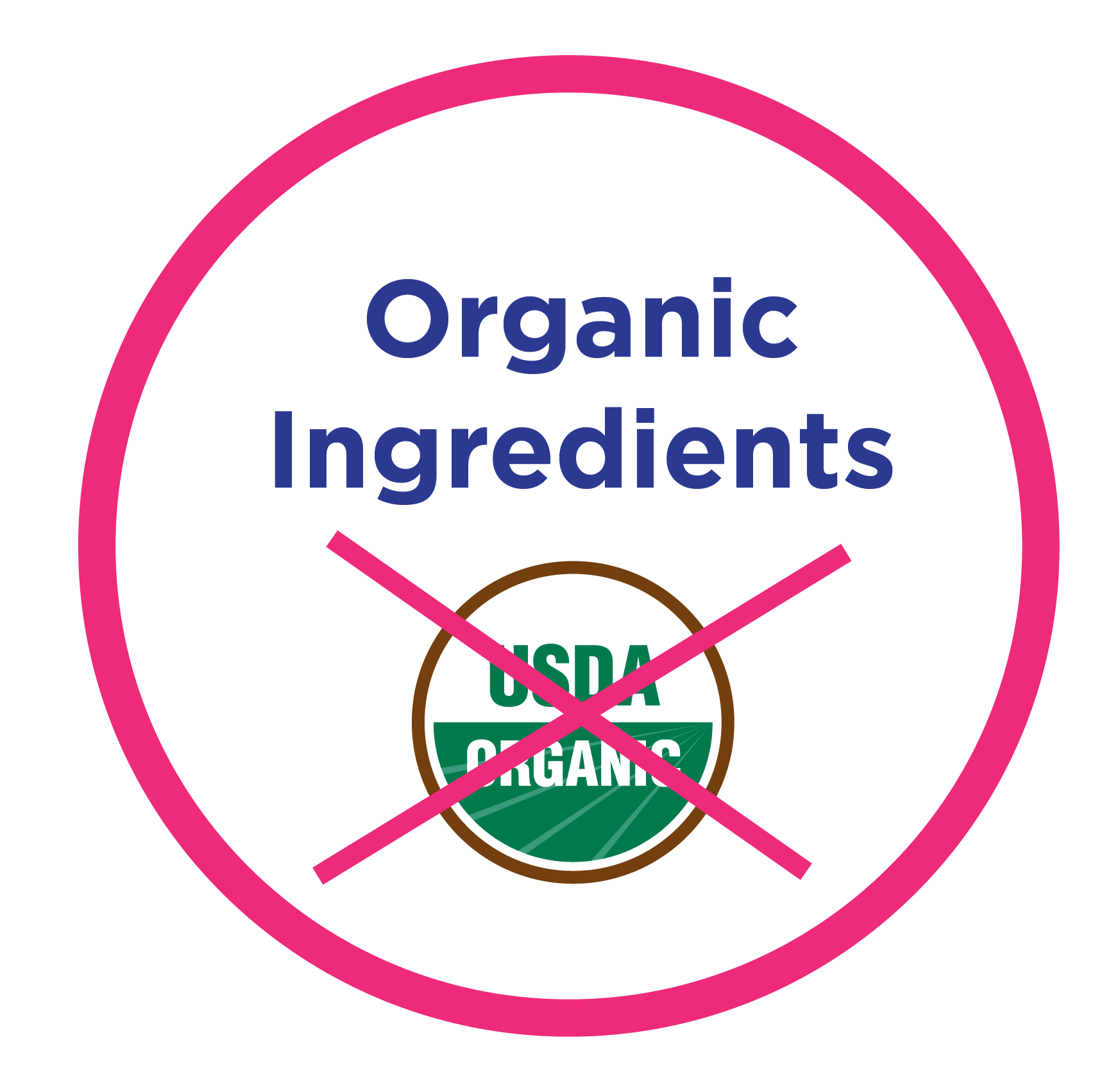
    In the United States, “organic” is a labeling term for food or agricultural products (“food, feed, or fiber”) created in accordance with the USDA Organic Regulations, a database that defines standards that unify “cultural, biological, and mechanical practices.” These standards for organic food labels promote resource cycling, promote ecological balance and conserve biodiversity. In addition to setting requirements for how organic agricultural products are grown, processed and handled, USDA National Organic Program also sets labeling requirements for these products. Labeling requirements are based on the percentage of organic ingredients in the product. If it is an agricultural product intended for human consumption, certification is required for the use of the term organic. Personal care products, textiles and dietary supplements fall outside the purview of the USDA. They may be certified for National Organic Program, but are not required by law.[1]

    To make an organic claim or to use the USDA Certified Organic Seal and to be entered into the organic database, the final product must strictly adhere to production, handling, and labeling standards and undergo an organic certification process. The standards address various factors such as soil quality, animal husbandry practices and pest and weed control. Artificial fertilizers, sewage sludge, irradiation and genetic engineering cannot be used. Organic agricultural operations should ultimately maintain or improve soil and water quality, and conserve wetlands, woodlands, and wildlife.

    USDA food label recognizes four types of organic production:

    Crops

    “Plants that are grown to be harvested as food, livestock feed, or fiber used to add nutrients to the field.”

    Livestock

    “Animals that can be used in the production of food, fiber, or feed.”

    Processed/multi-ingredient products

    “Items that have been handled and packaged (e.g. chopped carrots) or combined, processed, and packaged (e.g. bread or soup).”

    Wild crops

    “Plants from a growing site that is not cultivated.”

    Organic standards describe specific requirements that products must be tested by a USDA-accredited certifying agent before being labeled USDA Certified Organic.

    Using the label for organic products

    When developing the design for your client’s packaging it is very important to treat regulatory seals (like the USDA seal) with caution, and only use the allowed versions of the seals. The use of the USDA organic label is highly regulated and controlled. It is very important to recommend that your client consult a compliance attorney and share everything with them before placing the seal on your product. 

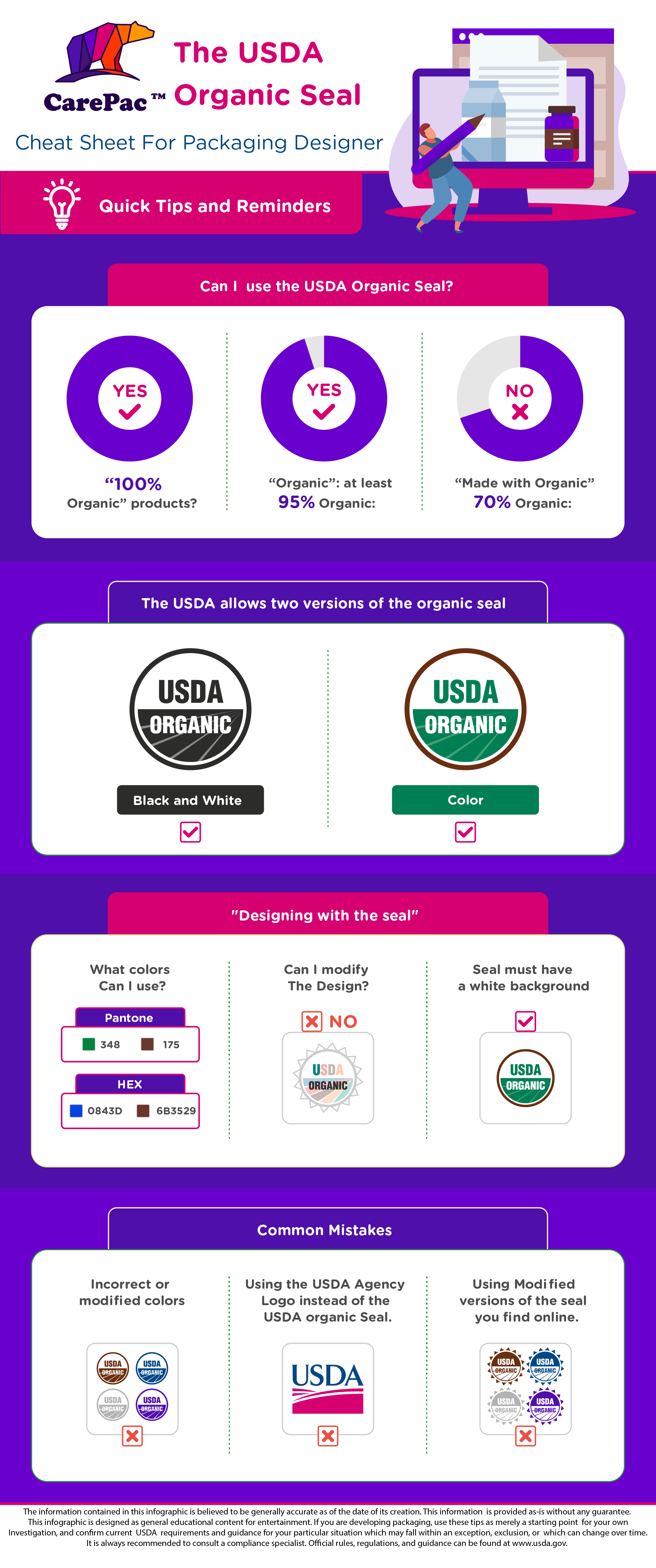
    USDA Organic Labels (Allowed Versions)

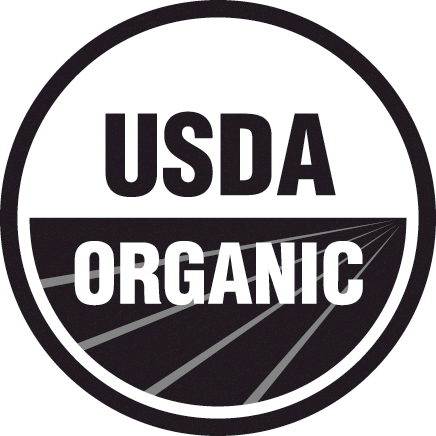
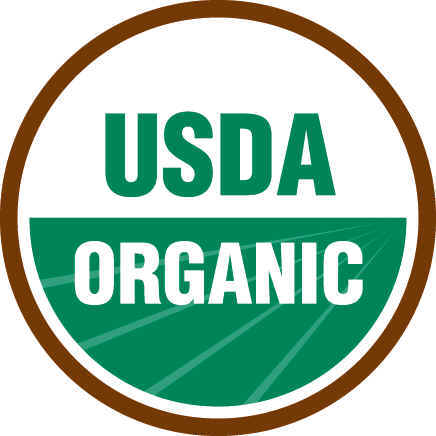
    Here are two versions of the seal which are allowed. These are the only two versions you should use. Do not try to elaborate, or “improve” the designs.

    Black and White Version

    Full Color Version

    Downloadable USDA Organic Seal

    Black and White USDA Organic Seal Files

    Color USDA Organic Seal Files

    USDA Organic Seal – Required Colors

    The USDA specifies how to use the USDA organic seal including which colors should be used. The use of Pantone Matching System (PMS) colors will provide the most accurate colors. 

    Pantone

    348 C

    LAB Value 47-54 26

    SRGB 0 132 61

    HEX 00843D

    Pantone

    175 C

    LAB Value 30 24 20

    SRGB 107 53 41

    HEX 6B3529

    Additional Printing Rules

    • You must use the designs provided by the USDA, don’t modify them. 
    • The seal must be placed on a white background. The easiest way to do this is to encapsulate the seal in a white area. 
    • When in doubt follow the rules in CFR 7 §§ 205.311 (click here to download the regulation from Govinfo.gov)

    Common Mistakes

    Below are some of the most common mistakes we see designers make designers make include the following. 

    1. Incorrect Colors and modified designs

    To the left you’ll see two errors. First the designer didn’t use the colors or layer specified, they tried to “blend” seal into the client’s design. Secondly if you look closely they modified the seal. You might be the most creative, artistic, and amazing designer out there, but this is one case where you shouldn’t mess with things and just let it be. 

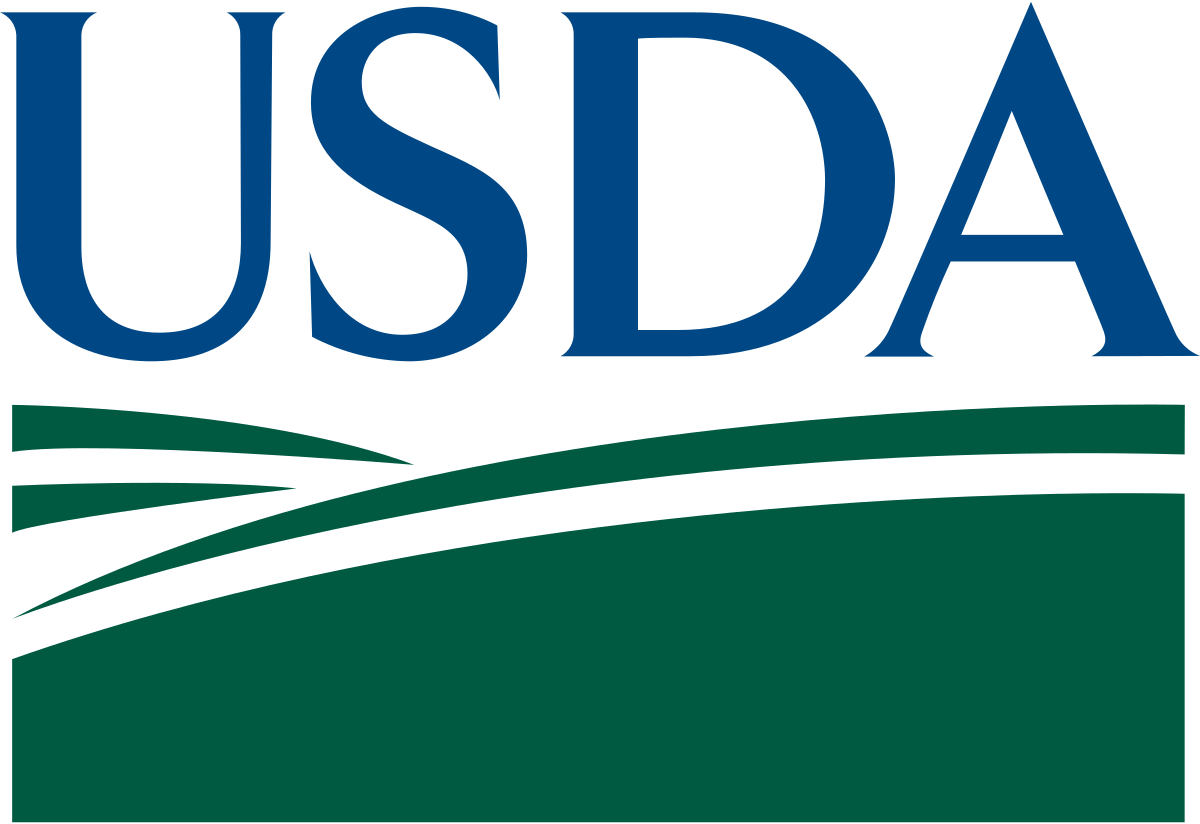
    2. Using the USDA Agency “logo” as a substitute

    Well, it does say USDA but this is not the USDA organic Seal. No this is just the agency’s logo, and it is not a substitute. Also be careful using this logo to imply any government approval, that can get you in hot water as well. 

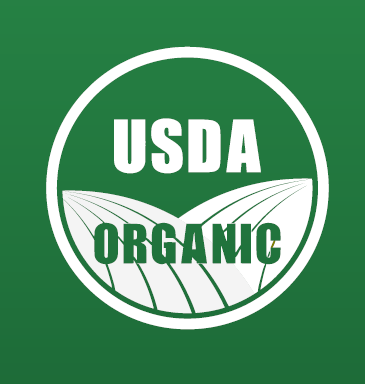
    3. Using random stock imagery or clipart found on the internet

    Something we see all the time, is the use of random variations of the seal. Do not use anything you find online at Shutterstock or other sites, these can get your client in big trouble and they’re going to blame you in the end. 

    None of these 5 examples we are showing you here are permissible USDA organic seals. And putting them on your client’s pouch could result in many thousands of dollars in fines, or having their product pulled from store shelves. 

    Organic Standards and Requirements

    Crop Standards

    USDA organic standards for organic crop production requires that:

    • No prohibited substances should be applied to the soil for at least 3 years before the harvest of organic crops.
    • Soil fertility and crop nutrients will be managed by tillage and cultivation methods, crop rotation and cover crops, supplemented with animal and crop waste materials and permitted artificial materials.
    • Crop pests, weeds and diseases will be controlled mainly by management methods including physical, mechanical and biological controls. When these practices are not sufficient, approved biological, vegetable, or synthetic substances may be used in the national catalog.
    • Organic seeds and other planting stock must be used in operations when available.
    • The use of genetic engineering, ionizing radiation and sewage sludge is prohibited.[2]

    Animal Feed Standards

    Livestock and poultry standards apply to animals used to sell meat, milk, eggs and other animal products, labeled or presented as organic. Some requirements include:

    • Dairy animals and animals for slaughter should be reared under organic management from the last third of pregnancy or after the second day of life for poultry.
    • Non-organic dairies have a one-time opportunity to transition non-organic animals into organic production (over a 12-month period).
    • Producers should feed livestock agricultural feed products that are 100 percent organic, but they can also provide approved vitamin and mineral supplements.
    • Preventive management methods must be used to keep animals healthy. Manufacturers cannot stop treating sick or injured animals. However, animals treated with a prohibited substance cannot be sold as organic.
    • Ruminants should be out in the pasture for the entire grazing season, but not less than 120 days. These animals should also get at least 30 percent of their food or dry matter intake (DMI) from pasture.
    • All organic livestock and poultry need to be allowed outdoors all year round. Animals may only be temporarily confined due to documented environmental or health issues.[3]

    Handling Standards

    The USDA organic standards for handling require:

    • All non-agricultural ingredients, whether synthetic or non-synthetic, must be allowed according to the National List of Allowed and Prohibited Substances.
    • In a multi-ingredient product labeled as “organic,” all agricultural ingredients must be organically produced, unless the ingredient(s) is not commercially available in organic form and listed on Section 205.606.[4]
      • Handlers must prevent the commingling of organic with non-organic products and protect organic products from contact with prohibited substances.[5]

    Four Labeling Groups

    100% Organic

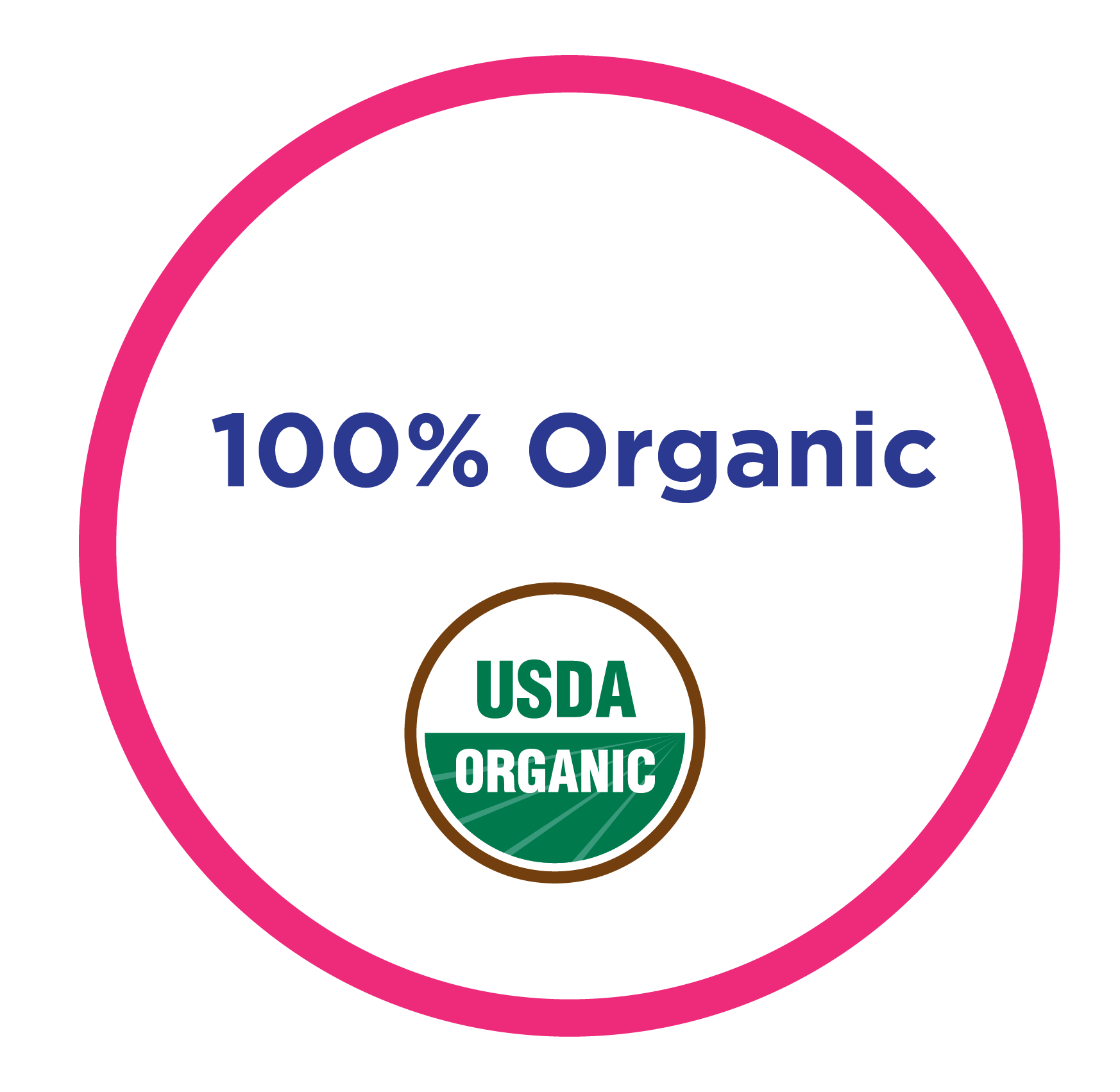
    Products made entirely with certified organic ingredients, methods and processing aids may be labeled as “100% organic” (including certified raw agricultural goods). It is used to label any product that contains 100% organic ingredients (except salt and water, which are considered natural). Most raw, unprocessed or at least processed farm crops can be labeled as “100 percent organic”. In the “100 percent organic” category, products must be made from 100 percent certified organic ingredients. The label must include the name of the certifying agent and may include a USDA organic seal and/or a 100% organic claim.[6]

    Organic

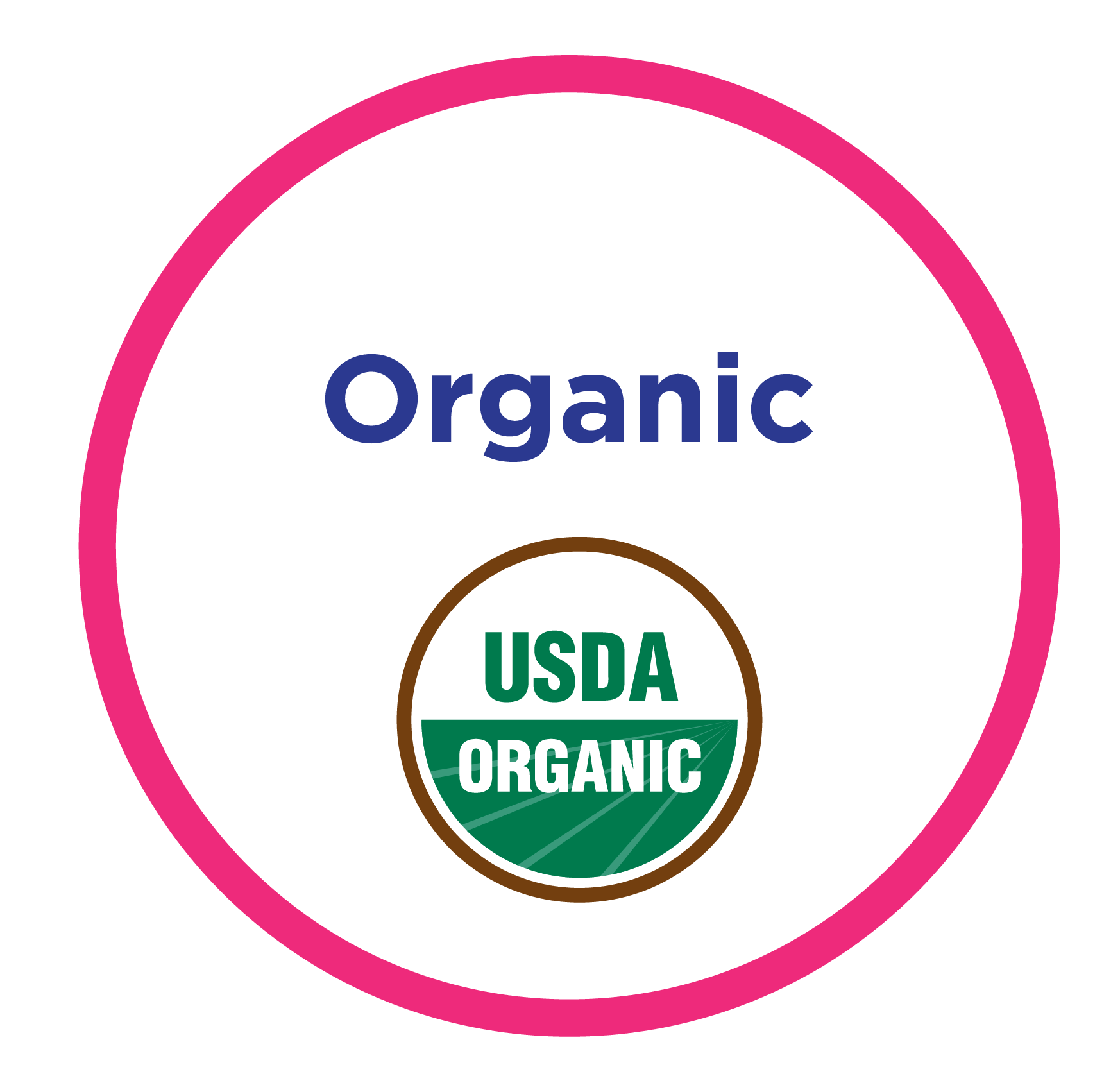
    This category includes products that contain at least 95 percent organic ingredients (excluding salt and water). Up to 5 percent of the content of inorganic agricultural products and/or non-agricultural products may be on the National List (non-organic agricultural products and many non-agricultural products in the National List may be used only if they are commercially commercialized as organic). Additionally, the label must include the name of the certifying agent, and may include the USDA Organic Seal and/or the Organic Claim.[7]

    Made with Organic

    This category includes products containing at least 70 percent organically produced ingredients (excluding salt and water), with a number of broad constraints regarding ingredients containing non-organic parts.

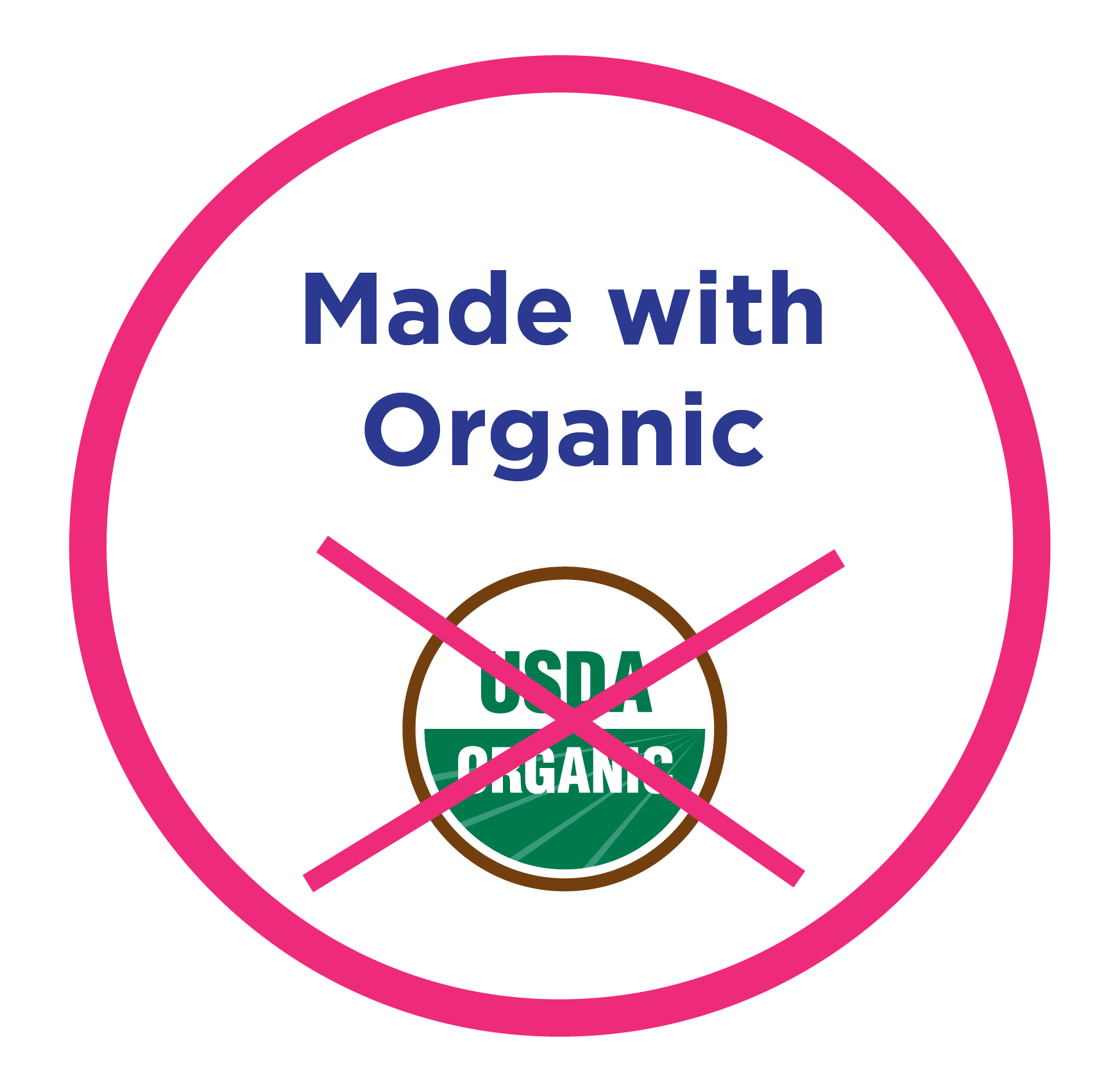
    For multi-ingredient products in the “Made with” organic category, at least 70 percent of the product must contain certified organic ingredients. The organic seal may not be used on the product, and the final product may not be displayed as organic – only three ingredients or ingredient categories may be indicated as organic. Any remaining materials do not need to be produced organically, but must be produced without any excluded methods (genetic engineering). All non-agricultural products should be included in the national list. For example, processed organic foods may contain some accepted non-agricultural ingredients, such as enzymes in yogurt, pectin in fruit jams, or baking soda in baked goods.[8]

    Specific Organic Ingredient Listing

    Multi-ingredient products with less than 70 percent certified organic ingredients would fall under “Specific Organic Ingredients” and do not need to be certified. These products may not display the USDA Organic Seal or use the word organic on the principal display panel. They may list certified organic ingredients in the ingredient list and the percentage of organic ingredients.

    Specific Labeling Rules for Certified Food

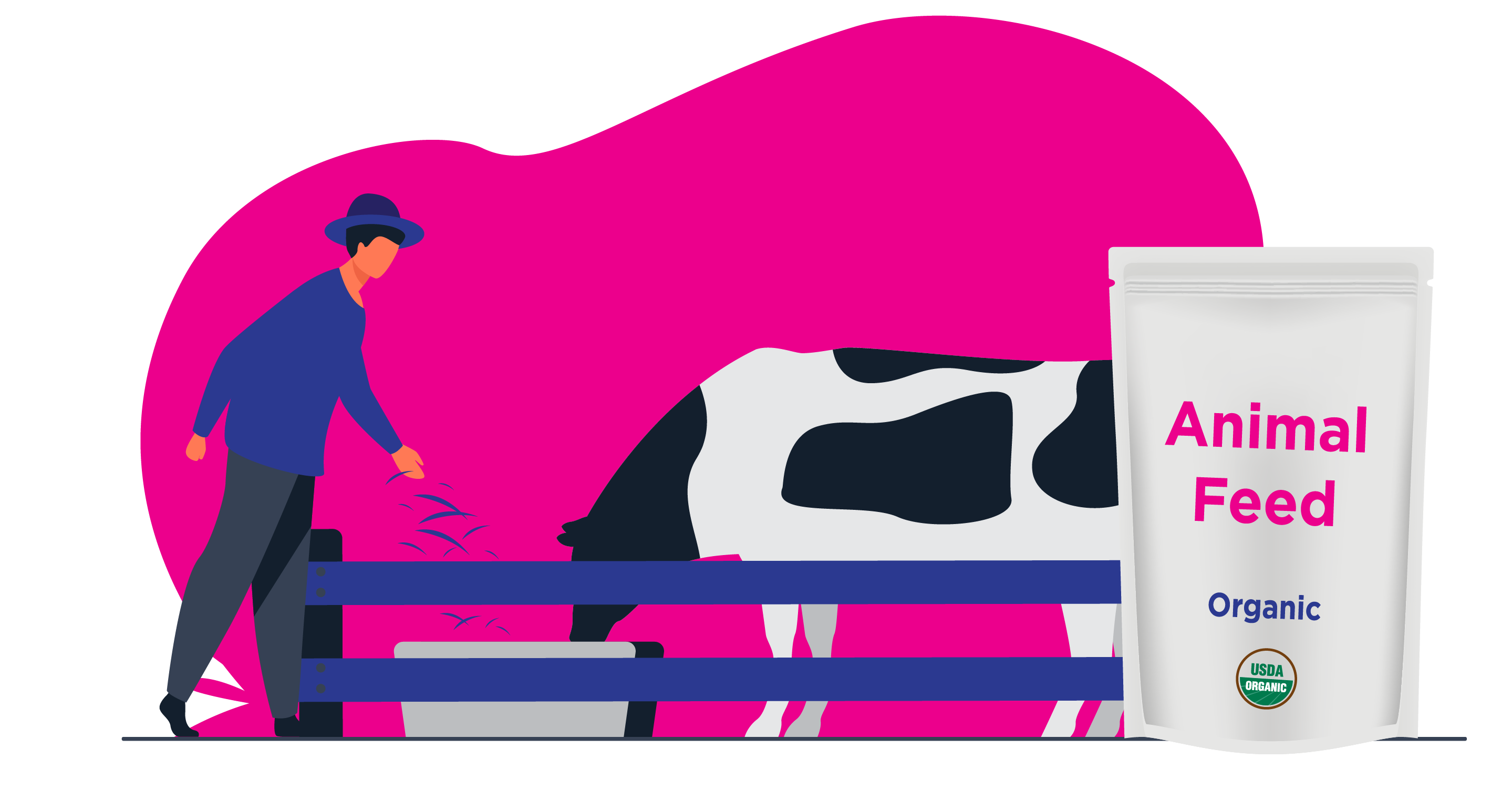
    Animal Feed

    Livestock feed products may display on any package panel the following terms:

    The statement, “100 percent organic” or “organic,” as applicable, to modify the name of the feed product.

    The USDA seal.

    The seal, logo, or other identifying mark of the certifying agent which certified the production or handling operation producing the raw or processed organic ingredients used in the finished product, Provided, That, such seals or marks are not displayed more prominently than the USDA seal.

    The word, “organic,” or an asterisk or other reference mark which is defined on the package to identify ingredients that are organically produced. Water or salt included as ingredients cannot be identified as organic.

    Livestock feed products must also comply with other Federal agency or State feed labeling requirements as applicable.[9]

    Alcoholic Beverages

    The organic alcoholic beverages must meet both USDA organic requirements and Alcohol and Tobacco Tax and Trade Bureau (TTB) regulations, including sulfite labeling requirements

    • Any use of added sulfites makes the wine only eligible for the “made with” labeling category; may not use the USDA organic seal
    • Sulfites may only be added to wine “made with” organic grapes; wine labeled as “made with” other organic fruit (e.g., apples) may not contain added sulfites

    All organic alcohol labels must be reviewed by an organic certifying agent and the TTB.[10]

    Track Back Audit Requirement

    Organic certification mandates that the certifying inspector must be able to complete both “trace-back” and “mass balance audits” for all ingredients and products that share the organic label. A trace-back audit confirms the existence of a record trail from time of purchase/production through the final sale. A mass balance audit verifies that enough organic product and ingredients have been produced or purchased to match the amount of product sold. Each ingredient and product must have an assigned lot number to ensure the existence of a proper audit trail.[11]

    Cases

    These cases highlight the importance of strictly following USDA guidelines.

    In APL-036-18 the company involved held an organic certification for it’s products, but subsequently relocated its processing facilities to a new co-packing facility which did not hold an independent organic processing certificate, and the USDA ALJ court found the company violated the organic regulations and suspended it’s organic certification. 

    In APL-047-19 Oregon Tilth Certified Oregon(OTCO) Act suspended the license of APAX USA Inc on the ground that Turmeric, Ginger, Garlic and Omega 3-6-9 products sold under brand name Feel Good Superfoods do not use an organic capsule. Moreover the products were not produced by NOP compliant co- manufacturer. The court denied the APAXUSA Inc appeal and held its organic certificate to remain suspended.

    APL-005-19 A company sold its coconut product with USDA organic seal during the suspension of its organic license. The court held that company’s certification remains in suspension for minimum 120 days and also required to pay civil penalty of $12,000 for selling under USDA Organic label during the suspension of license.

    In APL-70-20 NOFA-NY issued a notice of Denial of Certification after finding that the company had misrepresented that all of its products are certified organic and used USDA organic seal on its products when it wasn’t certified organic. The court affirmed the notice of denial and denied organic certificate to the company. 

    In APL-08-20 The company had a organic certificate but it was suspended, they internally identified mangos as “organic” but claimed to have only sold them mangos as conventional. The court didn’t believe them and held the company’s certifications was to remain suspended. 

    Some more useful case summaries can be found here.  Well that’s it folks! We hope this blog has gotten your wheels turning regarding the complexities of the USDA organic programs. Using the USDA seal on your packaging is a compliance heavy endeavor and when in doubt hire a compliance expert to review all your work before going to print! The information in this blog post is provided as-is without any guarantee of accuracy. Always consult official government publications for the current regulations, and regulatory interpretation. 

    Foot Notes

    [1] http://www.ams.usda.gov/AMSv1.0/getfile?dDocName=STELDEV3004446&acct=nopgeninfo

    [2] https://www.federalregister.gov/citation/65-FR-80548

    [3] https://www.federalregister.gov/citation/65-FR-80548

    [4] https://www.ecfr.gov/current/title-7/subtitle-B/chapter-I/subchapter-M/part-205/subpart-G/subject-group-ECFR0ebc5d139b750cd/section-205.606

    [5] IBID

    [6] https://www.ecfr.gov/current/title-7/subtitle-B/chapter-I/subchapter-M/part-205/subpart-D/section-205.303

    [7] https://www.ecfr.gov/current/title-7/subtitle-B/chapter-I/subchapter-M/part-205/subpart-D/section-205.304

    [8] https://www.ecfr.gov/current/title-7/subtitle-B/chapter-I/subchapter-M/part-205/subpart-D/section-205.305

    [9] https://www.ecfr.gov/current/title-7/subtitle-B/chapter-I/subchapter-M/part-205/subpart-D/section-205.306

    [10] http://www.ams.usda.gov/AMSv1.0/getfile?dDocName=STELDEV3004446

    [11] https://www.ams.usda.gov/sites/default/files/media/Labeling%20Organic%20Products%20Fact%20Sheet.pdf

    Insert Image

  • Overview of Oklahoma cannabis regulations for packaging

    Overview of Oklahoma cannabis regulations for packaging

    Overview of

    Oklahoma cannabis regulations

    for packaging 

    Since 2018 when voters approved medical marijuana in the state, Oklahoma became an attractive hub for running and establishing a cannabis business. Cannabis is illegal for recreational use in Oklahoma, but is legal for medical use with a state-issued license.

    It is important to know the laws surrounding cannabis to ensure that the drug is handled in a compliant manner among businesses. Let’s have a look at Oklahoma cannabis packaging & labeling regulation.

    Before we dive in, a quick note for licensees. Labeling and regulator compliance is complex , before you take your bag to print you really should consult with a qualified Oklahoma attorney who specializes in regulatory compliance. It will really save you down the road. Dispensaries must document any non-compliance and the reason they rejected it. So if you get your labeling right there will be a paper trail. [1]

    General Labeling Requirements 

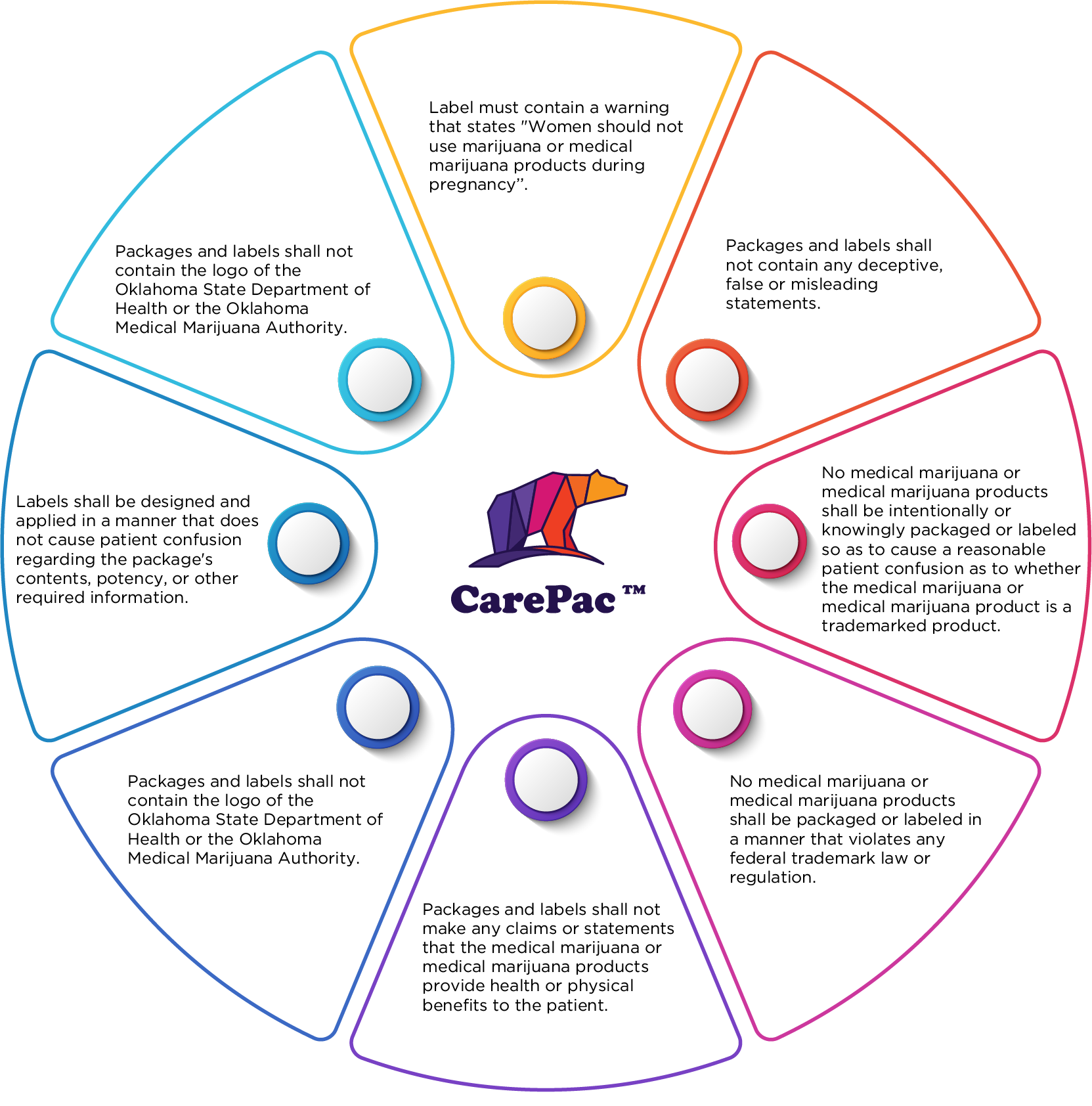
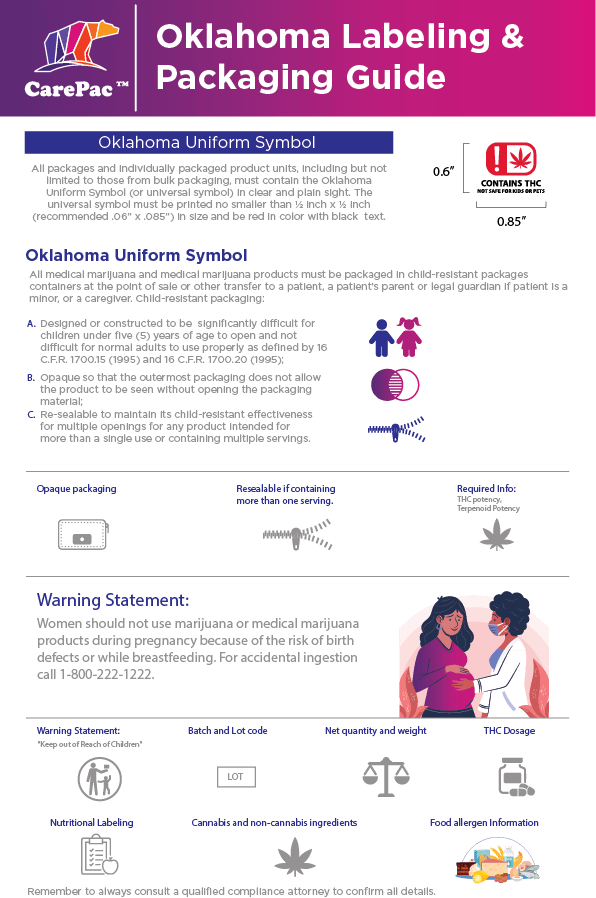
    • Label must contain a warning that states “Women should not use marijuana or medical marijuana products during pregnancy.”
    • Packages and labels shall not contain any deceptive, false or misleading statements.
    • No medical marijuana or medical marijuana products shall be intentionally or knowingly packaged or labeled so as to cause a reasonable patient confusion as to whether the medical marijuana or medical marijuana product is a trademarked product.
    • No medical marijuana or medical marijuana products shall be packaged or labeled in a manner that violates any federal trademark law or regulation.
    • Packages and labels shall not make any claims or statements that the medical marijuana or medical marijuana products provide health or physical benefits to the patient.
    • Packages and labels shall not contain the logo of the Oklahoma State Department of Health or the Oklahoma Medical Marijuana Authority.
    • Labels shall be designed and applied in a manner that does not cause patient confusion regarding the package’s contents, potency, or other required information.
    • All packaging and labeling must contain current and accurate information on file with the Authority, including, but not limited to, the licensee’s legal name, trade name, and license number.[2]

    Type Size and Readability

    All packaging is subject to compliance with the Oklahoma Medical Marijuana and Patient Protection Act. Pursuant to this act, all medical marijuana dispensaries reserve the right to reject any product that does not comply with state regulations.

    • Make sure all written material is easily readable for consumers.
    • It is recommended to use at least a 6-point font.
    • All labels should be on the outside of the packaging and not on the inside.[3]
    • Packages that are small in nature may use an information panel to display all the necessary information (peel back labels, hangtags, etc.).[4]

    Language

    ENGLISH

    Font

    6pt

    Child Resistant Requirement

    child resistant stand-up pouches

    Labels, packages, and containers shall not be attractive to minors and shall not contain any content that reasonably appears to target children, including toys, cartoon characters, and similar images. Packages should be designed to minimize appeal to children.

    • Packaging must contain a label that reads: “Keep out of reach of children.”
    • All medical marijuana and medical marijuana products must be packaged in child-resistant containers at the point of sale or other transfer to a patient, a patient’s parent or legal guardian if patient is a minor, or a caregiver.
    • Opaque, so you cannot see the contents without opening the container. 

    Guidelines For Labeling

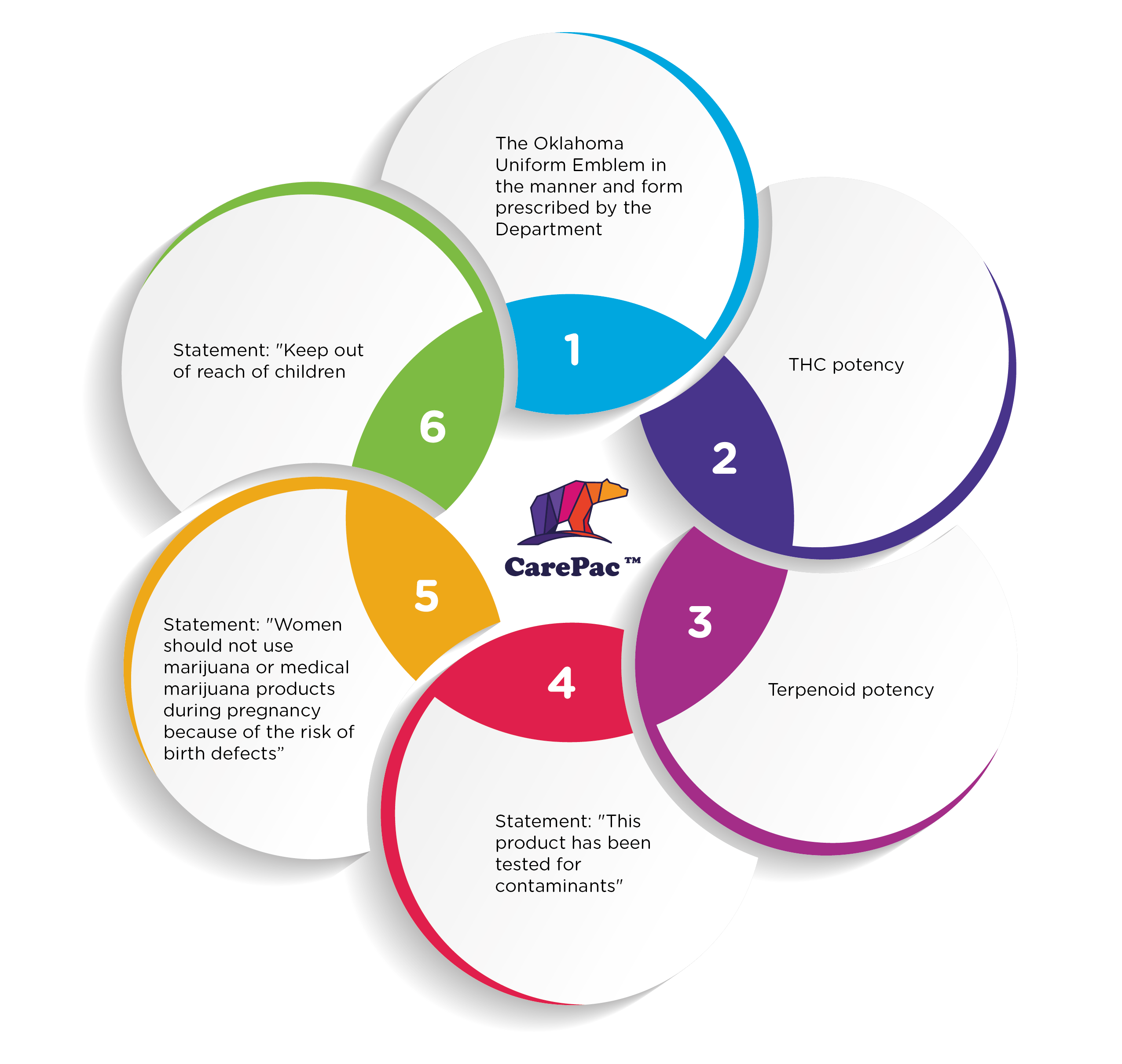
    It is important to follow label specific guidelines to ensure that the product will not be rejected or destroyed due to inconsistent requirements. All medical marijuana product labels must include at least the following information:

    • The Oklahoma Uniform Emblem in the manner and form prescribed by the Department
    • THC potency
    • Terpenoid potency
    • Statement: “This product has been tested for contaminants”
    • Statement: “Women should not use marijuana or medical marijuana products during pregnancy because of the risk of birth defects”
    • Statement: “Keep out of reach of children”

    Labels for edible medical marijuana products must also meet the requirements set out in OAC 310:681-5-8.1.[5]  

    Oklahoma Universal Symbol

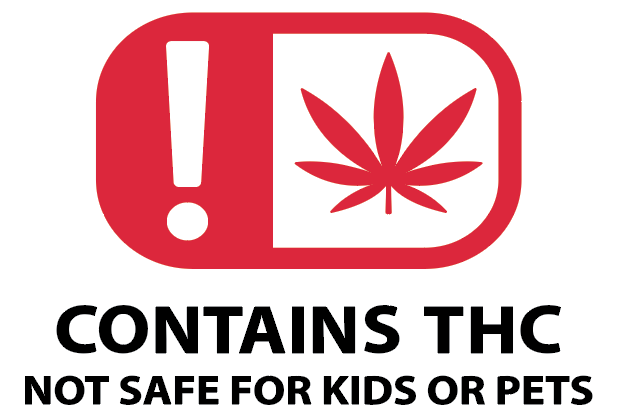
    Like most states that have legalized Cannabis, Oklahoma requires a “universal” warning symbol.

    As of this writing, the recommended size for the printed symbol is .06″ x .085″, and it should not be smaller than ½ inch x ½ inch. Keep the color red with black text. It must be present on all packages..[6]

    The warning symbol combines the red and white icon “! Cannabis Leaf” symbol and required text alerting that the product “contains THC not safe for kids or pets”

    Edibles

    Edibles get their own batch of packaging rules and regulations. In addition to the requirements of other cannabis products. Edibles also must include:

    • Name of the food product
    • Name and address of the business
    • Batch number, and lot code
    • Non-cannabis Ingredient list
    • Cannabis Ingredient list
    • Net quantity, weight, and THC dosage in milligrams per unit
    • Any food allergen information
    • Federal Nutritional Labeling as required by 21 CFR 101.9
    • An additional ingestion warning

    Other Packaging Graphics

    Oklahoma cannabis products must comply with typical advertising requirements similar to alcohol, and most dietary supplements. Some of these restrictions are no-brainers, such as no deceptive, false or misleading content. But others you might not have considered. Advertising on packaging or otherwise cannot:


    • Promote overconsumption of the cannabis product
    • Represent that the cannabis product or its use can cure, prevent or protect from any disease “cannot represent that the use of marijuana has curative or therapeutic effects.”
    • Show any children or other under-age person consuming marijuana. 
    • Depict anything that could suggest the presence of children or which is appealing to children. That would include showing toys, cartoons, cartoon characters, or similar images. 
    •  The government regulators will also not allow anything they believe is appealing to persons under eighteen.[8]

    Printed Packaging

    The best way to ensure your packaging is compliant is to hire a competent cannabis attorney in Oklahoma, and once you have your compliance requirements down, come to CarePac to get fully custom, child resistant, and printed packaging. We can print all the symbols, logos and warnings directly on your pouches, to your exact specifications. So you know that every pouch you sell carries the warnings.

    [1]https://oklahoma.gov/content/dam/ok/en/omma/docs/rules/OSDH%20681%20EME%206.2021%20FINAL%20RULE.pdf

    [2] https://casetext.com/regulation/oklahoma-administrative-code/title-310-oklahoma-state-department-of-health/chapter-681-medical-marijuana-regulations/subchapter-7-packaging-labeling-and-advertising/section-310681-7-1-effective-9142022-labeling-and-packaging

    [3] Section 310:681-7-1 – [Effective 9/14/2022] Labeling and packaging

    [4] https://oklahoma.gov/omma/administration/rules-regulations.html

    [5]https://oklahoma.gov/content/dam/ok/en/omma/docs/rules/OSDH%20681%20EME%206.2021%20FINAL%20RULE.pdf

    [6] Okla. Admin. Code § 310:681-7-1

    [7] https://oklahoma.gov/omma/administration/rules-regulations.html

    [8] http://omma.ok.gov/

  • CarePac vs Competitors

    CarePac vs Competitors

    Introduction


    Picking a packaging partner is a hard decision which is why we’re going to compare three of the most popular packaging companies on the market – Carepac vs Roastar vs ePac Flexibles. We’ll present an in-depth assessment of each company’s packaging capabilities and provide recommendations at the end. 


    Our goal was to use our deep experience in the packaging & marketing industry to understand the bagging landscape and find out how each company stands up. 


    The main difference between the three companies is their selection of materials, printing options, and cost. 


    Click here if you want to skip to the end and see the winner!


    Before You Buy


    You probably have a lot of questions about the specific features or services provided by CarePac, Roastar and ePac. Depending on your budget, material requirements, and lead time one company may appeal to you more than the other. 


    Let’s dive into some of the details!


    Flexible Barrier Packaging 


    What is flexible barrier packaging exactly and what is it used for? Flexible barrier packaging is used to maintain freshness, extend shelf life and prevent damages to the contents of the package. Materials such as flexible plastics, aluminum, paper and coatings are used to keep oxygen, moisture and light out. This keeps your product fresh and damage free.


    Flexible barrier packaging is better than other forms of barrier packaging due to its lightweight, lower cost, convenient portions, protection, and easy customization to specific applications. 


    Selection of Materials:


    The product you are packaging determines what material will work best for you. There are important considerations and questions you must ask yourself when deciding which material to use. Remember, the cheapest material may not be the correct material for your product, and you may end up paying for it in the end. 

    It’s always smart to consult a qualified packaging expert to help you choose the correct material. Having the right material is vital to keeping your product fresh and your customers happy. 


    Here are a few questions you should consider when deciding what packaging works best.


    o   How much product do you need in each barrier package? 

    o   Where is the product stored? Freezer, shelf, outdoors, indoors? 

    o   How is it transported? Is this package going to face pressure changes from air transportation? 

    o   Is your product single us or multi-use?


    When deciding on a material, it is wise to listen to packaging experts and not demand a certain material if they advise against it. Additionally, if a company is willing to package your product in a material they know is not right for the job, you may want to reconsider if they have sound business ethics.


    Lets see what each packaging company has to offer for materials: 


    Material

    Roastar

    ePac

    CarePac

    PET
    PET/FreezerPE
    Metalized PET
    PE/PE  
    PA/PE  
    KPET/Nylon/PE  
    PET/RCPP  
    Paper/NKME/PBS  
    High-barrier and multi-layer films 
    Spot Metalized 
    Recyclable Films
    Compostable Materials 
    Biodegradable Materials  
    PET/AL/RCPP  
    Freezer & Microwave safe 
    PCR film  
    MOPP/Paper/Foil/NYLON/PE  


    In addition to the barrier materials listed above, CarePac also offers barrier coatings like EVOH, PVDC, and ALOX which enhance the barrier of the base material. Their line of flexible barrier materials: CareClear, CareSilver, CareFoil, and CareKraft offer the widest variety of packaging combinations that we could find! 


    If you’re looking for eco-friendly packaging, ePac or CarePac is your place to go! ePac offers recyclable vegan and compostable packaging materials but not biodegradable. CarePac offers all three packaging materials! Learn more about the difference between these materials. 


    Configurations: 


    When deciding what company to use, it is important to make sure that they offer the specific configuration your product requires. The chart below shows the different configurations available and which companies offer each bag style. 


    While Roastar offers a Fill-n-Ship option that no other company offers, CarePac has an overwhelming amount of bags to choose from. Businesses with multiple products may find that Carepac is their one stop shop for all their product packaging needs.


    Configuration

    Roastar

    ePac

    CarePac

    Stand Up Pouch
    Stand Up Pouch Plow Bottom  
    2 Seal Pouch 
    3 Side Seal Pouch 
    Tamper Evident Pouches  
    Square Bottom 
    K-Style and Doy 
    Liquid Spout Pouch  
    Die-cut Shaped Pouches  
    Fin Seal Pouches  
    Flexible Barrier Tubing  
    Fill-n-Ship Mailer  
    Rollstock 


    Features:

    As consumers are becoming more picky with what they buy, it is important your bag manufacturer has all the features you’ll need to help your product stand out on the shelf! 


    The soft-touch finish has been growing in popularity recently and will continue to do so. Recent studies have shown that consumers are more likely to purchase a product if it engages their sense of touch. Products packaged in this material are often considered high end (compared to traditional plastic materials) and consumers are likely to pay more for your product. If you’re looking to upgrade your products’ appearance and feel, ePac and CarePac are your places to go!


    Feature

    Roastar

    ePac

    CarePac

    Traditional Matte
    Soft-touch 
    Gloss
    Spot Matte / Spot Gloss  
    Child Resistant  
    Zippers
    Tear notches
    Transparent or clouded windows 
    Cold seal  
    Hang holes
    Clear Gloss Laminate
    Clear Matte Laminate
    Kraft 
    Degassing Valve 
    Liquid Spouts  
    Lip and Seal Tape 
    Anti-Static Bags  
    Retort Boilable Bags  
    Easy peel  


    Printing Options: Digital and Plate Printing

    All three companies offer digital printing; however, Carepac is the only one that offers both digital and plate printing. When deciding which option is best for you, it’s important to remember that the printing process is different, but your bags will look exactly the same whether you choose to use digital or plate printing. Let’s look into these processes a little more!


    Digital

    Plate

    Digital printing is the process of printing digital-based images directly onto your package

    Uses a thin aluminum plate to transfer your design onto the pouch 

    Digital files such as PDFs, AI files, are sent directly to the printer. All designs are made from 5 ink colors: cyan, magenta, yellow and black (CMYK +White) 

    Artwork is separated into ink colors. Both CMYK and true PMS Pantone Colors can be applied to the bag

    Best for small projects that have many different designs. 

    Provides maximum economies of scale to reach the lowest per-unit cost.  

    MSpot matte / gloss and soft touch coatings.  

    Use up to 10 colors 

    Pros/Cons of Digital vs Plate printing

    When deciding which printing process suits your business better, it’s important to look at the pros and cons for both printing processes. One may suit you better than the other depending on your company’s needs.

    Plate Printing

    Pros

    Cons

    Lowest per-unit cost

    Metalized colors available

    Minimum order quantities 5,000+

    Most economical choice

    Full range of print effects

    One-Time Plate Costs

    Spot Gloss & Spot Matte available

    PMS ink colors can be used

    Startups with lots of different designs could have a lot of plates. 

    Works with any material

    Most versatile printing method

    Cell

    Edge to Edge printing allows you to cover the entire bag with your design or color

    CellCell

    Digital Printing

    Pros

    Cons

    Zero Setup Costs but higher per unit costs

    Great for high color count designs

    Higher costs

    Don’t want to commit to ordering thousands of customized packages

    Best for trial runs to test your design in the market

    Not advisable for higher quantities 

    Perfect for smaller print runs

    Frequent regulatory changes make bag designs obsolete quicker than you can use your bags

    Unable to color 100% match PMS colors

    Easier to print multiple versions of your design

    Great for multiple SKUs (e.g. chocolate, vanilla and strawberry)

    Cell

    Short runs-as low as 1,000 bags

    Quick turnaround time

    Cell

    No plate fees

    Can be used with any material

    Cell

    Digital vs Plate Printing Conclusion

    When deciding whether to use digital or plate printing, it is vital to understand the requirements of your business. If you want a large number of bags for a low cost and don’t mind paying a one-time plate fee, CarePac has you covered with their plate printing option. 

    However, if you’re just starting out and don’t want to commit to ordering thousands of customized packages or you want to test out different designs in the market and don’t mind paying the higher cost, digital printing may be the best option for you! 


    Selection of Lead Times:

    Lead times can vary significantly depending on where you purchase your bags. If you’re thinking about purchasing from China, it’s important to remember you’ll likely have to wait over 3-4 months until you see your beautiful pouches. However, you shouldn’t have to wait that long if you’re ordering from one of the three U.S. based packaging companies we’re talking about today.

    If ordering from ePac, they state that your pouches will be produced in 15 business days once your artwork is approved. Rollstock will be produced in 5 business days (once artwork is approved). Not a bad turnaround time for someone who needs bags quickly. However, they do not offer options to help decrease costs. 

    If you’re considering ordering from Roastar, they estimate their lead times to be between 17-30 business days after artwork is approved. Roastar updates their lead times weekly so check out their website when you decide to order for the most up to date estimate. On some forums customers complain about how Roastar is unable to deliver on their lead times. 

    When ordering from Carepac, customers can choose a 15 day, 30 day, or 60 day lead time depending on their wants and needs. Carepac is the only company to offer different lead times for customers who would like great bags but are willing to sacrifice one of two things. All of Carepac’s bags are high quality; however, you may be able to save some money if you’re willing to accept a longer lead time. You could also receive your bags more quickly if you’d like to spend a little extra. Carepac allows customers to make the best decisions for themselves, so you can get exactly what you want without having to sacrifice the quality of your bags! 


    Ordering Process: 

    Unless you know EXACTLY what you’d like to order and have knowledge on all things barrier material, it’s a great idea to get a consultation before ordering any packaging. Having a company that will send you samples is also a great way to ensure you are getting exactly what you want! 

    CarePac and Roastar offer samples to customers and will provide a free consultation. All three companies we are comparing today allow you to easily request a quote online from their website; however, CarePac is the only company that can provide an instant estimate for you. 

    Instant estimates through CarePac are best for start-ups or new buyers, getting a rough estimate, basic options, orders requesting 1,000 bags or if you don’t have any art or designs. If this sounds like you, head over to their website and get an instant estimate!

    If you’re an established company, have art designs or graphics ready and want to order 5,000 bags or more, it’s best to get a detailed quote. By receiving a detailed quote you will also be able to select advanced options for your packaging. 


    Design Process:


    Each company has a slightly different design process. Whether you’re a startup or an experienced packaging designer, it is almost always best to choose a company that will support you through the design process, especially if this is your first time using a new company. 


    Roastar:

    Roastar’s design process begins with getting an optional free quote. At stage one you will choose your type, size, and material to receive pricing. Next you will start your project, create your account and download templates. You can then create and upload your artwork. If you need a designer, you can use their directory and choose a designer. After this, you will receive and approve your proofs either digitally or physically. Place your order and watch for your bags to arrive!


    ePac:

    ePac’s design process is much simpler than Roastar’s and from what we could find, offers less support during the process than Roastar and CarePac (we’ll get to them in a minute). 

    ePac’s process starts by requesting a quote. They will then approve your artwork, print and finish your packaging and ship your bags. They focus on providing bags quickly to customers; however, lack in support from designers or customer service representatives. 


    CarePac:

    CarePac prides themselves on their exceptional customer service and support they provide to their customers. They are dedicated to providing you with the most support during your bag creation process. 

    Their design process starts by providing you with an online quote either instantly or detailed. You will next select your size and configuration of your bags. Next you will approve your proofs with the help of a CarePac professional. You don’t even have to bring press ready art, they will take your original art files and set them up for printing during this step to ensure you get the best quality printing, and develop digital art proofs that you can revise. They will then print your materials and you can enjoy your new bags! 
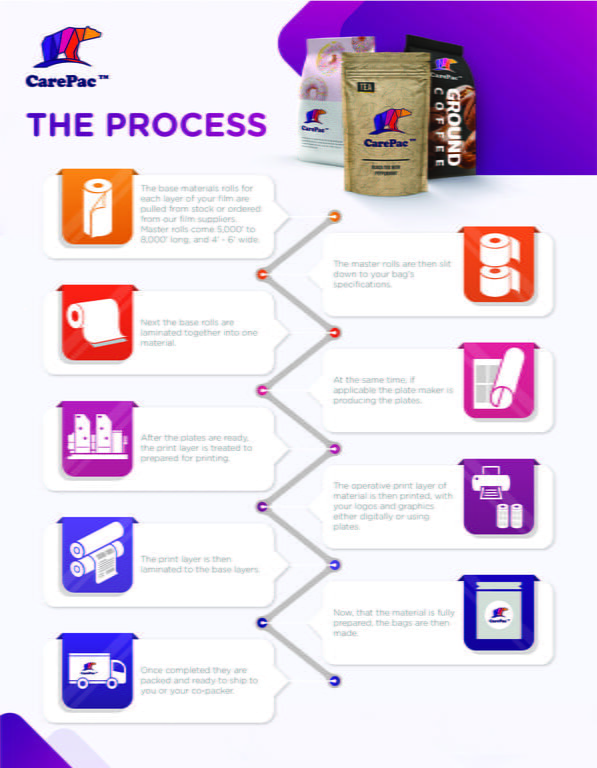
    How Stand Up Pouches are Made - Bags 101 (1)

    Cost: 

    Cost is an extremely important thing to consider when making any business decision. Customized bags vary in price depending on which printing method you decide, type of bag, bag features and size. 

    CarePac is the only company out of the three we are comparing that will price match within 5% of any other quote so you don’t have to settle for an inferior product just to save money. 


    Customer Service:


    Customer service is extremely important in any industry and packaging is no exception. Deciding on materials, sizing, printing, features, and design can seem overwhelming almost instantly. Having a great, experienced team supporting you is vital to the success of your bags (and sanity). 

    As mentioned above, ePac seems to have the least support when it comes to designing and creating your bags. They offer the quickest turnaround time compared to the other two companies; however, the lack of support may have you stuck with bags that aren’t right for your product. 
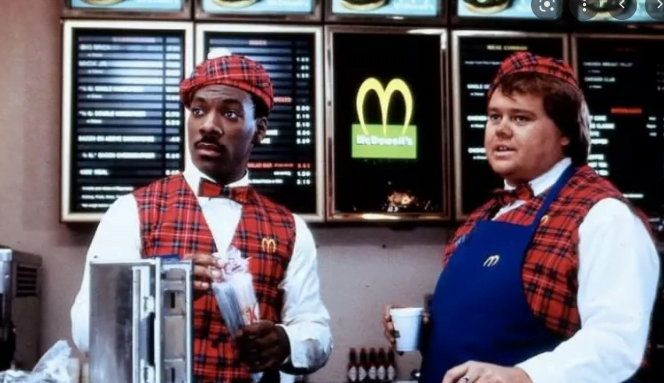
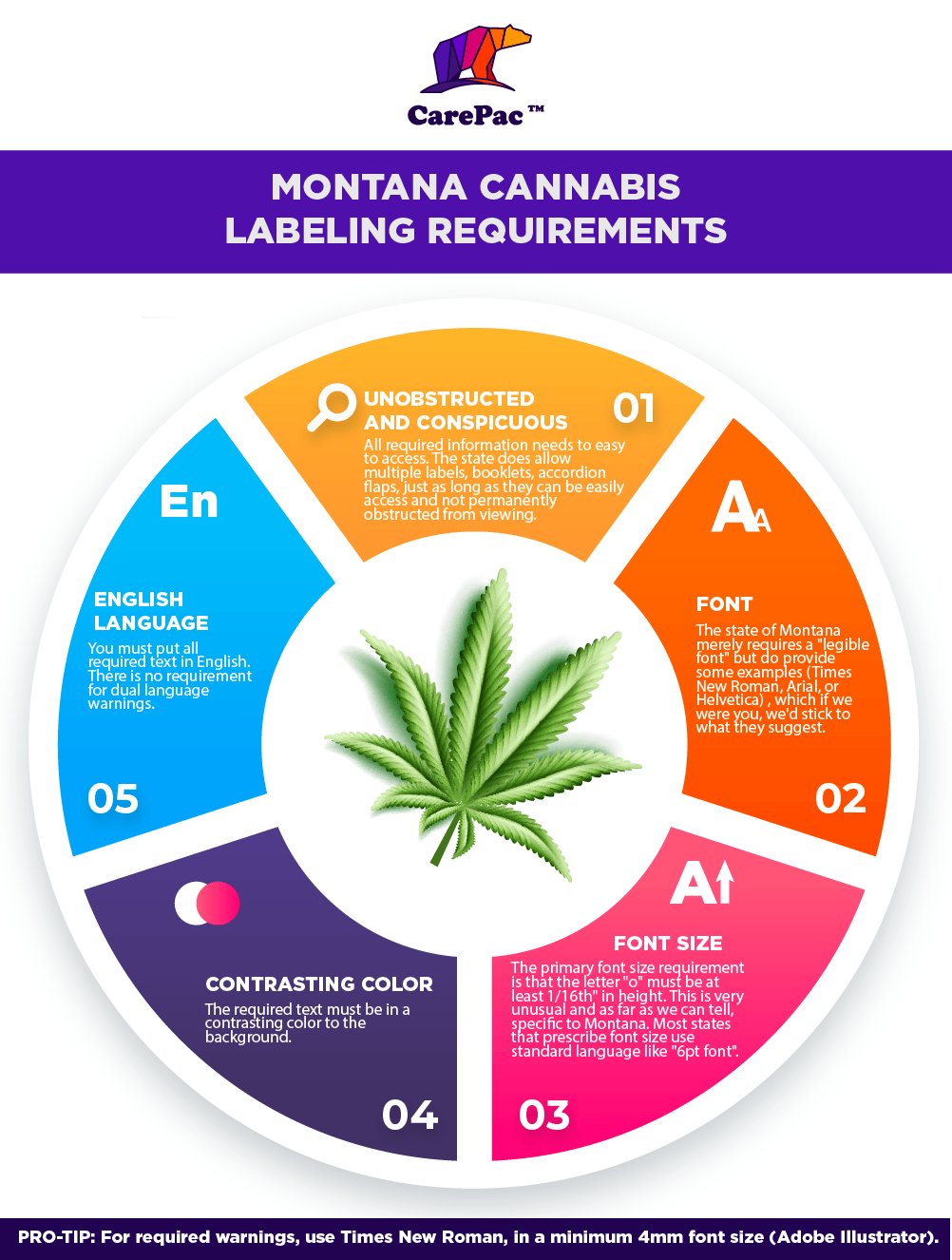
    Roastar prides themselves on the creativity and design work of their bags. They allow you to pick one of their designers to help with artwork design but seem to offer little support when it comes to deciding what material is best for your product. While having an amazing design is super important, making sure your material holds up and keeps your product fresh is even more vital. People don’t like soggy popcorn! 

    CarePac’s main focus is their customers. They reiterate how important customer service is to them on every page of their website. They will be with you through every stage of the packaging process from deciding which materials are best for your product to helping you design the best artwork. They also uphold their ethics with every customer they serve. If the professionals at CarePac know that a certain material will not work for the product you are packaging, they will not provide the bags. You can rest assured with CarePac you will get high quality, beautifully designed bags that are perfect for your product’s requirements.  


    Roastar: Overview

    Roastar has done an excellent job marketing their quick and easy packaging creation process while making the experience enjoyable. They offer personal help to businesses during the design process and are able to digitally print designs for their customers. They acknowledge that small business needs are different from a big corporation and offer quick turnaround times in order to get products on the shelves fast! 

    Roastar offers many bag types including stand-up pouches, gusseted bags, flat-bottom pouches, flat pouches, and fill-n-ship mailers. Roastar is located in the United States and believes that small businesses can look big with their packaging!


    ePac Flexibles: Overview

    ePac is a relatively new player in the packaging space. Created in 2016, their mission has been to help small brands obtain a big brand presence while giving back to the communities they serve. ePac also aims to contribute to the creation of a more sustainable, circular economy. 

    ePac currently has locations throughout the United States, Canada, and the United Kingdom. Once artwork is approved, orders will ship between 5-15 business days and customers can purchase low minimum quantities. They offer many bag types including lay flat pouches, stand up pouches, rollstock, child resistant packaging, films and sustainable packaging.


    CarePac: Overview

    CarePac is focused on making sure their customers are properly educated, guided and cared for through the entire packaging process. They are a California based company that focuses exclusively on flexible barrier packaging and putting the customer FIRST. They claim to offer deeper knowledge, better product selection, and higher quality service than any other packaging company in the market. Carepac guarantees that your bags will be done right through their CareDesign process to reflect your company’s values. They are a transparent, tell it like it is, company that ensures their customers receive exceptional customer service and great bags! 

    CarePac is one of the only companies to offer both plate and digital printing and a variety of materials. They offer 10+ available features customers can add to their bags and have 14 different pouches to choose from. Customers can get exactly what they need to make their products stand out against the big guys with CarePac! 


    What Packaging Company is the Best? 

    While all companies we discussed today have similarities, Carepac is the best choice. Their exceptional customer service, wide variety of materials and bag choices, knowledgeable staff, and price matching promise makes them the top choice for any company looking to create custom printed bags. With Carepac, you’ll receive the best customer service in the packaging industry. Still skeptical? Give them a call todaycall today and see for yourself!